
Developer Tools and Agent Workflow Optimization
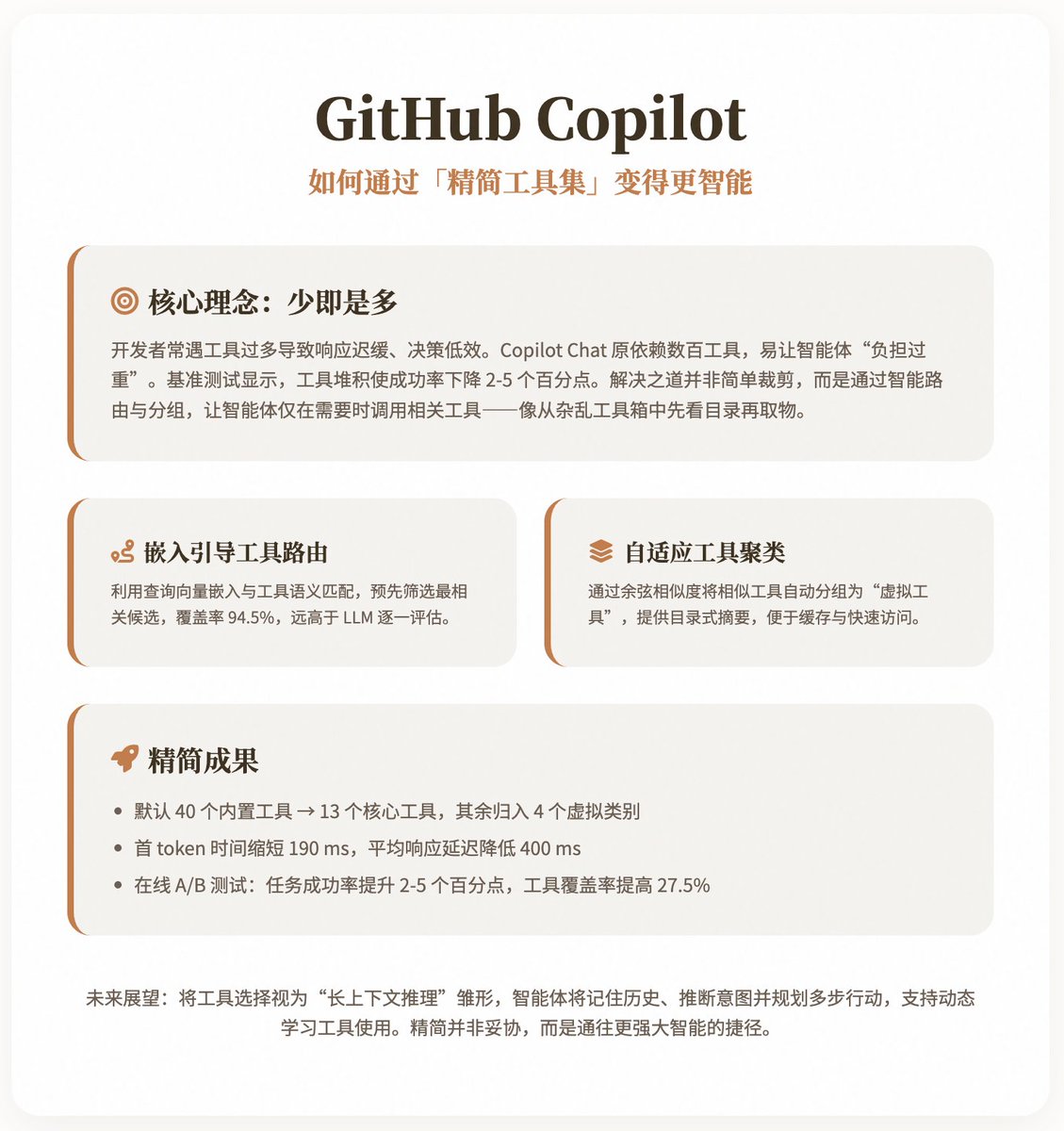
Core Event: GitHub Copilot optimizes tool scheduling to enhance agent speed and accuracy. Identified that an excess of tools leads to slower agent reasoning, increased error rates, and a 2-5 percentage point decrease in success rates. Introduced Embedding-Guided Tool Routing to match query vectors with tool semantics, achieving a coverage rate of 94.5%. Implemented Adaptive Tool Clustering to group similar tools into 'virtual tools,' with small models generating summaries for caching. Default built-in tools reduced from 40 to 13 core tools, while others are categorized into four virtual categories. After improvements, the first token time decreased by 190 milliseconds, average response latency reduced by approximately 400 milliseconds, and task success rates improved by 2-5 percentage points. The article notes future directions include remembering tool usage history, cross-session planning, and long-term context reasoning.
Key insights
Streamlining the Toolset to Enhance Agent Reliability and Speed
GitHub Copilot points out that an excess of tools can reduce the decision-making efficiency and accuracy of agents, with benchmarks showing that the success rate of tasks actually decreases by 2-5 percentage points under a full toolset. To address this, Copilot has streamlined the default built-in tools from 40 to 13 core tools, categorizing non-core tools into four virtual categories. This significant reduction minimizes misuse and irrelevant information interference, thereby enhancing response speed and success rates while reducing cache misses and API limit issues.
Embedding-Guided Routing Increases Tool Selection Coverage
The introduced Embedding-Guided Tool Routing matches user query vectors with tool semantic representations to pre-filter relevant tool candidates. In benchmark tests, this method achieved a tool usage coverage rate of 94.5%, outperforming the 87.5% of LLM one-by-one evaluations and the 69.0% of static lists. This reduces exploratory calls and interference from irrelevant tools, thereby improving reasoning efficiency.
Adaptive Tool Clustering Builds 'Virtual Tools' for Quick Access
Adaptive Tool Clustering automatically groups tools based on cosine similarity through tool embeddings, abstracting multiple tools into 'virtual tools' with small models generating summaries for each group to cache. This design is similar to directory management, reducing the cost of the model evaluating tools one by one, significantly shortening the first token time and lowering average response latency, thus enhancing overall user experience and system efficiency.
Agent Engineering Needs to Evolve from Determinism to Long Context
The blog suggests viewing tool selection as part of long-context reasoning. Future agents will remember tool usage history, infer intentions from conversations, and plan multi-step actions. By combining embeddings, memory mechanisms, and reinforcement learning, Copilot's improvements lay the groundwork for cross-session collaboration and thousands of interaction rounds, demonstrating a roadmap for the evolution towards long-context agents.