
Enterprise AI & Organizational Change — Apps, Context Graphs, and RAG
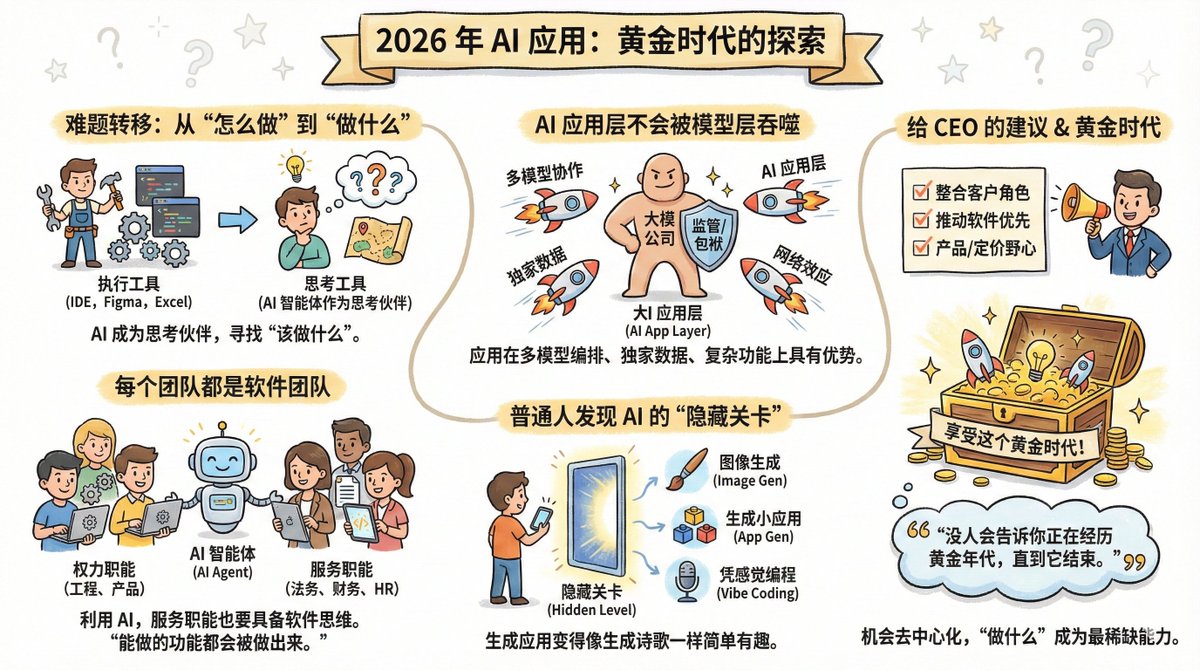
Multiple analyses show enterprise AI moved from hype to production in 2025. a16z’s notes forecast tools that 'help think' (not just execute) and predict each department must become a 'software team' (20207). Context Graphs record why decisions were made, not just facts, enabling AI to generalize policies (19506). Ivan Zhao argued AI will restructure organizations like steam/steel reconfigured factories, enabling large-scale asynchronous agent coordination (19193). MenloVentures report: enterprise generative AI spend rose from $1.7B (2023) to $37B (2025); applications $19B, infra $18B; 76% of use-cases buy vs build; Anthropic leads enterprise LLM spend (40%) (17429). Systematic review of RAG literature found 77 papers, identified hallucination, privacy, latency, domain adaptation and business-impact evaluation gaps (16888).
Key insights
Enterprise apps must shift from execution to ideation
Anish Acharya described a 2026 trend where AI moves beyond execution tooling to 'thinking tools' that propose what to build. He argued teams will stop treating engineering as a scarce constraint and instead reframe work as selecting and approving AI‑suggested initiatives. This implies product and organizational culture must adapt: decision-makers need new skills to curate AI proposals and maintain governance over proliferation of auto-generated features.
Context Graphs record rationale so AI can generalize human decision logic
A Context Graph captures not only facts (customer bought X) but the why—policies, approvals, prior exceptions—and links decisions to causality and rules. The post argues future enterprise systems that store decision rationale will let AI infer dispositions and apply judgment repeatedly across cases, improving automated decision-making and enabling auditability of AI-driven outcomes.
Organizational form will change as AI becomes production infrastructure
Ivan Zhao compared AI’s adoption to steam and steel revolutions: technology enables new organizational topologies and scale. Notion experiments with hundreds of internal agents handling meeting notes and IT requests; Zhao argues companies must rethink workflows and governance (e.g., fewer manual handoffs) to realize large productivity gains and avoid merely grafting AI onto old processes.
Enterprise AI spending accelerated; application-layer remains investor opportunity
MenloVentures reported enterprise generative AI spending rose to $37B in 2025, split ~50/50 between applications ($19B) and infrastructure ($18B). Most enterprise use-cases buy rather than build (76%). Startups captured ~63% of application-layer market while incumbents dominated infra. Predictions include agentic programming and continued capex on governance and explainability.
RAG research-to-production gap persists with five recurring enterprise challenges
A systematic review of 77 RAG+LLM studies (2015–2025) found common issues: hallucination control, data privacy, latency/scalability, domain adaptation and weak measures of business impact. Most academic work relies on static evals; only 13% deployed prototypes in real enterprises. Hybrid retrieval and knowledge graph techniques improved explainability in some cases.
Practical advice for leaders: convert every function to 'software-first'
Posts recommend leaders make each department behave like a software team, prioritizing automation and experimentation. Guidance includes mapping customer-facing roles to unified agent-driven experiences, evaluating third-party applications vs custom builds, and investing in decision logging (Context Graphs) to make AI decisions auditable and improvable.