
Enterprise Generative AI: 2025 Market & Adoption Reports
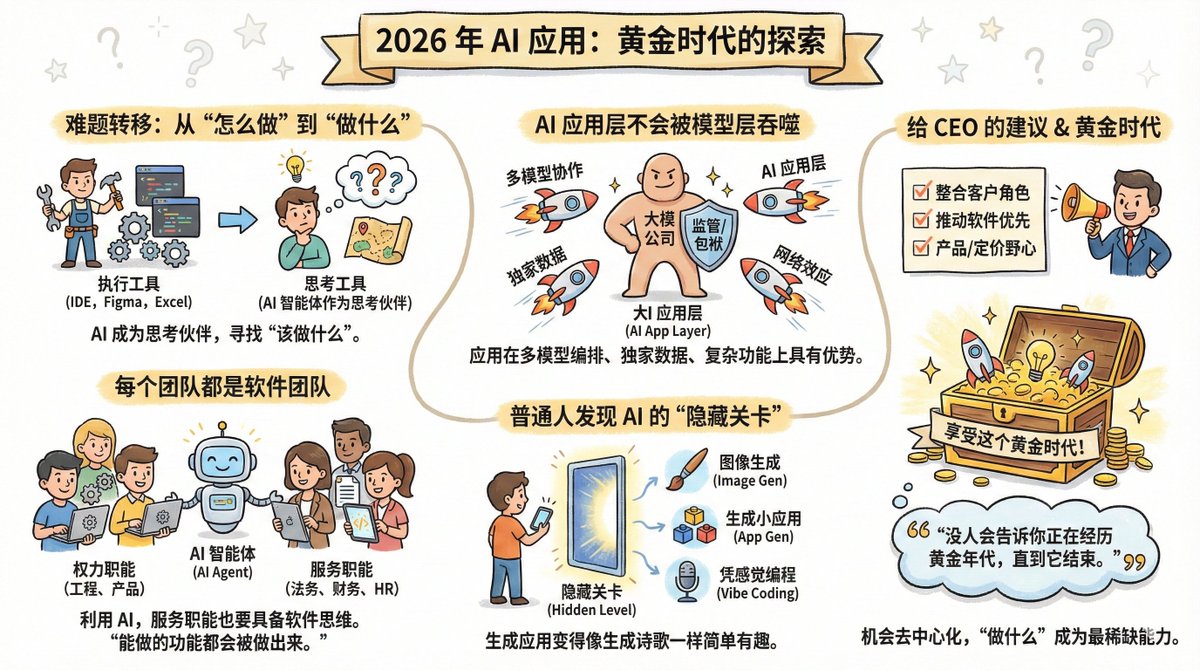
Industry reports and essays summarized enterprise Generative AI adoption and market shifts. - 2025 enterprise AI spending jumped dramatically; applications and infrastructure both capture large spend. - Menlo Ventures report: enterprise generative AI is a real boom; programming dominated departmental spend and Copilots remain central. - a16z/OpenRouter State of AI 2025: 'Agentic' and reasoning models drove a shift; mid-size open models (15B–70B) became popular. - a16z’s Anish Acharya: future apps must help 'decide what to build', not only 'how to build'; every team needs software-first thinking. - Company procurement shifted to buying over building: 76% of enterprise AI use cases used purchased solutions. - Startups won application-layer share while incumbents defended infrastructure; vertical, data-rich, and multi-model orchestration apps captured value. - Predictions: programmatic automation growth, continued spend rise, governance and explainability mainstreaming, and more on-device models for privacy and latency.
Key insights
Enterprise adoption accelerated in 2025 with measurable spend increases
Multiple reports quantified rapid enterprise adoption: surveys and market models showed enterprise AI spend leapt from tens of millions to hundreds of millions (and cited $370B overall generative AI spend allocations in 2025 reports). Applications (particularly programming and copilot services) captured a majority of near-term spend while infrastructure and data platforms retained significant budgets. The trend favors bought solutions: enterprises preferred purchasing production-ready AI products over building from scratch.
Application layer wins: startups capture most application revenue
Reports noted that startup vendors captured ~63% of application-layer market share while incumbents held infrastructure positions. Successful apps combined multi-model orchestration, proprietary data, and vertical integration. The application layer’s winners focus on embedding AI into workflows and providing measurable ROI rather than model parameter leadership.
Shift from 'how to build' to 'what to build' creates new product opportunities
Anish Acharya argued future product opportunities lie in tools that help teams decide what to build—ideation and exploration—rather than solely in execution tools. He recommended that every internal function adopt software-first and agent-enabled workflows, and cautioned that organizations must change culture to fully realize AI-driven product expansion.
Mid-size open models and agentic architectures reshape developer choices
State of AI reports highlighted that mid-size open models (15B–70B) offer favorable cost-performance tradeoffs for developers, and that agentic/ reasoning-capable models became central to complex tasks. Open-source ecosystems and China-based models increased global competition and diversified available model choices.