
Enterprise Implementation and Forward Deployed Engineering (FDE) Practices
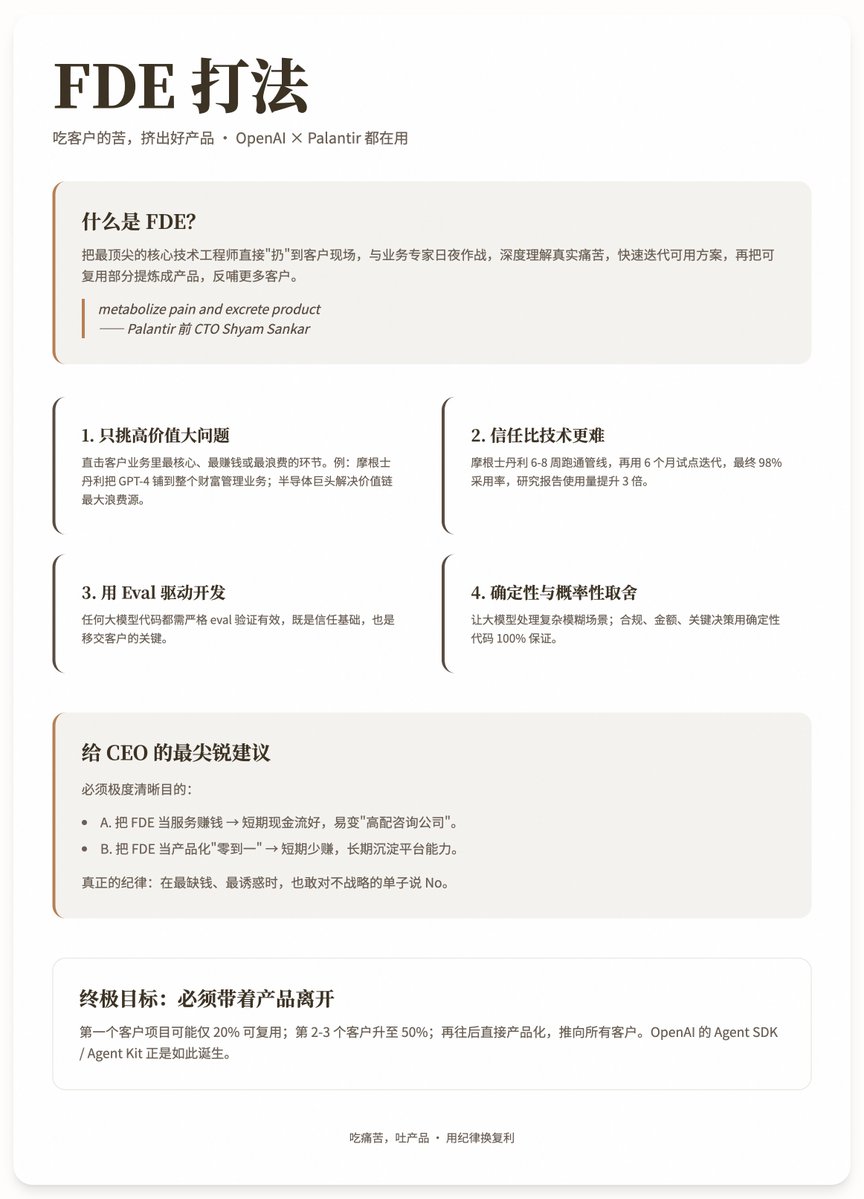
Forward Deployed Engineering (FDE) is seen as a key pathway for transforming cutting-edge AI into enterprise products, emphasizing deep iteration and evaluation-driven development on the client site. FDE is defined as deploying top technical engineers to client locations to deeply understand pain points and iterate solutions into reusable products. An example of OpenAI's FDE is its implementation with Morgan Stanley for wealth management, where the technology pipeline took 6–8 weeks to operationalize, but it took 6 months of piloting and iteration for actual adoption by consultants. FDE principles include selecting only high-value problems, using evaluation-driven development, and making clear trade-offs between deterministic and probabilistic tasks. It is recommended to treat FDE as a means of productization rather than a long-term consulting service, emphasizing that the reuse rate of early client projects should increase from 20% to 50% before productization. Practical challenges include identifying implementable scenarios, system permissions and speed, and accuracy verification, highlighting the significant gap between 'feasible' and actual implementation. Enterprises can leverage free trials and cloud credits (such as the 30-day trial of Gemini Enterprise) to facilitate internal adoption.
Key insights
FDE is an Effective Pathway for Engineering Cutting-Edge AI into Enterprises
FDE effectively deploys top engineers directly to client sites, working alongside business experts to tackle real pain points and refine reusable products. OpenAI's practices demonstrate that FDE can gradually productize custom implementation experiences (for example, from Klarna's custom project to the general Agent Kit), but significant business complexity must be digested on-site initially.
Evaluation-Driven Development and Clear Task Determinism Boundaries are Key Practices of FDE
FDE emphasizes that any output generated by large models must be validated through rigorous evaluation. Additionally, when designing solutions, aspects requiring 100% certainty should be encapsulated in traditional deterministic code, allowing LLMs to handle ambiguous and semantically rich parts to build client trust.
There is a Significant Gap Between Feasibility and Implementation, Involving Engineering Issues of Accuracy, Permissions, and Speed
The community points out that while many solutions appear feasible, actual implementation faces challenges such as accuracy of identification, system permissions, performance, and iterative disturbances. It emphasizes that developing impressive technology and transforming that technology into usable products are two distinct challenges.
Trial Before Promotion is a Practical Strategy to Drive Internal Adoption in Enterprises
It is recommended to utilize free trials and cloud service credits provided by vendors (such as the 30-day trial of Gemini Enterprise or new user credits on cloud platforms) to allow CTOs/CIOs to experience and validate the effectiveness before advancing to formal procurement, which can reduce internal resistance and procurement barriers in practice.