
Enterprise RAG and memory systems review
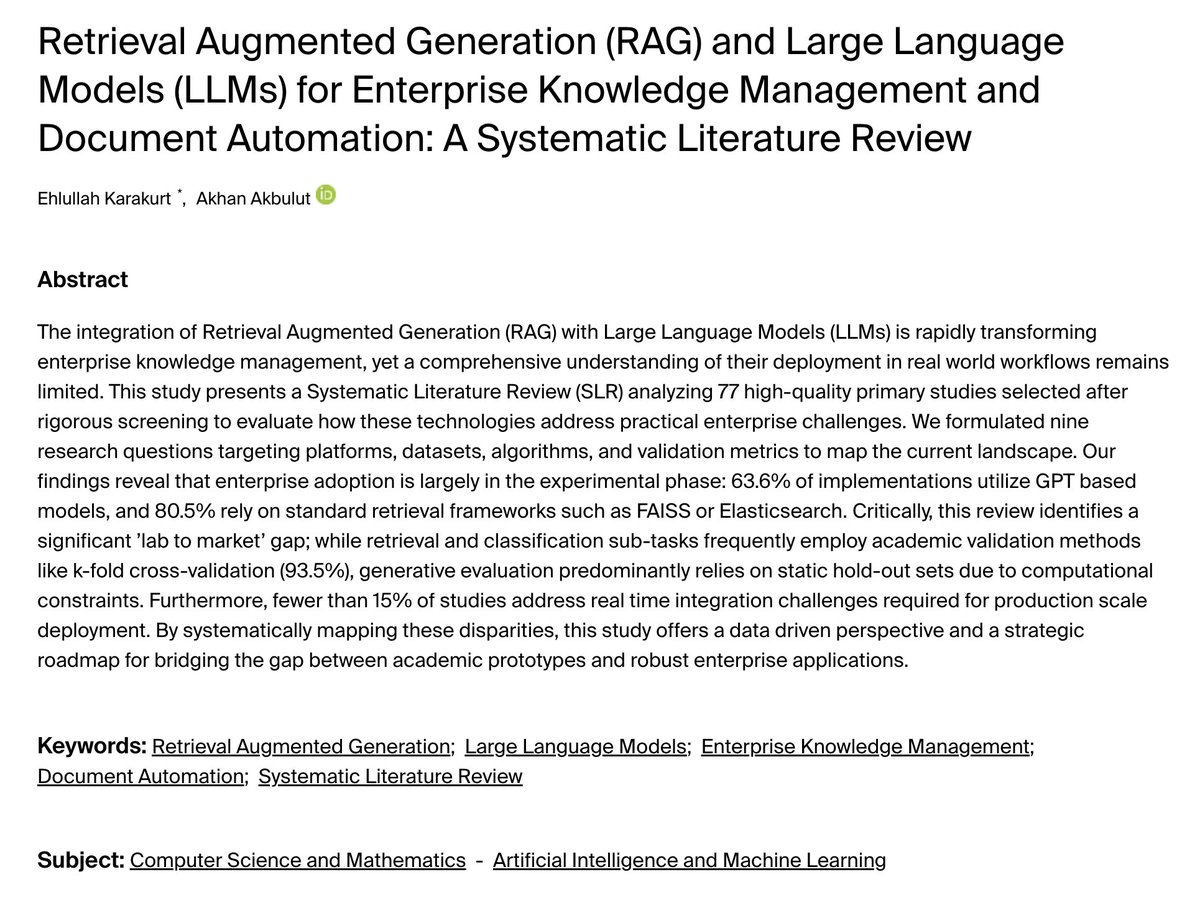
A systematic review of enterprise RAG systems identified recurring deployment challenges and Memori released as an open SQL-native memory engine. - Review analyzed 77 RAG+LLM papers (2015–2025) - 63.6% implementations used GPT models; 80.5% used FAISS/Elasticsearch - 66.2% rely on cloud infrastructure - Only 13% of studies deployed prototypes in enterprise environments - Top five challenges: hallucination control (48.1%), data privacy/security (37.7%), latency and scalability (31.2%), domain adaptation (23.4%), measuring business impact (15.6%) - Evaluation commonly uses precision/recall/accuracy (80.5%); ROUGE/BLEU in 44.2%; only 19.5% include human-in-the-loop evaluations - Memori announced as an open-source SQL memory engine storing memories in SQL DBs, automatic entity extraction, modes (Conscious/Auto/Hybrid) and one-line integration (memori.enable()) - Memori emphasizes auditability via SQL and integration with LangChain, OpenAI, Anthropic and 100+ LiteLLM-models
Key insights
Systematic review: RAG remains immature for enterprise production
A literature review of 77 RAG + LLM studies (2015–2025) found most prototypes rely on GPT models and standard vector search frameworks, with 66.2% using cloud infrastructure and only 13% deployed in real enterprise settings. The review identified hallucination control, privacy/security, latency/scalability, domain adaptation and difficulty measuring business impact as persistent barriers to production adoption. Evaluation practices often lack robust human-in-the-loop and business-centered metrics.
Memori offers SQL-native memory for LLMs to improve auditability
An open-source project, Memori, was released as an SQL-native memory engine for LLMs and agents. It stores extracted memories in standard SQL databases, provides automatic entity extraction and multiple memory modes (Conscious, Auto, Combined), and integrates with OpenAI, Anthropic, LangChain and many LiteLLMs. Memori emphasizes one-line integration, auditability through SQL, and background distillation to keep short-term memory relevant.
Hybrid retrieval and evaluation gaps persist
The review notes hybrid retrieval (dense vector + knowledge graph) appears in ~23.1% of work and often improves interpretability and accuracy, but industry deployments still struggle to meet enterprise latency, privacy and end-to-end business-evaluation requirements. Few papers report real-world business outcomes or comprehensive human collaboration assessments.