
Enterprise RAG, memory engines and prompt-transfer tools
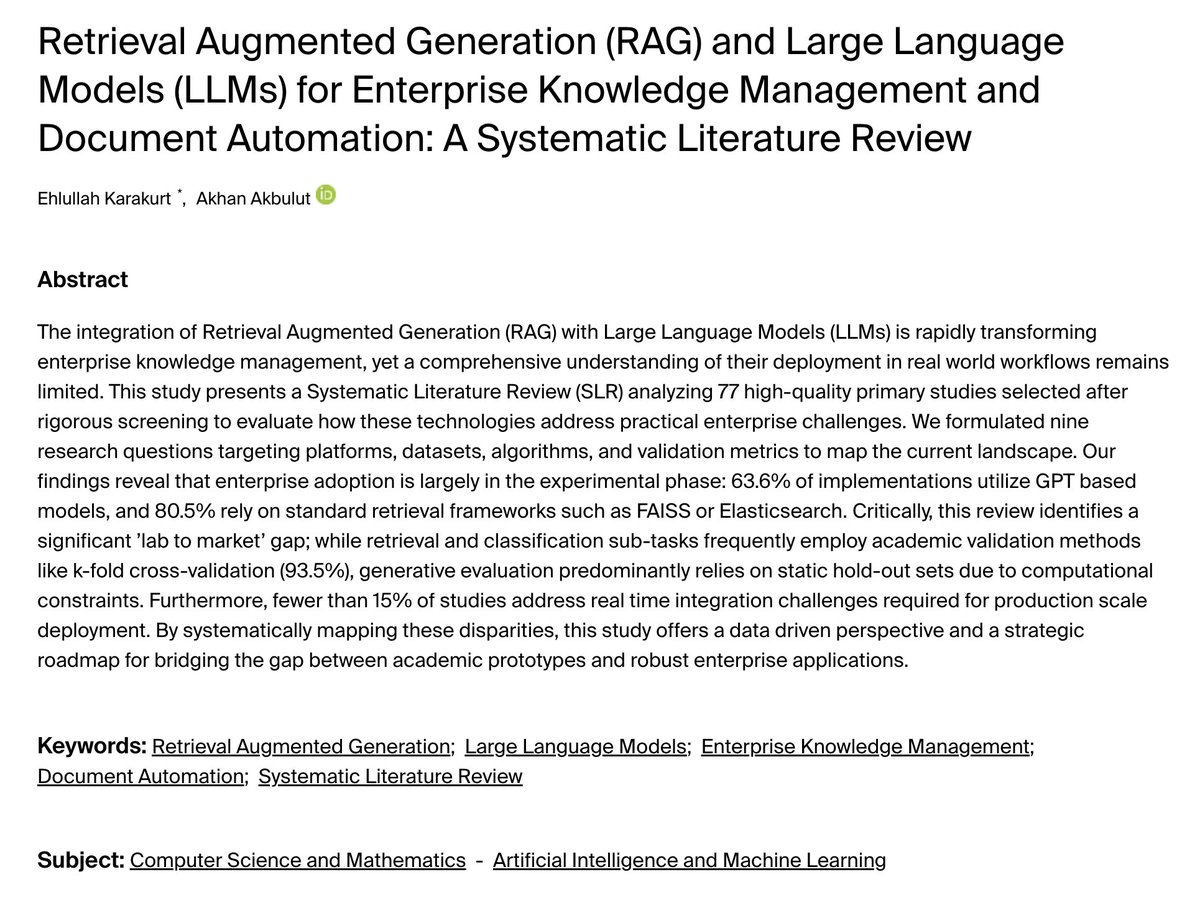
Research and tools highlight enterprise RAG limits, high-performance retrieval systems, memory engines, and prompt-transfer solutions. - Systematic review of 77 RAG+LLM studies (2015–2025) shows 63.6% use GPT models, 80.5% use FAISS/Elasticsearch, 66.2% use cloud scaling; only 13% deployed prototypes in enterprise settings. - Common challenges: hallucinations (48.1%), data privacy (37.7%), latency/scalability (31.2%), domain adaptation (23.4%), measuring business impact (15.6%). - Index (Opennote) described as a millisecond-level dynamic retrieval system optimized for agent use with P99 <300ms, Postgres+pgvector design, global Cloudflare edge runtime, chunk-level hashing, partial re-embedding, and three-layer cache invalidation. - Memori open-source SQL-native memory engine stores persistent memories in SQL, extracts entities, supports conscious/auto/combined memory modes, integrates with many LLMs, and runs periodic condensation for short-term memory. - PromptBridge (Accenture paper) provides a no-training mapping to transfer prompts across models via a calibration step and mapping learned from paired optimum prompts, enabling cross-model prompt portability without retraining. - Mixed retrieval (dense vectors + knowledge graphs) appears in 23.1% of studies and improves explainability and precision. - Practical enterprise constraints remain: <100ms latency goals, privacy-preserving retrieval, and business-centered evaluation metrics are outstanding gaps.
Key insights
RAG research shows production deployment lags and five recurring enterprise challenges
A literature review of 77 RAG+LLM studies from 2015–2025 finds strong technical adoption (63.6% use GPT variants; 80.5% use FAISS/Elasticsearch; 66.2% rely on cloud scaling) but limited enterprise deployment—only 13% had production prototypes. Recurring challenges include hallucination control (48.1%), data privacy/security (37.7%), latency and scalability (31.2%), domain adaptation (23.4%), and difficulty quantifying business impact (15.6%). The review recommends domain fine-tuning and hybrid retrieval strategies to improve facticity and explainability.
Index: design choices for millisecond retrieval for agents
Opennote's Index engineering post described a production retrieval stack optimized for agents and personal knowledge: Postgres with pgvector+pg_trgm+tsvector, global Cloudflare edge runtime, chunk hashing with selective re-embedding, dynamic filtering, and a three-layer cache that supports both exact and semantic hits. The system achieved P99 latency ~209–300ms while matching or exceeding ChromaDB on standard retrieval metrics, prioritizing dynamic filtering, multi-tenant isolation, and low-latency global operation.
Memori offers SQL-native memory primitives for LLMs
Memori is an open-source SQL-native memory engine providing one-line integration (memori.enable()) to persist conversation memory in standard SQL databases. It extracts entities, categorizes memory types (conscious, auto, combined), supports periodic condensation into short-term memory, and integrates with OpenAI, Anthropic, LiteLLM, and various agent frameworks. The design emphasizes auditable, user-owned storage over opaque vector-only stores.
PromptBridge enables cross-model prompt portability without retraining
PromptBridge (Accenture) proposes a zero-training framework to translate high-performing prompts from one model to another by calibrating with paired optimal prompt examples. The approach uses a small calibration set and learns a mapping so that a prompt optimized for model A can be automatically converted for model B, reducing the need for manual prompt engineering when switching models for cost, privacy, or capability reasons.
Hybrid retrieval and domain fine-tuning yield factuality gains
The review and engineering accounts note that hybrid retrieval (dense vectors plus knowledge graphs) and domain fine-tuning typically improve facticity and explainability. Domain-specific fine-tuning outperforms zero-shot by ~10–20% on factual measures; hybrid retrieval appears in ~23.1% of studies and improves precision and interpretability.