
FineDNA Releases Open Mid-Training and Post-Training Recipe for DNA Models
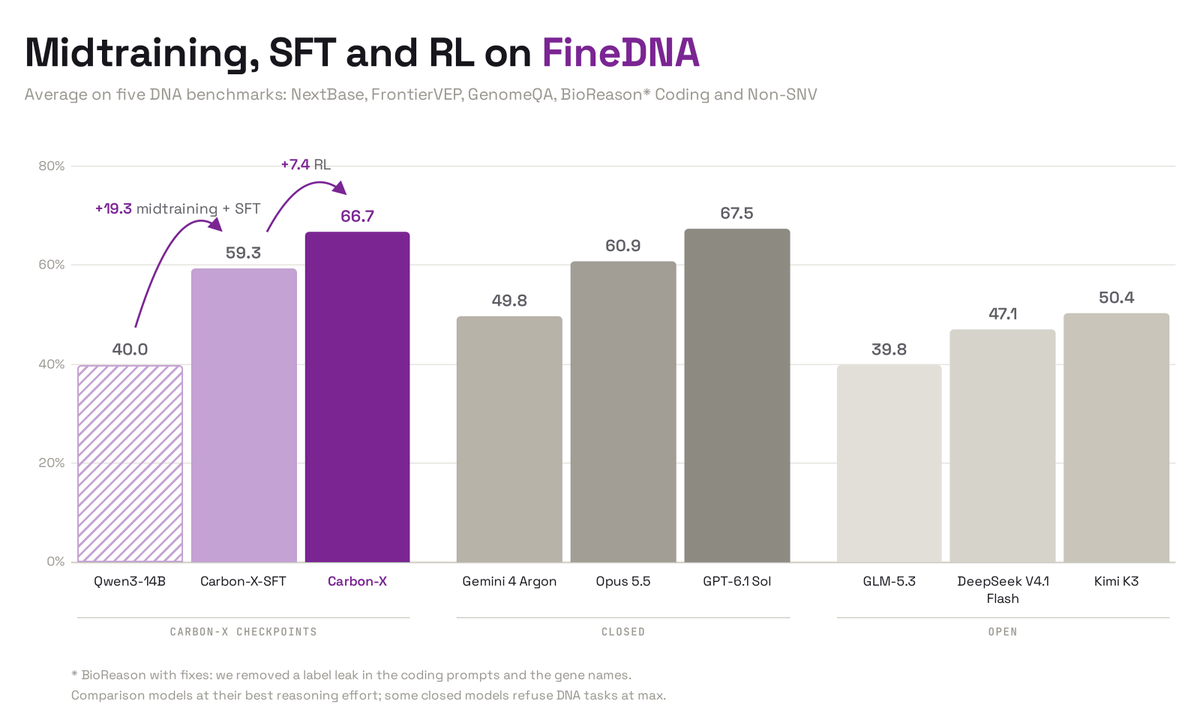
The FineDNA team released an open mid-training and post-training recipe for DNA understanding after finding that distillation from frontier models failed on genetic variant classification. The recipe uses code-computed facts plus the model's own mutation-unusualness signal to build grounded reasoning traces, reaching about 67% accuracy versus below 60% for self-distillation.
Event version 1.
Key insights
Frontier models failed as distillation teachers
Three frontier models were asked to classify 1,000 genetic variants as harmless or harmful. GPT-6.1 Sol returned bare labels with encrypted reasoning, Gemini 4 Argon refused over 50% of the time, and Opus 5.5 ran out of tokens on about 20% of prompts. Open weight models performed barely better than random.
Self-distillation produced hallucinations
Running RLVR on the base model and SFT on correct rollouts raised reward but produced hallucinations such as citing studies and databases that do not exist.
Grounded reasoning traces outperformed self-teaching
Each training explanation was assembled from facts computed in code plus the model's own sense of how unusual the mutation looks. Accuracy rose to about 67%, while the self-taught version stalled below 60%.
Domain mid-training was a prerequisite
Off the shelf, Qwen3-14B gave a learning signal on 17% of prompts. After mid-training on 300B tokens of DNA and text, the figure rose to 42%.