
From the Era of Scaling to the Era of Research — Interview with Ilya Sutskever and Industry Strategy
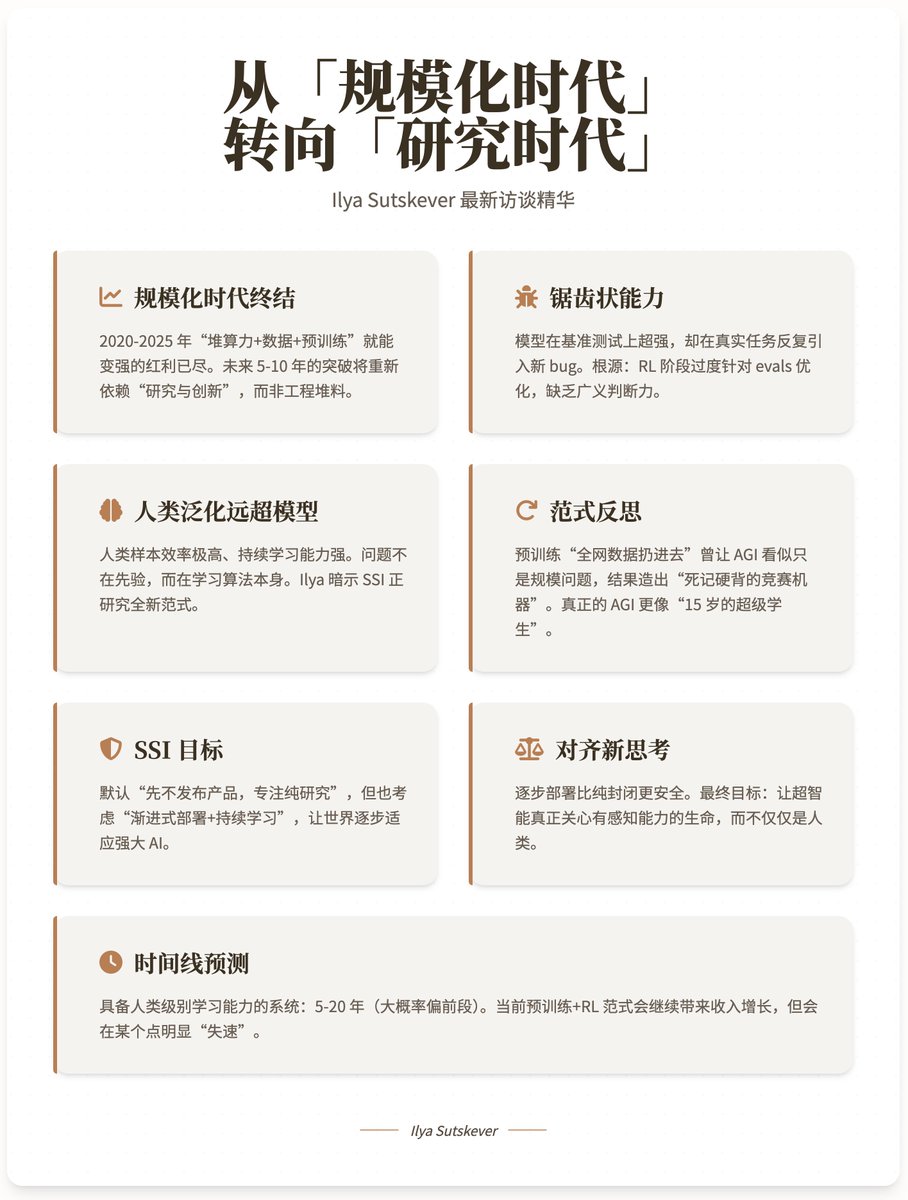
Ilya Sutskever's public interview reveals a directional shift in the industry and the SSI strategy. He claims that 2020-2025 is the 'Era of Scaling', after which the marginal returns of scaling will decline. He predicts a return to a 'Research Era' focused on research and innovation in the next 5-10 years. He believes current models perform well on benchmarks but frequently encounter new bugs in real tasks, attributing this to excessive optimization for evaluation and insufficient generalization capability. He points out that human generalization surpasses that of models due to learning algorithms and continuous learning abilities rather than priors. He reflects on the 'pre-training + RL' paradigm: while convenient, it leads to over-specialization and memorization capabilities. The goal of SSI (Straight-shot Safe Superintelligence) is to prioritize pure research until safety is achieved while considering gradual deployment for continuous learning and world adaptation. He updates the alignment concept, leaning towards allowing the world to gradually experience AI capabilities to promote a culture of safety; alignment ultimately requires superintelligence to care about sentient life or achieve deep human-machine integration. The timeline predicts systems with human-level learning capabilities moving towards superintelligence within 5-20 years, with a higher probability in the earlier part of that range. He emphasizes the importance of 'research taste': selecting research directions based on brain analogies, simplicity, elegance, and multi-faceted beliefs.
Key insights
The Era of Scaling Has Ended, Research-Driven Focus Will Return
Ilya Sutskever clearly states in the interview that 2020-2025 belongs to the 'Era of Scaling', relying on computational power, data, and pre-training to rapidly enhance model capabilities. However, starting in 2025, simply amplifying computational power will face the reality of sharply declining marginal returns. Therefore, key breakthroughs in the next 5-10 years will increasingly depend on foundational research and algorithmic innovation rather than pure engineering. This judgment is based on observations of recent model performance curves and evaluation optimization effects, suggesting that the research paradigm will again become dominant.
Analysis of the Root Cause of Strong Benchmarks but Insufficient Real-World Generalization
The interview points out that current models perform excellently on benchmark tests but frequently encounter new bugs and require iterative fixes in real tasks. The root causes include excessive optimization for evaluation during the RL phase (reward hacking) leading to specialized behavior, and the models' lack of continuous learning and taste similar to humans. Ilya compares this phenomenon to students who only practice competitive programming skills without broad judgment capabilities, concluding that the bottleneck lies in learning algorithms and generalization capabilities rather than computational power itself.
Human Generalization Surpasses Models; Algorithms and Continuous Learning Are Key
Sutskever suggests that humans exhibit high sample efficiency, strong continuous learning, and robustness, which cannot be solely explained by priors (such as vision and motion). The human advantages in semantic domains (language, mathematics, programming) indicate that the issue lies in learning algorithms. The interview reveals that SSI is exploring new machine learning paradigms aimed at achieving human-like continuous learning and generalization, but details have not been disclosed due to competitive reasons.
Reflection and Positioning on the Pre-training + RL Paradigm
Ilya states that the success of pre-training lies in its ability to leverage vast amounts of network data without the need for meticulous data selection, but this has also led to a misjudgment in the industry: believing that AGI is merely about pushing pre-training to its limits. The result is the creation of 'rote memorization competition machines' rather than flexible intelligence. True AGI resembles a '15-year-old super student': possessing strong foundational abilities but still needing to acquire specific knowledge and skills through continuous learning during deployment.
SSI Strategy: Focus on Pure Research and Gradual Deployment Consideration
Sutskever describes SSI's default plan as initially not releasing products and focusing on pure research until achieving fundamentally safe superintelligence. However, he also indicates for the first time that they are seriously considering a path of 'gradual deployment + continuous learning from the real world', reasoning that this approach allows the world to gradually adapt to strong AI and that superintelligence is more likely to emerge in a continuous learning form rather than as an all-knowing, all-powerful final state.
Evolution of Alignment Concepts and Timeline Predictions
The interview reveals significant shifts in Ilya's thoughts on alignment strategies over the past year: he now believes that gradual deployment and allowing the world to genuinely experience AI's power is more important than pure theoretical considerations. When AI begins to 'feel powerful', leading companies will become extremely paranoid about safety. He provides a timeline predicting that systems with human-level learning capabilities moving towards superintelligence will emerge within 5-20 years, with a higher probability in the earlier part of that range; current pre-training + RL will continue to generate revenue but will ultimately stall in generalization.