
Gemini 3 Release and Capability Analysis
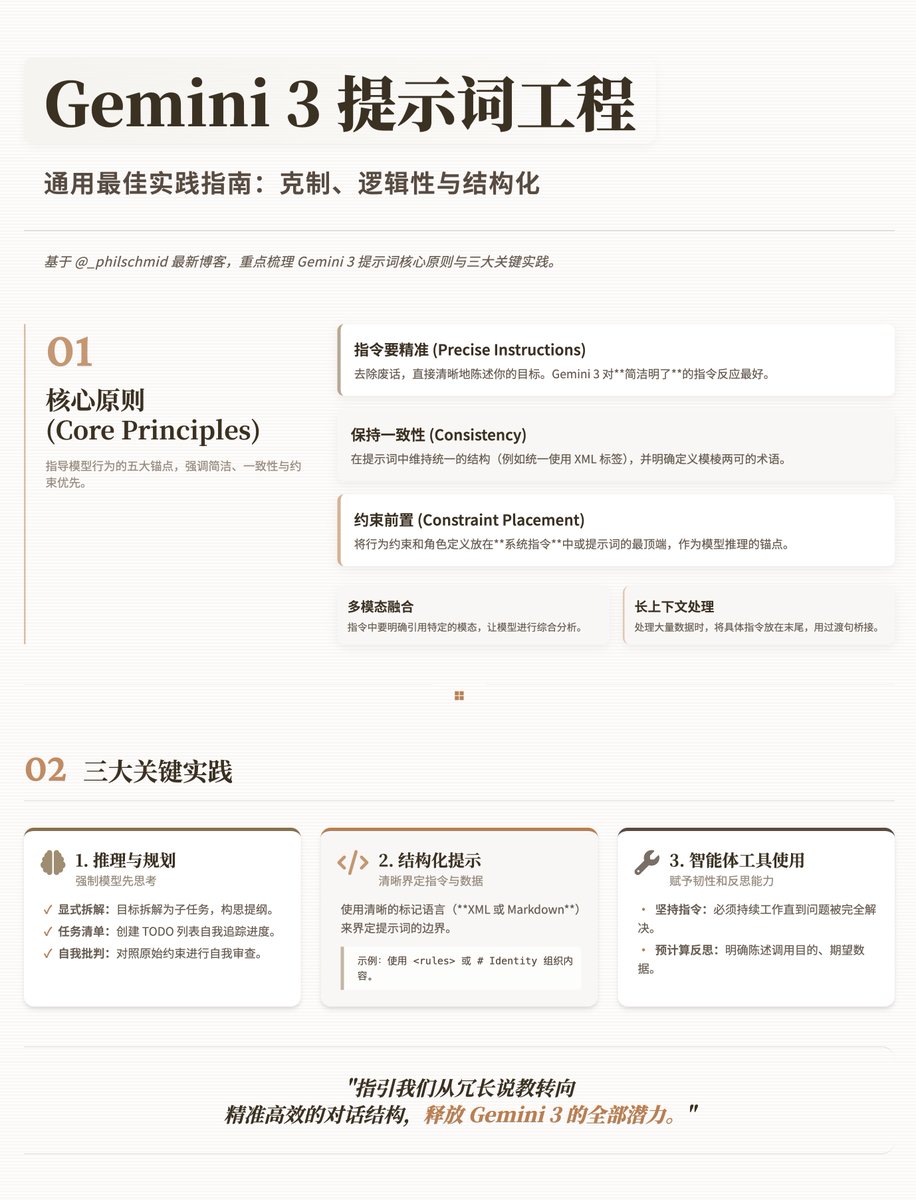
Google has released Gemini 3, outlining prompt engineering practices and capability analysis. - Core of prompts: Instructions must be precise, eliminating unnecessary words. - Core of prompts: Maintain consistency, suggesting a unified tag format (e.g., XML). - Core of prompts: Multimodal integration, processing text, images, and audio together. - Core of prompts: Constraints upfront, placing roles and limitations at the top of system instructions. - Core of prompts: Long context handling, with data presented first and questions at the end, bridged by transitional sentences. - Key practice: Reasoning and planning, requiring explicit breakdown of sub-tasks and generation of a TODO list. - Key practice: Structured prompts, recommending the use of XML/Markdown to delineate boundaries of instructions and data. - Key practice: Agent tool usage, emphasizing 'adherence to instructions' and pre-calculated reflective questions (why call, expected data, data usage). - Gemini 3.0 Pro has been rated as SOTA in design directions (Website, UI, 3D, Game Dev). - Gemini 3 is trained on its own TPU, controlling training/inference costs with fast inference speed. - DeepMind's chief and team claim Gemini 3 is the most comprehensively tested model to date, noting significant investments in efficiency and distillation. - Gemini 3 sets core metrics around 'helping users complete daily tasks' and improves the model persona to be 'more concise and to the point.' - An official interview mentioned: helping students learn, offering one year of free usage to college students across the U.S.; AGI still requires years and research breakthroughs (reasoning/memory/world models).
Key insights
Prompt Engineering: Gemini 3 Prefers Concise, Structured Instructions
Gemini 3's preference for prompts is clear and structured: instructions need to be precise and free of redundancy, maintaining consistency in prompts (e.g., using XML tags uniformly), placing behavioral constraints and role definitions at the top of system instructions to serve as anchors for model reasoning; in multimodal scenarios, text, images, and audio should be referenced together, requiring the model to conduct comprehensive analysis rather than isolated processing. This viewpoint is based on a systematic summary of core principles and three key practices of prompt engineering, including structured prompts (XML/Markdown examples) and long context handling suggestions.
Agents and Tool Invocation: Emphasizing Persistence and Pre-Reflection
When using Gemini 3 as an autonomous agent, it is essential to endow it with greater resilience and reflective capabilities: instructions should explicitly require 'must continue working until the problem is fully resolved'; if a tool invocation fails, the agent should analyze the error and attempt alternative solutions; before invoking a tool, the model should state why it is calling that tool, what specific data it expects to obtain, and how this data will help solve the problem (the three pre-calculated reflective questions). This approach is proposed as the third key strategy in prompt engineering practices to enhance the reliability and traceability of agentic workflows.
Gemini 3 Demonstrates SOTA Performance in Design Tasks, Showing Strong Practicality
Cross-platform evaluations show that Gemini 3.0 Pro ranks first in design directions such as Website, UI Components, 3D Design, and Game Dev; evaluators noted its excellent performance in design taste, layout, and color matching. Additionally, some users described Gemini 3 as 'an always-available thought partner,' suitable for creative and product iteration scenarios, but also emphasized that 'no model is better than how well the user utilizes it,' requiring practical experience.
Training and Efficiency: Google Uses TPU and Invests in Distillation and Costs
Public information indicates that Gemini 3's training and inference heavily utilize Google's own TPU, with Google investing substantial resources in efficiency and distillation technologies to support services for billions of users; evaluations and user experiences point to fast inference speeds and appropriate cost control, discussing whether architecture optimization is achieved due to sufficient computational power preparation or solely relying on large-scale TPU computational resources.
Official Interview: Gemini 3 is the Most Comprehensively Tested Model and Offers Free Period for Students
DeepMind and the Gemini team stated in an online interview that Gemini 3 is the most comprehensively tested model by Google to date; one of the model's goals is to help users 'learn anything,' and they mentioned offering one year of free usage for college students across the U.S.; the team noted the need for significant investments in efficiency and distillation to serve a large-scale user base, and predicted a timeline of several years for AGI, requiring several research breakthroughs (such as reasoning, memory, and world models).
Usage Recommendations: Enforcing Model Decomposition and Self-Critique Before Reasoning
Prompt engineering practices recommend forcing the model to decompose goals, check information completeness, and provide a structured outline before giving the final answer; simultaneously, the model should create and update a TODO list, executing self-critique before outputting to check if it meets the original constraints. These methods are listed as key practices to improve answer accuracy and verifiability.