
GitHub Copilot Streamlined Toolset and Performance Optimization
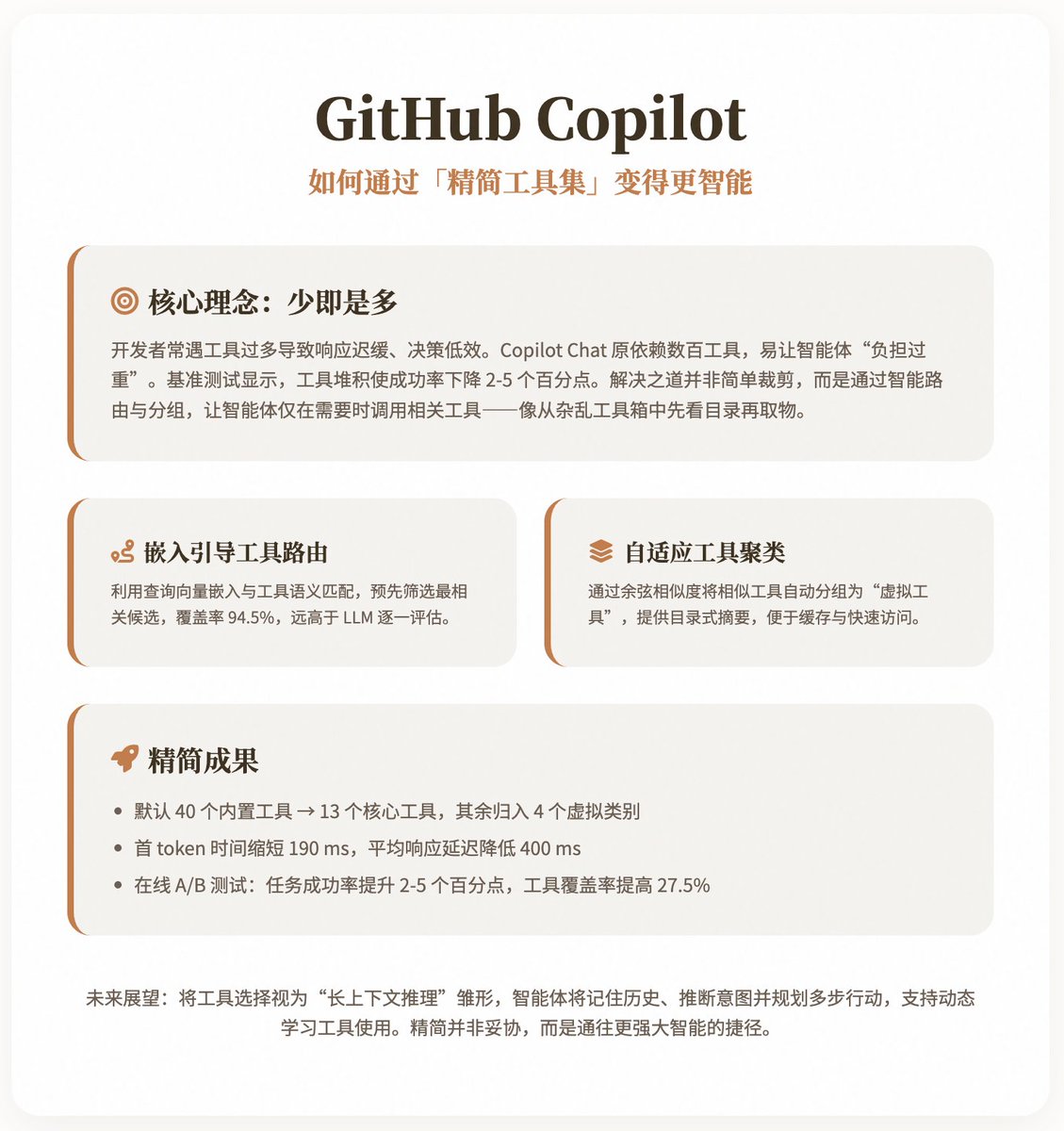
GitHub Copilot has introduced a streamlined toolset and intelligent selection mechanism to accelerate performance and enhance accuracy.
Key insights
Introduction of Embedding-Guided Routing and Adaptive Clustering for Precise Tool Selection
The update to GitHub Copilot includes two key mechanisms: embedding-guided tool routing and adaptive tool clustering. The embedding-guided approach pre-screens relevant tools by matching query vectors with tool semantic representations, achieving a tool usage coverage of 94.5% in tests. Adaptive clustering groups similar tools based on cosine similarity, generating virtual tools summarized by smaller models for caching and quick access. The overall goal is to replace full tool invocation with a 'less is more' approach, reflected in performance improvements in benchmark and A/B testing.
Streamlined Toolset and Optimization Enhance Response Speed and Success Rate
This update has reduced the default built-in tools from 40 to 13 core tools, with the remaining non-core tools categorized into four virtual categories. The time to the first token has been shortened by 190 milliseconds, and average response latency has decreased by approximately 400 milliseconds. Online A/B testing shows an increase in task success rates by 2–5 percentage points and a 27.5% improvement in tool coverage. Caching embeddings and group summaries have also reduced operational costs and alleviated API limit issues.
Users Hope for Copilot to Be an Inspiring 'Content Teacher' Rather Than a Cold Rewriting Tool
One user expressed that while Copilot can now complete tasks in one go, they hope it will function more like a content teacher to inspire creativity, rather than simply rewriting content into soulless AI text. The user also plans to implement an automatic extraction feature for tweets after logging into X, aiming to generate corresponding writing styles as the next optimization goal.