
GLM Achieves Recursive Self-Improvement
Zhipu AI disclosed that GLM-5.3-Flash's production inference runs on over 100,000 domestic AI accelerators, with end-to-end throughput improved 3.2x by an AI agent powered by GLM-5.3 itself. The agent fixed three real engineering issues: precision drift, concurrency bottleneck, and redundant computation. CEO Tang Jie stated the model optimized the system running it.
Key insights
Agent-Driven Inference Optimization
Zhipu AI's GLM-5.3-Flash model is now running production inference on over 100,000 domestic AI accelerators. The entire optimization process, from first run to production, took less than two weeks and achieved a 3.2x end-to-end throughput improvement. The optimization work was performed not by engineers but by an AI agent powered by GLM-5.3 itself.
Dense Feedback System for Agent Debugging
The agent used a 'dense feedback' system with layered verification interfaces: correctness feedback, system behavior feedback (time spent), and performance feedback (which solution is better under conditions). This allowed the agent to identify and fix three real engineering problems. The system was built to convert implicit engineer expertise into explicit, verifiable signals.
Three Engineering Fixes Discovered by the Agent
The agent discovered and fixed: 1) Precision drift in KDA kernels due to TF32 rounding errors accumulating over long contexts; 2) Concurrency bottleneck where KV cache transfer never overlapped with computation due to GIL not being released in DeepEP; 3) Redundant computation in a decoding kernel that repeated normalization four times. The fixes improved performance by up to 1.71x for the last issue.
CEO Reflections on Recursive Self-Improvement
CEO Tang Jie emphasized that the key takeaway is not any single optimization but the shift in engineer role from problem-solver to feedback-designer. He noted that the agent's tasks can become training data for future models, creating a minimal closed loop of recursive self-improvement. Human oversight remains for goal setting, feedback environment setup, and high-risk change review.
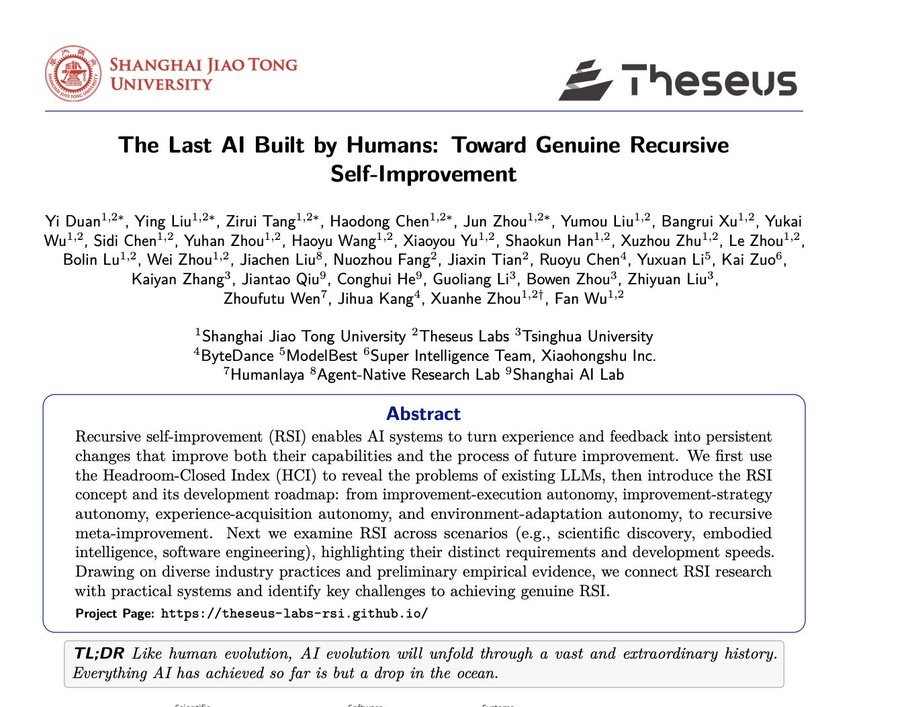
Research Paper on AI Self-Improvement Levels
A separate paper by 30+ researchers proposed a 5-level taxonomy for AI self-improvement, from Level 1 (humans decide what to improve) to Level 5 (AI rewrites the process of creating next-gen AI). They reviewed 491 papers and found 75% remain at Level 1-2, with less than 6% reaching Level 5. This provides a framework for understanding GLM's achievement as an early step toward recursive improvement.