
Google Gemini 4 Argon Flagship Model Released
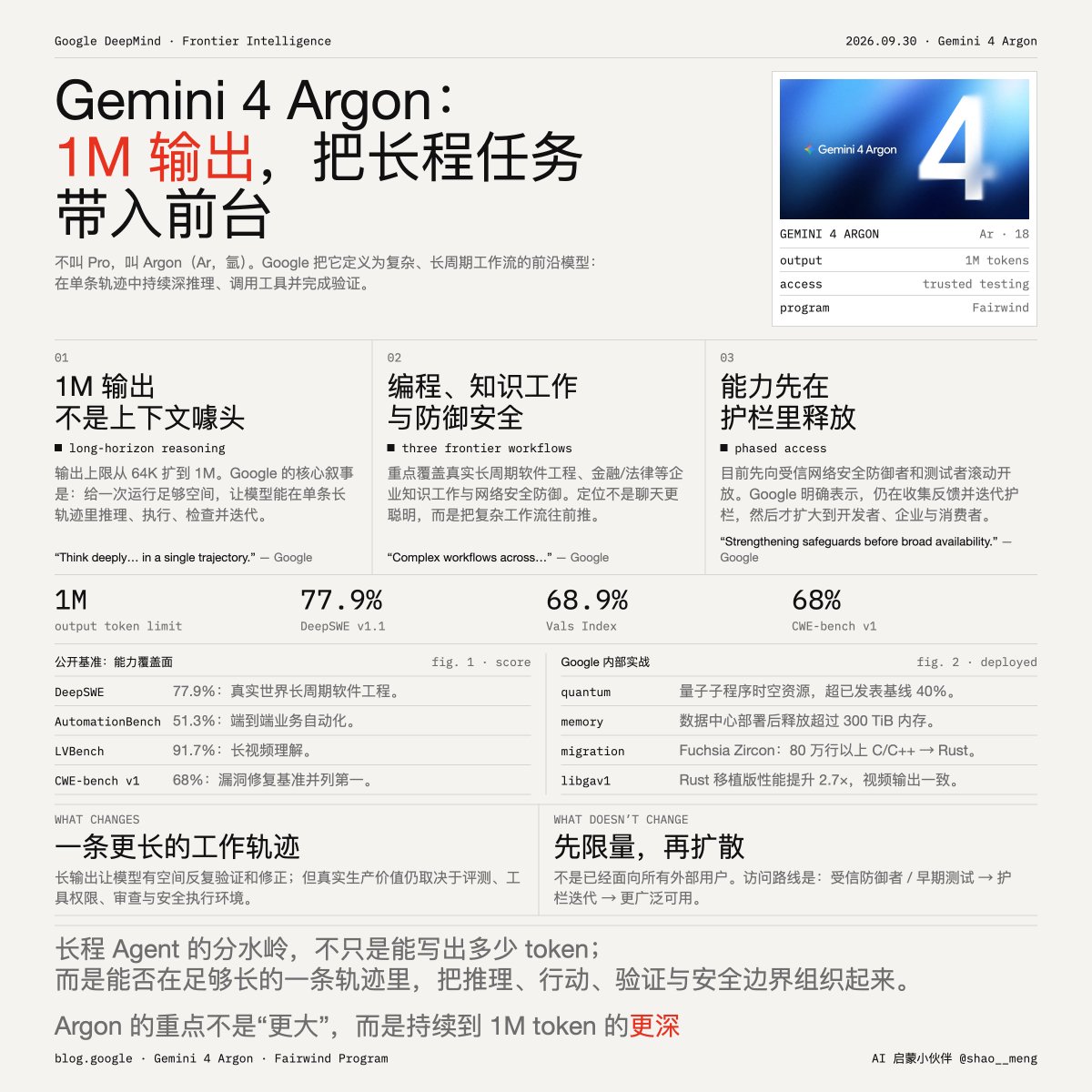
Google unveiled Gemini 4 Argon, its new flagship model with a 1 million token output limit, priced at $2 per million input tokens. Initially available to Fairwind cybersecurity users, it leads in long-context tasks, legal AI benchmarks, and internal optimizations like freeing over 300 TiB of memory.
Key insights
Pricing and Availability
Gemini 4 Argon is priced at $2 per million input tokens and $10 per million output tokens during the introductory period, matching GPT-6.1 Sol. After the period, prices rise to $4/$20, matching Claude Opus 5.5. Cached input is 5% of the price. It is initially available only to Google Fairwind cybersecurity users, then to paid API customers and Google AI Ultra subscribers, with general availability date not announced.
1 Million Token Output Capability
Argon can output up to 1 million tokens in a single run, nearly 8 times the 128k limit of GPT-6 Astra, GPT-6.1 Sol, Claude Fable 5.1, and Claude Opus 5.5. This enables sustained deep reasoning over long contexts without splitting tasks into multiple rounds. Google claims it can generate tens of thousands of tokens in one continuous thought process.
Performance Benchmarks and Comparisons
In Google's 19-benchmark comparison, Argon leads in 13, ties in 1, and trails in 5. Notable wins: Harvey legal benchmark (19.6% vs 5.4% for Astra), Vals Finance Agent v2 (65.4% vs 53.5%), Zapier AutomationBench (51.3% vs 41.4%), and long-context GraphWalks (84.2% vs 71.8%). It trails in FrontierSWE v2 (55.0% vs Astra 65.5%), Terminal-bench 4.0 (57.4% vs Opus 5.5 66.4%), and OSWorld-2.0 (69.2% vs Astra 72.6%).
Cybersecurity Focus and Safety Measures
Argon is specifically trained for cybersecurity defense: autonomously finding, verifying, and patching vulnerabilities. It achieved 68% on CWE-bench v1 (tied with Astra). It discovered a critical vulnerability in a medical software used by hospitals that previous models missed. Safety measures include refusal of harmful requests, prompt injection defense, monitoring of internal activations, and sandbox isolation for high-risk tasks.
Internal Use Cases: Quantum, Memory, and Rust Migration
Google's internal teams used Argon for significant optimizations: quantum research team improved a subroutine's resource benchmark by 40% over published results; agent team freed over 300 TiB of memory (estimated 500 TiB to 1 PiB total); Argon agents are migrating C/C++ code to Rust, including the 800,000+ line Fuchsia Zircon kernel. The libgav1 Rust port achieved 2.7x speedup over the original Rust version.
Comparison to Competitor Pricing and Positioning
Google positions Argon as a cost-effective alternative: its introductory price matches GPT-6.1 Sol, and its regular price matches Claude Opus 5.5, both of which are significantly cheaper than GPT-6 Astra and Claude Fable 5.1 ($10/$50). Despite lower price, Argon outperforms on many benchmarks, especially in long-context and enterprise knowledge work.