
Google Gemini ecosystem: Live API, Agents and multimodal features
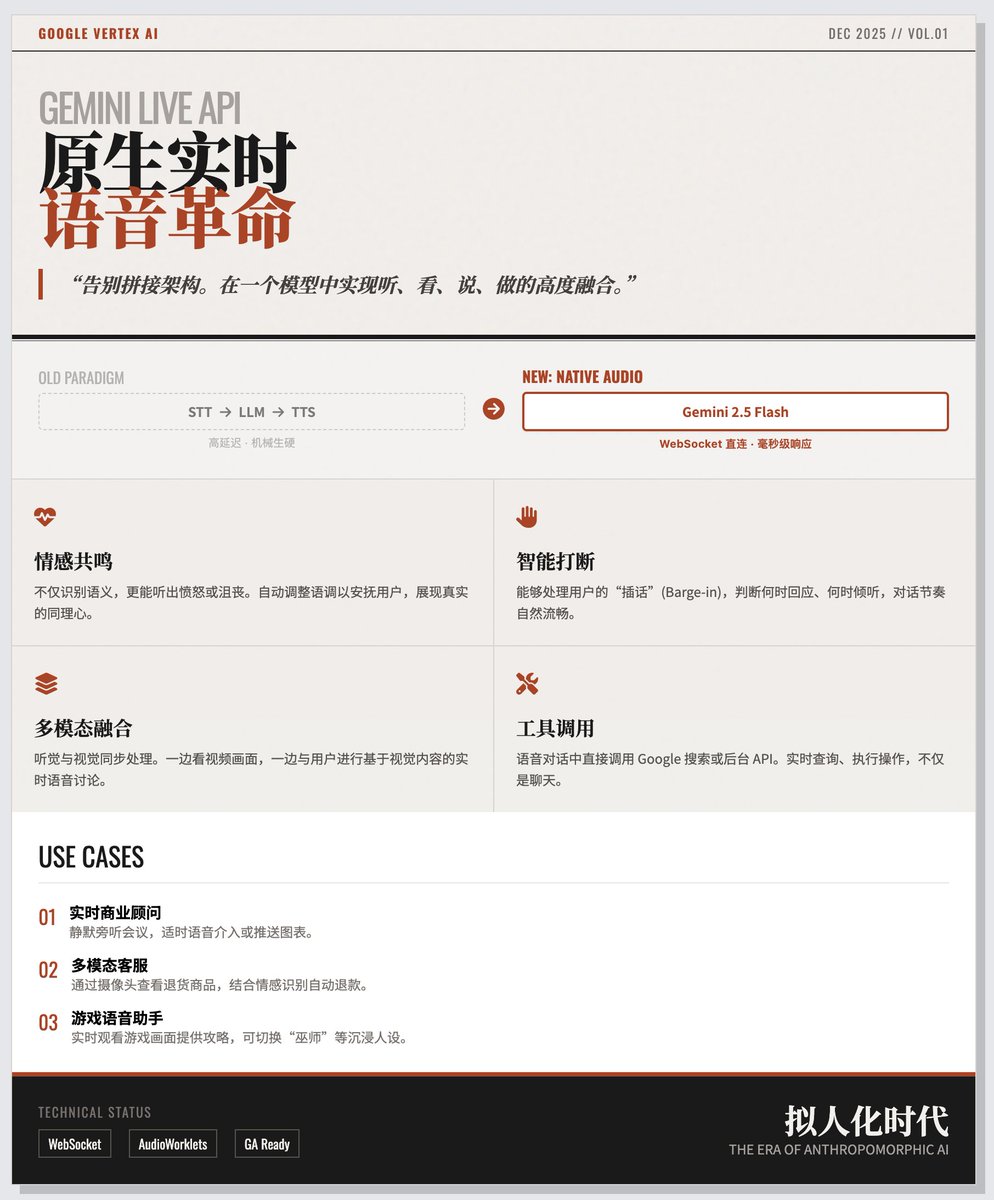
Google announced the Gemini Live API and the Interactions API and new multimodal agents. - Gemini Live API uses Gemini 2.5 Flash Native Audio model. - Native audio processing removes STT/TTS chaining and lowers latency. - Live API handles audio, video, text in one WebSocket stream. - Capabilities: emotion detection, interruptible responses, tool calling, persistent memory. - Quickstart templates: Vanilla JS and React. - Demo apps: real-time business advisor, multimodal customer service, game voice assistant. - Gemini TTS allows prompt-controlled voice attributes (gender, tone, age, pronunciation). - Gemini Deep Research Agent built on Gemini 3 Pro for autonomous planning and verifiable citations. - Deep Research scored SOTA on DeepSearchQA, Humanity's Last Exam, and BrowseComp.
Key insights
Gemini Live API offers native audio multimodal low-latency pipeline
Google released Gemini Live API based on Gemini 2.5 Flash Native Audio, enabling a single-model stream that 'hears' raw audio and directly generates audio responses, eliminating separate STT and TTS steps. The API uses WebSocket connections for millisecond-level latency, supports emotion recognition and interruptible dialogue, and can call external tools and search during a live conversation. Google provided templates (Vanilla JS, React) and demo scenarios to accelerate developer adoption.
Gemini TTS and voice control expand multimodal expressiveness
Google's new Gemini TTS model accepts prompt-level controls for voice attributes including gender, tone, age, and pronunciation of specific words, removing the need to swap voice models. Developers reported using the TTS to produce distinct character voices for interactive media, combining Gemini image models for scene visuals with TTS voice control.
Gemini Deep Research Agent targets autonomous rigorous research with citations
DeepMind introduced Gemini Deep Research Agent built on Gemini 3 Pro, designed to autonomously plan research, execute targeted searches, read results, identify gaps, and re-query. It integrates private documents with public sources and aims for verifiable outputs with explicit citations. The agent scored SOTA on internally published DeepSearchQA (66.1%), Humanity's Last Exam (46.4%), and BrowseComp (59.2%) and is available via the Interactions API.
Gemini platform exposes tool-selection and UI behaviors to developers
Developers explained how choosing the 'Create image' option affects tool invocation: unchecked, the LLM may still call an image tool if context indicates; checked, system prompts enforce image generation. The Gemini App and other chat apps wrap raw LLM APIs with tool definitions, search connectors, and UI behaviors that determine when and which external tools are invoked.