
Google Gemini Live API and Native Audio model update
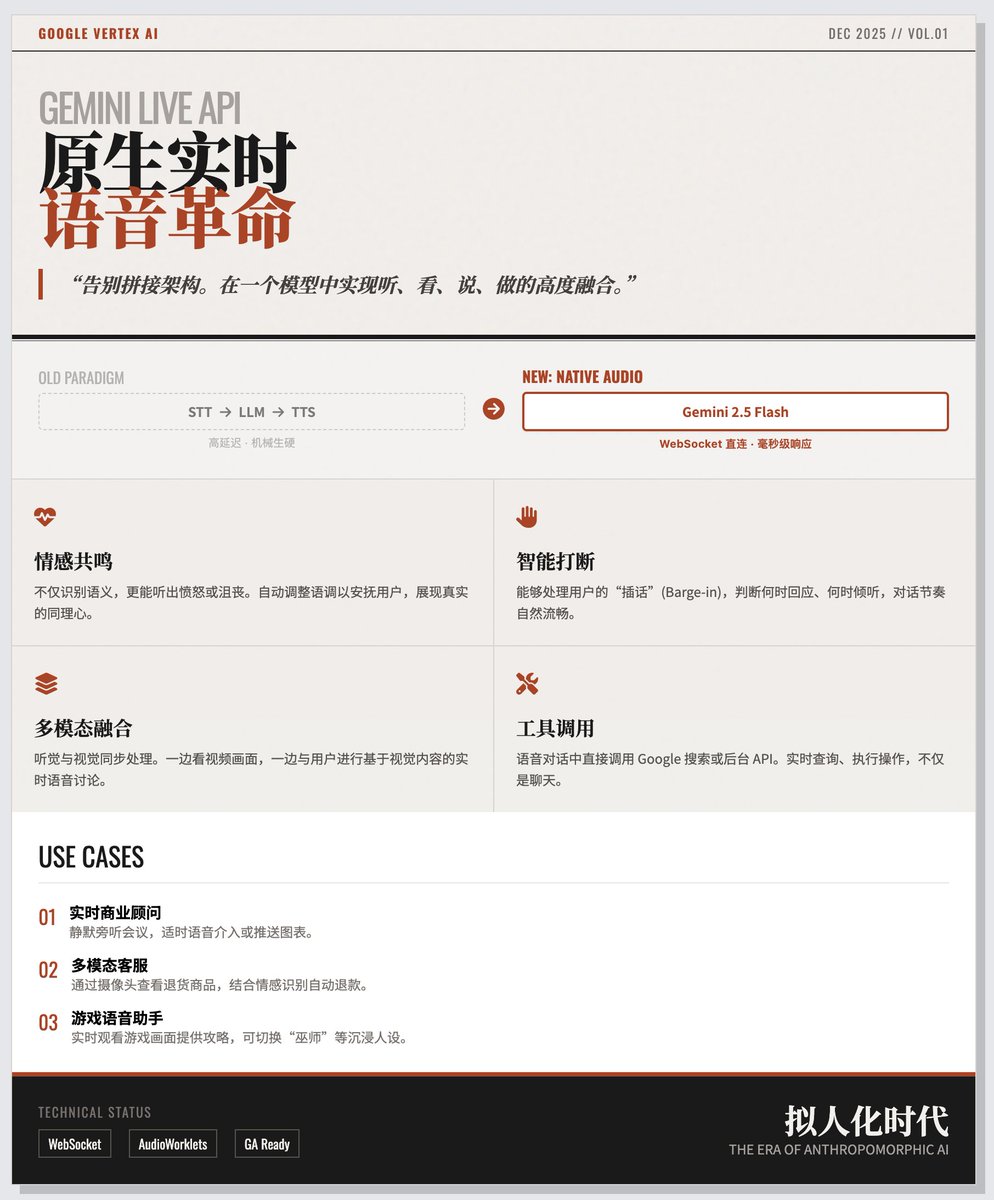
Google launched Gemini Live API with native audio. - Google launched Gemini Live API (GA). - Built on Gemini 2.5 Flash Native Audio model. - Model handles audio, video, text, and vision. - Eliminates STT → LLM → TTS pipeline. - Native audio processing: listens and replies directly. - Millisecond-level low latency via a single WebSocket. - Supports real-time tool calls and Google Search. - Detects speaker tone, speed, and emotional state. - Adjusts voice to soothe or show empathy. - Intelligent interruption and interjection handling. - Maintains persistent multimodal memory. - Enterprise-grade availability and multi-region support. - Two quickstart templates: Vanilla JS and React. - Three demos: real-time business advisor, multimodal customer service, game voice assistant. - Separate update: Native Audio model improved for higher-precision function calling, better realtime instruction following, and smoother conversational abilities; available now in the Gemini API. - Sources timestamped: blog post 2025-12-13 and tweet 2025-12-12.
Key insights
Gemini Live API provides native real-time audio multimodal processing
Google announced the Gemini Live API as a GA release built on the Gemini 2.5 Flash Native Audio model. The API enables a single-model approach that directly ingests raw audio and produces audio responses, removing the prior STT→LLM→TTS assembly. The service accepts audio, video, text, and visual inputs in a unified workflow and uses a single WebSocket connection to deliver millisecond-level latency for real-time interactions. These facts are described in the launch documentation and demo descriptions for the Live API.
API emphasizes humanlike conversational behaviors and enterprise stability
The Gemini Live API documentation highlights five core humanlike capabilities: detection of speaker emotion, tone and speech rate; adaptive voice modulation to soothe or express empathy; intelligent interruption and interjection handling to preserve natural dialog rhythm; the ability to call external tools and Google Search during voice interactions; and persistent memory across multimodal sessions. The launch is provided as GA with enterprise-grade high availability and multi-region support, indicating production-readiness stated in the release material.
Developer templates and demos demonstrate integration patterns
Google published two Quickstart templates (a zero-dependency Vanilla JS template that demonstrates WebSocket and media flow, and a modular React template with audio workflow components) and three representative demos. The demos include a real-time business advisor with silent and speaking modes that can push charts or intervene by voice, a multimodal customer service flow that uses camera input plus voice emotion detection to call backend tools (e.g., refunds), and a game voice assistant that watches gameplay and lets users switch AI personas for different in-game roles.
Native Audio model updated for function calling and realtime instruction following
Separately, Google announced an updated Gemini Native Audio model rolled out to developers in the Gemini API with higher-precision function calling, improved realtime instruction following, and smoother, more cohesive conversational abilities. The update was described as available to developers immediately in the Gemini API and complements the Live API’s native audio capabilities. The update message was posted one day prior to the Live API blog timestamp.