
Google Launches Gemini 4 Argon Flagship Model
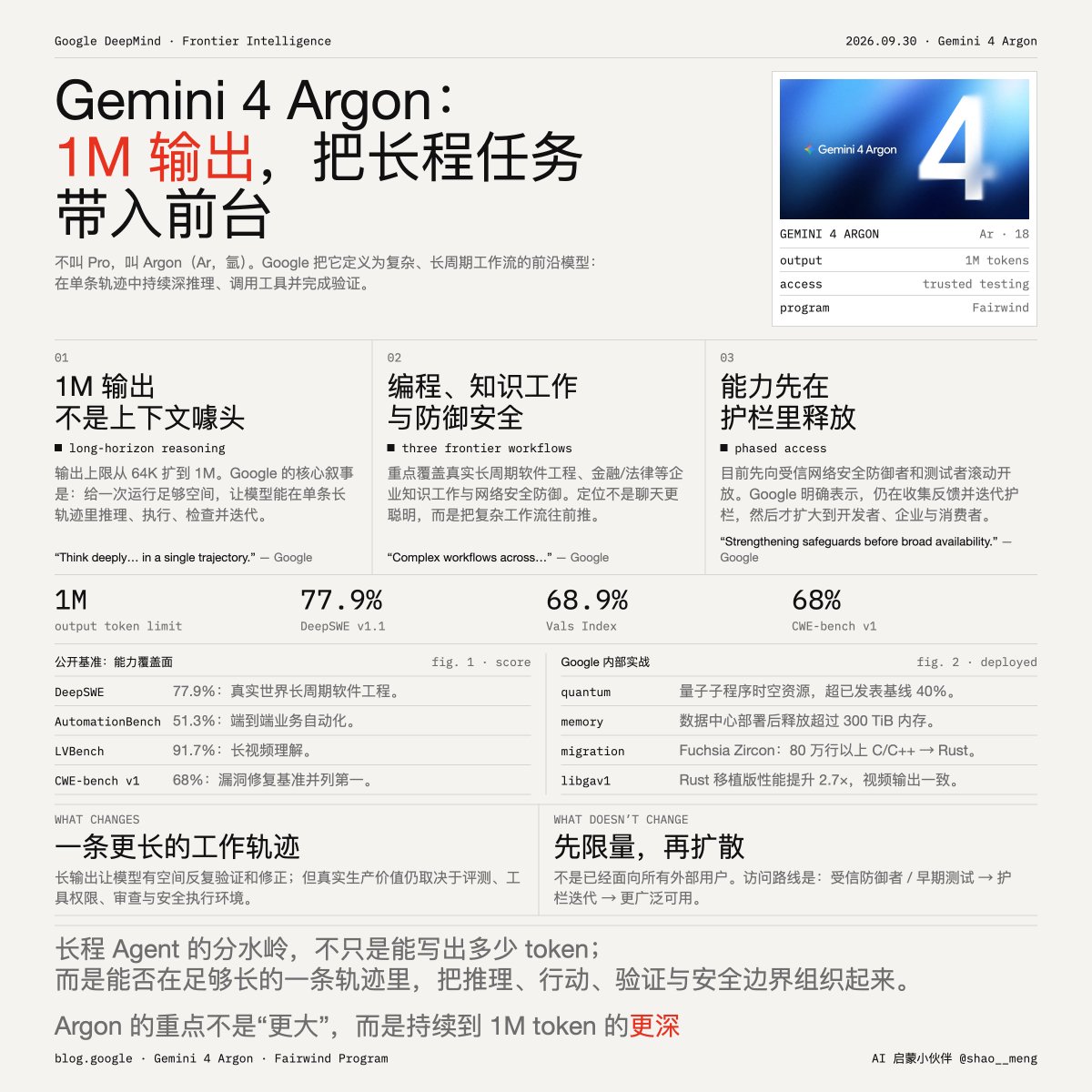
Google launched Gemini 4 Argon, a flagship model for long-horizon tasks with a 1 million token output limit, about 8 times its rivals. It is in trusted testing for Fairwind cybersecurity defenders, priced at $2/$10 per million input/output tokens and led 13 of 19 published benchmarks.
Key insights
Argon Tops 13 of 19 Benchmarks Against Rival Flagships
Google's comparison table pitted Gemini 4 Argon against OpenAI's GPT-6 Astra, Anthropic's Claude Fable 5.1, and Claude Opus 5.5 across 19 tests; Argon took 13 first places, tied one with Astra, and trailed in 5. Its largest leads came in professional work: 19.6% on Harvey's legal agent test versus 3.8-6.7% for rivals, 65.4% on Vals Finance Agent v2 versus 53.5-58.9%, and 51.3% on Zapier's AutomationBench. It lost FrontierSWE v2 (55.0% versus Astra's 65.5%), Terminal-bench 4.0 where Opus 5.5 led at 66.4%, PostTrainBench, Terminal-Bench Science, and OSWorld-2.0.
1 Million Token Output Defines Long-Horizon Positioning
Argon's headline specification is a 1 million token output limit per run, roughly 8 times the 128,000 tokens offered by GPT-6 Astra, GPT-6.1 Sol, Claude Fable 5.1, and Opus 5.5, and up from 64,000 in the previous generation. Google states the model can think and generate hundreds of thousands of tokens continuously in a single task without splitting it into many rounds. Long-material results support the positioning: 84.2% on GraphWalks at 256K-1M token contexts versus 65.0-71.8% for rivals, and 91.7% on LVBench long-video understanding, ahead of all three competitors.
Cybersecurity Defense Is the Launch's Center of Gravity
Google trained Argon specifically for defensive security: autonomously finding, verifying, and patching critical vulnerabilities, with the trusted-defender and internal versions carrying no cyber restrictions. Security firm Wiz already uses Argon in its free Scan for Good program, where it found a critical vulnerability in medical software used by hospitals worldwide that previous frontier models missed. Argon tied GPT-6 Astra for first on CWE-bench v1 at 68% and clearly beat the previous security-specialized 3.8 Flash Cyber in vulnerability discovery. Four safety measures accompany the release: refusal of cyberattack and CBRN assistance with activation-state abuse monitoring, indirect prompt-injection defense, monitoring of reasoning and actions with abort on intent deviation, and isolated sandboxes for high-risk training and testing.
Aggressive Pricing Undercuts Frontier Rivals
Argon's introductory price is $2 per million input tokens and $10 per million output tokens, identical to GPT-6.1 Sol; after the promotion it rises to $4 and $20, matching Claude Opus 5.5. Even at list price it costs one-fifth of GPT-6 Astra and Claude Fable 5.1, which both charge $10 and $50 per million input and output tokens. Cached input is billed at 5% of the list price, level with Sol and Opus 5.5.
Internal Deployments Show Long-Output Value
Google cited internal results: a quantum research team used Argon to optimize subroutine space-time resources 40% beyond published baselines within minutes; Argon agents analyzing datacenter memory usage found and applied optimizations freeing over 300 TiB, with estimated total savings of 500 TiB to 1 PiB; and agents are migrating Google's C/C++ code to Rust, spanning foundational libraries up to over 800,000 lines of the Fuchsia Zircon kernel, all passing automated and human review before release. In the libgav1 video decoder's Rust port, agents replaced 32,000 lines of handwritten acceleration code with compiler-optimizable safe Rust running 2.7x faster with identical output.
Staged Rollout Starts with Security Defenders
Argon is in trusted testing and unavailable to general users. First access goes to cybersecurity defenders in Google's Fairwind program, followed by paid API customers and Google AI Ultra subscribers, then ordinary consumers, with no dates announced. Google is participating in the US government's voluntary pre-deployment review process, giving the government model access before formal release. Thousands of Google employees already use Argon in daily work.