
Google open-sources AX for agent workload orchestration
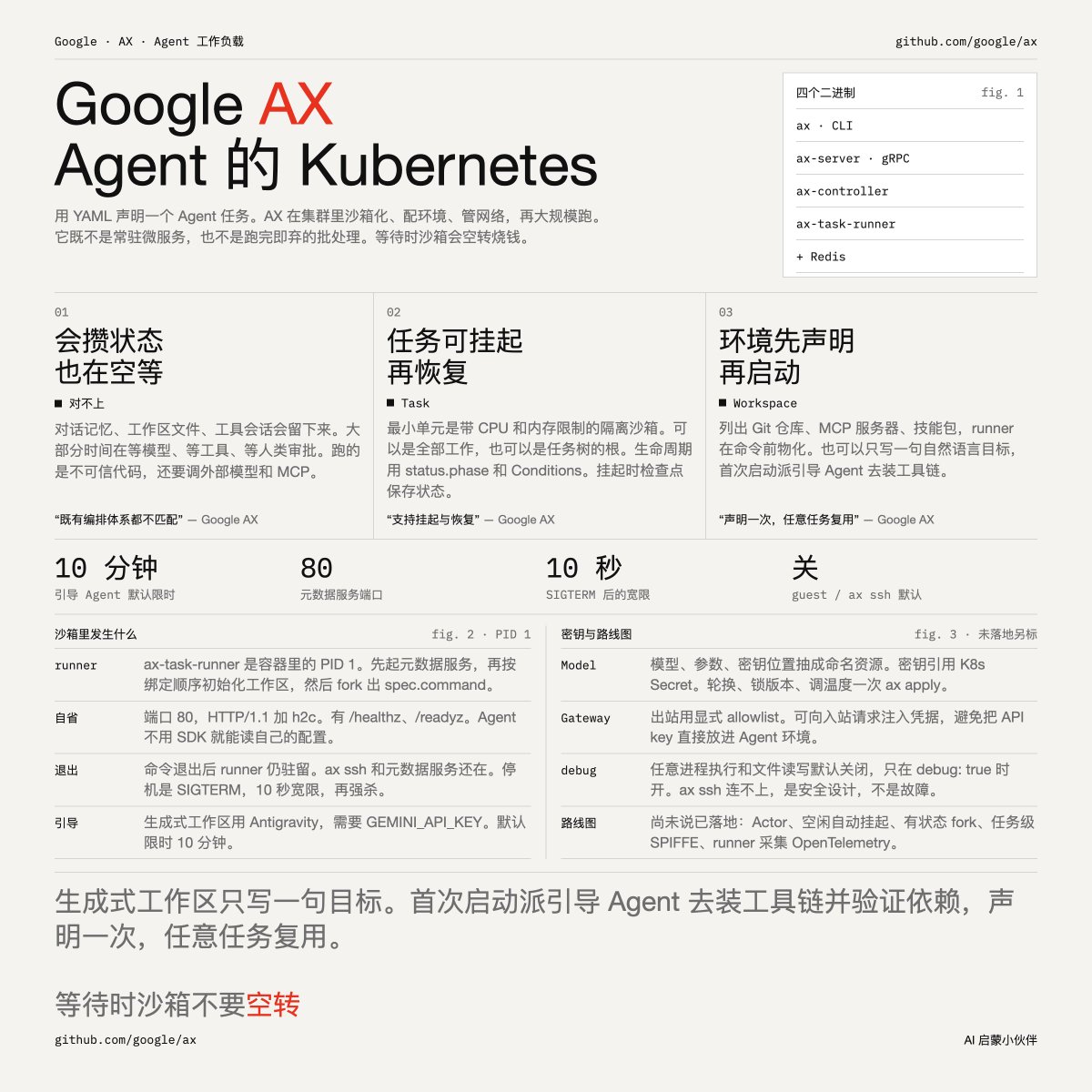
Google open-sourced AX, a declarative orchestration runtime for agent workloads. AX uses YAML to define tasks and handles sandboxing, networking, and scaling across clusters. It addresses agent-specific challenges like state accumulation, idle waiting, and untrusted code execution through a four-binary architecture with Redis.
Key insights
AX solves agent workload orchestration gaps
AX is designed for a new class of workloads that don't fit existing orchestration systems like Kubernetes. Agents are stateful (conversation memory, workspace files), idle during model responses or human approval, and run untrusted code requiring isolation. AX uses a declarative approach where users define tasks in YAML, and the system handles sandboxed execution, environment configuration, and network management at scale.
Core primitives: Task, Workspace, and Model
AX introduces three core primitives. Task is the minimum execution unit with CPU/memory limits and sandboxing, supporting suspend and resume. Workspace declares environment dependencies (Git repos, MCP servers, skill packages) and can be generative—accepting natural language goals to automatically set up toolchains. Model abstracts model selection, parameters, and API keys as named resources, referencing Kubernetes Secrets for key management.
Architecture: four binaries plus Redis
AX consists of four binaries: ax (developer CLI), ax-server (stateless gRPC API), ax-controller (reconciliation loop), and ax-task-runner (PID 1 inside each task container). Each task container runs ax-task-runner as PID 1, which starts a metadata service, initializes workspaces, forks the command, and monitors it. The runner persists after command exit to allow debugging via ax ssh. Shutdown follows SIGTERM with a 10-second grace period before force kill.
Security and safety features in AX
AX includes several security gates. The guest service (allowing arbitrary process execution and file read/write) is disabled by default and only enabled with debug: true. The Gateway uses an explicit allowlist for outbound traffic and can inject credentials into inbound requests, avoiding exposure of API keys to agent environments. This design intentionally prevents ax ssh from connecting to non-debug tasks.
AX roadmap includes actor model and auto-suspend
The project's roadmap outlines five major directions: deeper actor architecture, automatic idle detection and suspension, stateful task forking, task-level SPIFFE identities for zero-trust mTLS, and automatic OpenTelemetry telemetry and structured agent trace collection at the runner layer.