
Google Paper: Continued Learning After Training and Nested Memory
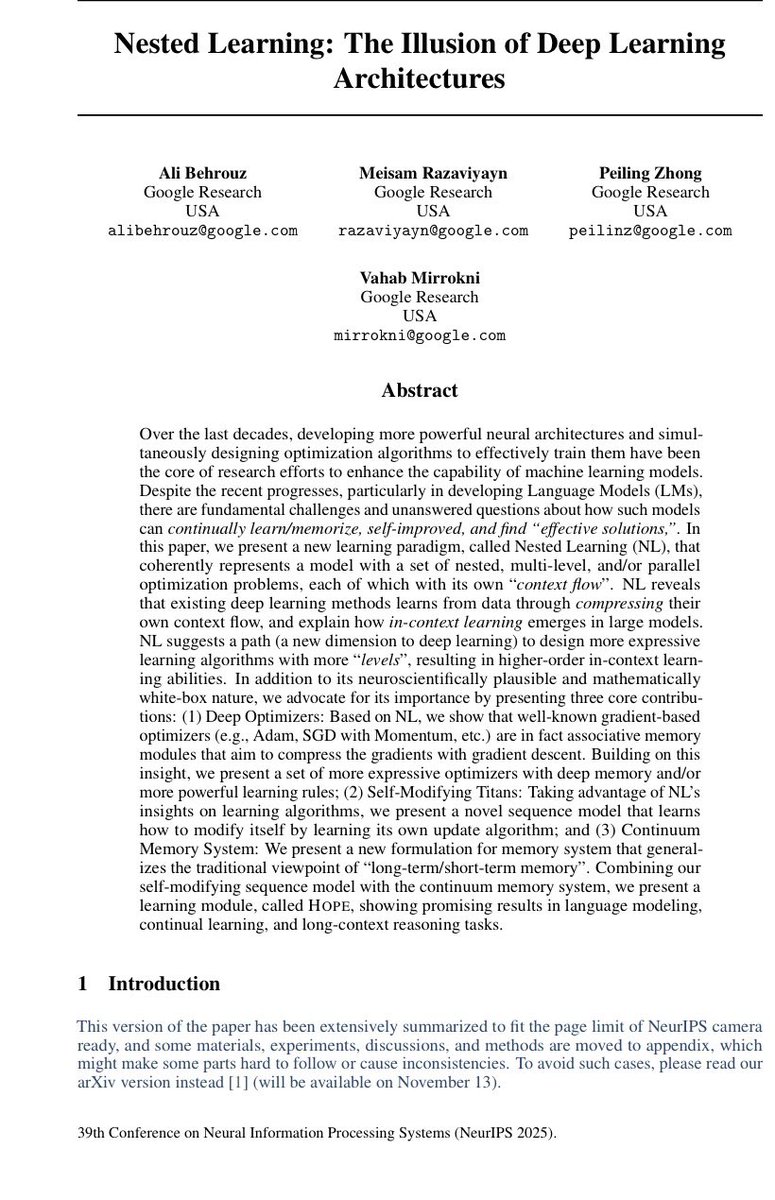
Google Research addresses the issue of large language models (LLMs) being unable to continue learning after training and proposes solutions, advocating for an expansion of memory from a binary 'fast/slow' model to a continuous spectrum of time and updates (nested learning). The paper highlights a common problem in existing models known as 'digital amnesia,' where they cannot systematically and persistently integrate new information into long-term memory. It introduces the concept of 'nested learning,' which establishes a continuous spectrum of memory between fast and slow memory (different time scales of memory levels). The paper argues that changing the training paradigm should consider not only scale but also time and update frequency. Both authors and commentators believe that if effective, this could transform the way AI continuously improves during use.
Key insights
Identifying the Problem: Inability to Continue Learning After Training
The Google paper points out that current LLMs can access the current conversation and pre-training data but cannot systematically and persistently integrate new information into long-term memory. Researchers refer to this issue as 'digital amnesia' and see it as a key obstacle to the continuous improvement of AI during use.
Proposed Solution: Memory Spectrum of Nested Learning
The paper proposes the 'nested learning' solution, which builds a continuous memory spectrum (fast—medium—slow across multiple time scales) to replace the binary short-term/long-term memory model. This allows the model to learn and solidify information at different frequencies, similar to the gradient curve of human memory.
New Dimension in Methodology: Considering Time Scale
The paper emphasizes that AI design should regard time and update frequency as equally important dimensions as scale. This means that models should not only be larger and deeper but also possess mechanisms to continuously absorb and stabilize new information at varying speeds.