
Google TPUv7 Competes with NVIDIA (AI Chip and Computing Power Landscape)
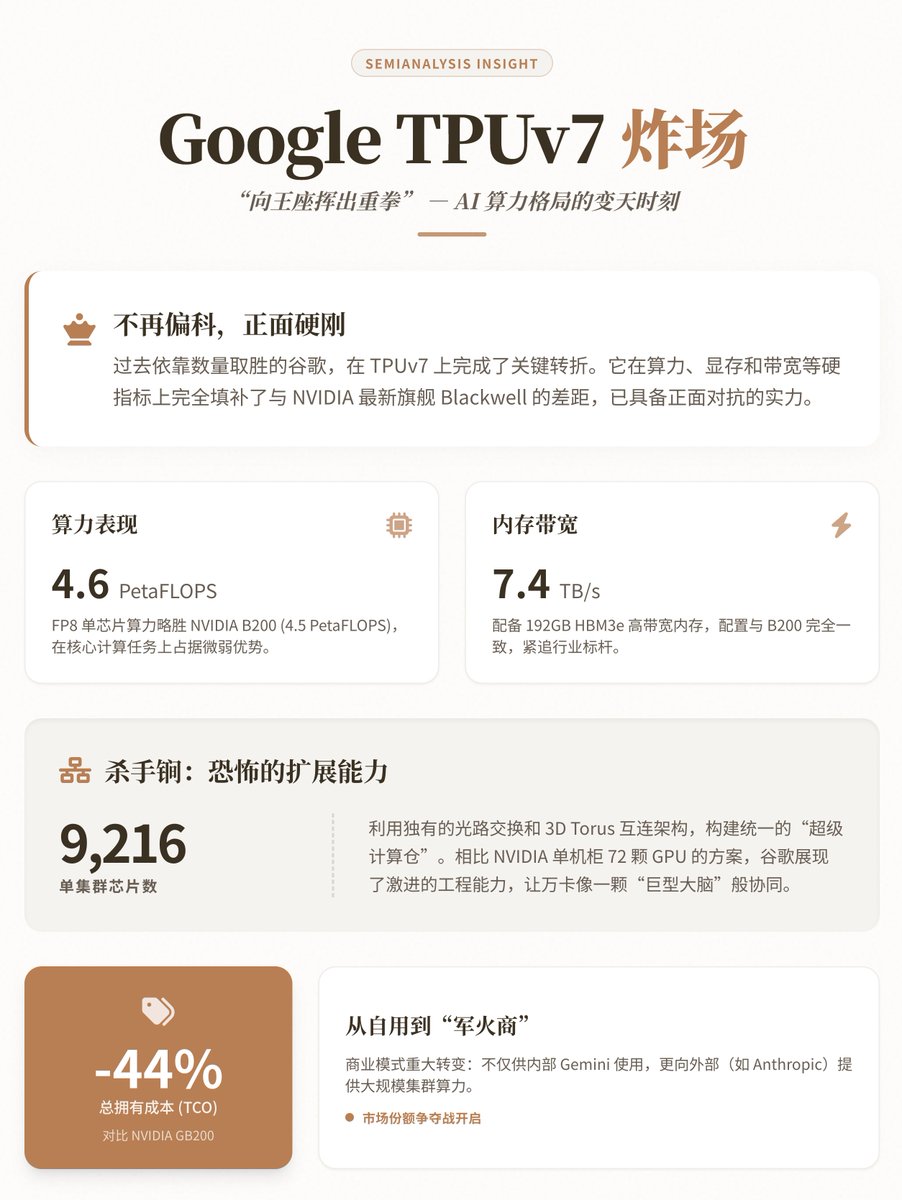
According to a report by SemiAnalysis, the TPUv7 (Ironwood) has reached a comparable level to NVIDIA's Blackwell series in hard metrics and has advantages in cluster scalability and cost. • The TPUv7 single-chip FP8 computing power is approximately 4.6 PetaFLOPS, slightly higher than NVIDIA's B200 at 4.5 PFLOPS. • The TPUv7 is equipped with 192GB HBM3e, with a memory bandwidth of 7.4 TB/s. • Google utilizes optical switching and a 3D Torus interconnect to connect 9,216 chips into a massive cluster. • The estimated total cost of ownership (TCO) is about 44% lower than NVIDIA's solutions. • Google is transitioning from 'in-house' to providing computing power externally, with major clients like Anthropic already committing to using TPU clusters. • Community voices suggest that the moat between TPU and GPU is influenced by engineering implementation, where a skilled engineer can significantly impact efficiency.
Key insights
TPUv7 Matches or Slightly Exceeds NVIDIA in Single-Chip Hard Metrics
Analysis indicates that the TPUv7's single-chip FP8 computing power is approximately 4.6 PFLOPS, equipped with 192GB HBM3e and achieving 7.4 TB/s bandwidth, placing its hard metrics on par with NVIDIA's B200. This performance directly competes with common tasks in training and inference, indicating significant progress in Google's chip design.
Google's Unique Engineering Advantage in Large-Scale Interconnect and Cluster Scalability
The key competitive edge of TPUv7 lies in its scalability: Google can build a unified supercluster of 9,216 chips through optical switching and 3D Torus interconnect design, reducing communication bottlenecks and making it suitable for training trillion-parameter models. Compared to NVIDIA's cabinet-based connections, Google's cluster engineering path is different and offers scalability advantages.
Cost and Commercialization Shift May Alter Market Structure
SemiAnalysis estimates that based on Google's vertical integration, the total cost of ownership for the TPUv7 system is approximately 44% lower than NVIDIA's servers. Google is transitioning from internal use to providing computing power externally, attracting major clients including Anthropic, which suggests that the market competition landscape may shift from a 'single supplier' to a more intense duel or multi-party competition.
Community Perspective: Moat Depends More on System Engineering Capability
The engineering community points out that the gap between TPU and GPU is not insurmountable; improvements in efficiency and kernel/system engineering talent can significantly change operational efficiency. Therefore, relying solely on hardware is not an absolute moat, as skilled engineers can optimize different hardware platforms for efficient operation.