
GPT-6 Astra Performance and Deployment
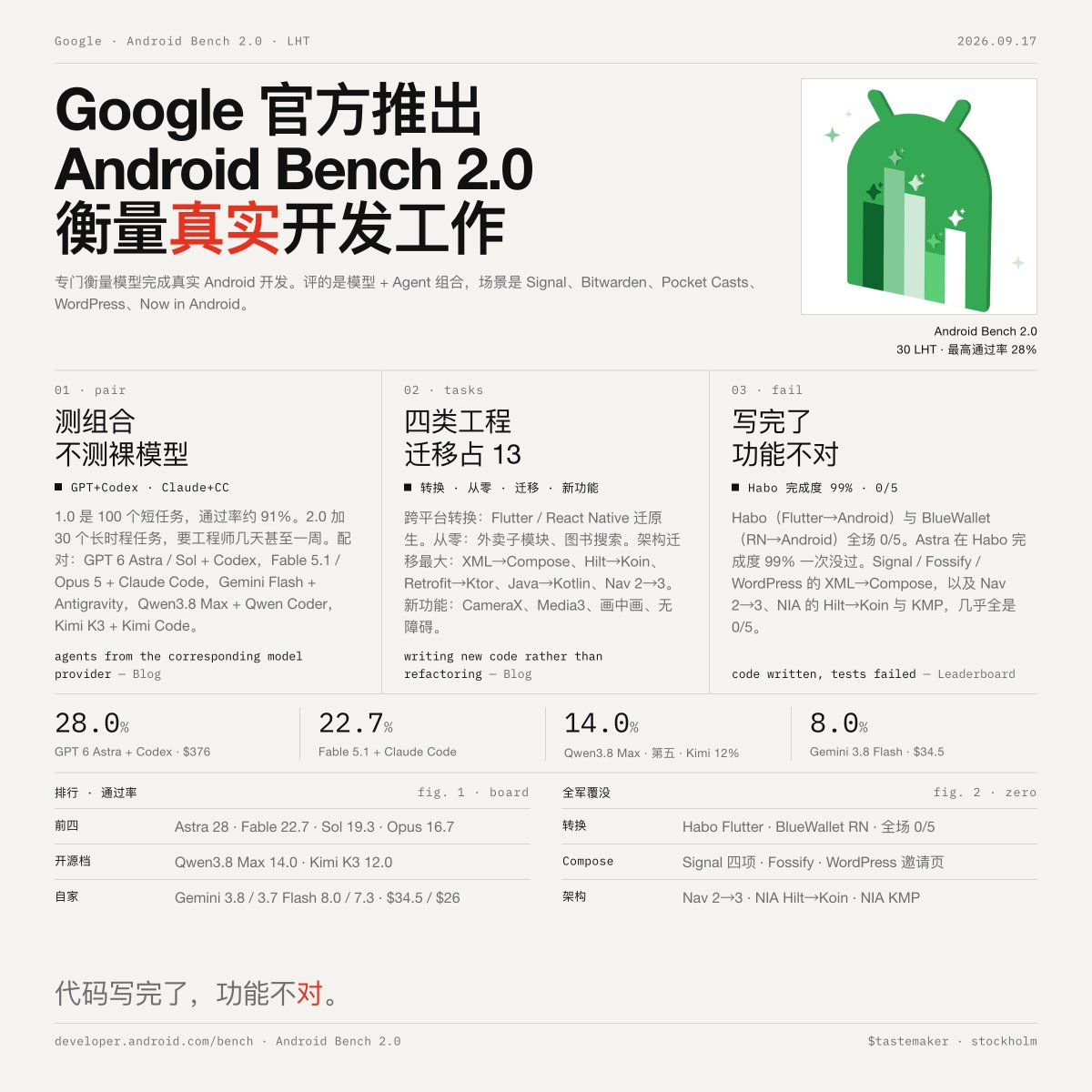
Databricks deployed GPT-6 Astra to 3,500 engineers, observing a 60% increase in coding spend. The model's gains are concentrated on complex tasks, with no perceptible improvement on simple ones. In Android Bench 2.0, GPT-6 Astra with Codex ranked top, but all models failed on cross-platform migration tasks.
Key insights
Databricks Deployment Observations
Databricks co-founder @pwendell shared five key observations from full deployment of GPT-6 Astra. The model clearly outperforms previous flagships (Opus 5, Sol 5.6) on high-complexity tasks like system design and long-horizon tasks, but shows no perceptible improvement on medium-to-low complexity tasks, attributed to saturation. Overall coding spend rose 60%, interpreted as increased usage due to better model quality.
Android Bench 2.0 Results
Google released Android Bench 2.0, testing model+agent combinations on real Android development tasks. GPT-6 Astra + Codex and Claude Fable 5.1 + Claude Code took the top two spots. The benchmark includes 30 tasks covering app conversion, build from scratch, architecture migration, and new feature development. All models scored 0/5 on cross-platform conversion tasks (Flutter→Android, React Native→Android) and most XML→Compose migrations.
Autonomous Robotics Task
A user gave GPT-6 Astra a single prompt to train a dexterous hand to perform a pen spinning task using Isaac RL and Sharpa hand. The model autonomously ran for 1.5 days, including training a policy and producing a visualization video, demonstrating end-to-end autonomous research capability.
Cost Management and Budget Routing
Databricks implemented a budget mechanism to guide model selection: a separate sub-budget for Astra encourages engineers to use it for complex tasks and cheaper models for routine work. The budget is a pricing and incentive tool, not a hard cap, and can be adjusted via review. This approach turns model routing into a resource allocation problem.
Data Compliance as Adoption Barrier
Databricks could not compare Astra with Fable 5.1 because Fable's data retention policies did not meet their requirements. This highlights that data compliance is often the first hurdle for enterprise model selection, ahead of capability.
Gateway and Queue-Based Rollout
Databricks used a Unity Gateway as an internal LLM gateway to conduct queue-based experiments. A 200-person pilot gathered quality and cost signals before expanding to 3,500 engineers. This demonstrates a governance paradigm where new models are introduced experimentally like feature flags.