
GPT-6 Astra Usage Best Practices and Tips
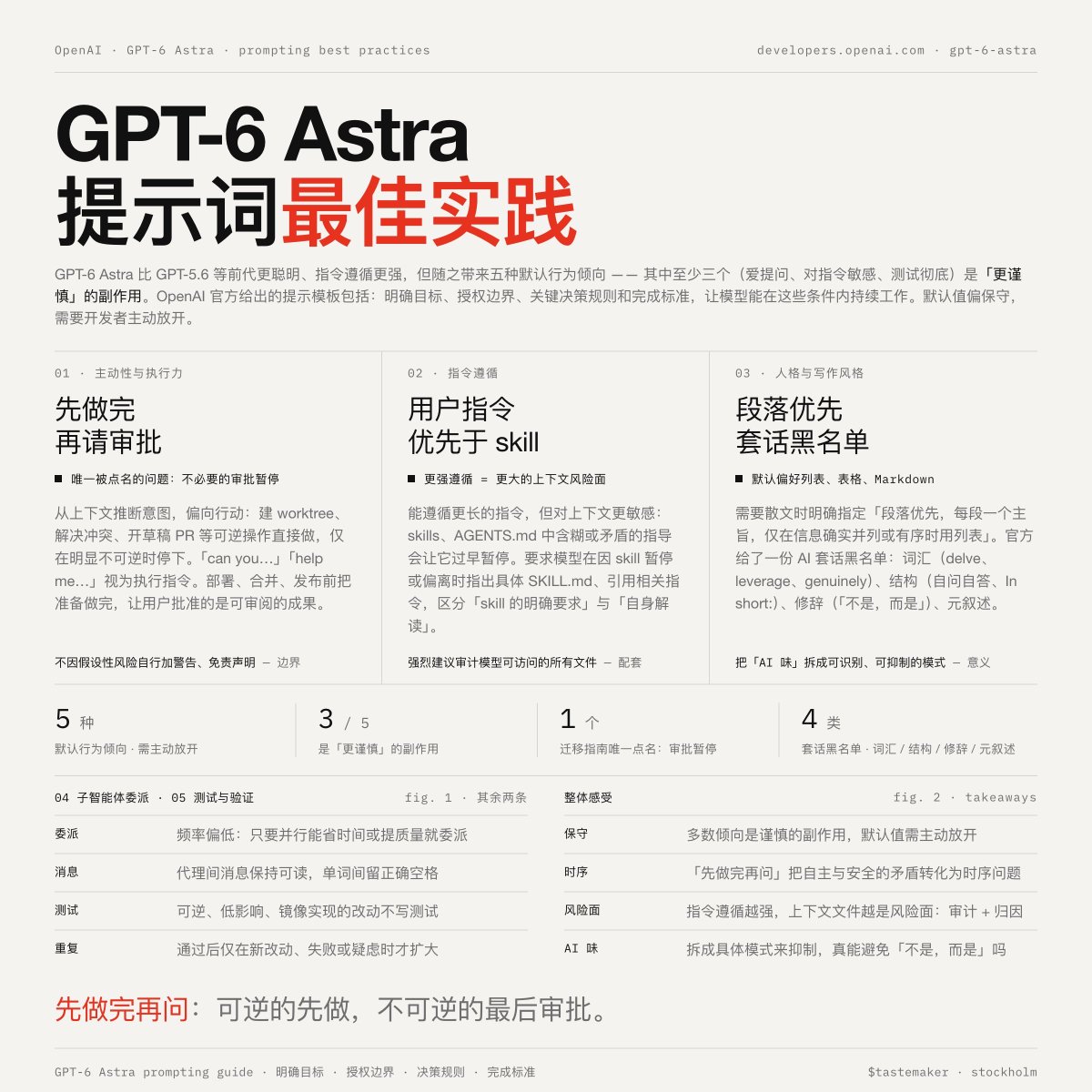
OpenAI released best practices for prompting GPT‑6 Astra, addressing five default behavior tendencies. The model is smarter and more instruction‑following than predecessors, but these tendencies can stall productivity. - Proactivity: Astra asks for permission instead of acting. Best practice: infer intent, perform reversible actions immediately (worktree, draft PR), only halt for destructive steps; treat "can you…" as a command. - Instruction following: More context‑sensitive; ambiguous or contradictory instructions in skills files can cause premature pauses. Best practice: declare user instructions override skills, require model to cite the specific SKILL.md file when pausing, audit all accessible files. - Writing style: Defaults to lists, tables, Markdown, and reuses fixed phrases across sessions. Best practice: specify paragraphs first, limit lists to truly parallel information; calibrate technical density to user background; suppress an anti‑AI blacklist of words/patterns (delve, leverage, genuinely, it’s worth noting, self‑Q&A, "In short:", contrast frameworks, meta‑narration). - Sub‑agent delegation: Delegates less than optimal. Best practice: explicitly prompt to delegate whenever parallel execution saves time or improves quality, for root or child agents; ensure inter‑agent messages remain readable with correct spacing. - Testing and verification: Tests too thoroughly on small tasks. Best practice: skip tests for reversible, low‑impact changes; run checks proportional to the change; expand only on failures or unresolved doubts. Overall, three of five tendencies stem from a "more cautious" design, and the core methodology is "act first, ask later" for reversible operations.
Key insights
Proactive execution: default caution must be overridden for autonomy
GPT‑6 Astra proactivity is muted: it pauses to ask for permission even when extra information won't change the outcome. The official guidance tells developers to treat open‑ended requests as execution commands, perform all reversible prep work without asking, and only solicit approval before irreversible merges or deployments. This turns the timing of the approval request, not the fact of it, into the safety control.
Instruction sensitivity makes context files a risk surface
Astra’s improved ability to follow long instructions also means it is more sensitive to ambiguous or conflicting guidance in skills files and AGENTS.md. The best practices require explicitly stating that user instructions override skills, and forcing the model to point to the exact SKILL.md rule when it pauses. OpenAI recommends auditing every file the model can see as a step in prompt design.
Writing style blacklist systematically attacks 'AI flavor'
OpenAI identified that GPT‑6 Astra overuses lists, tables, Markdown, and a set of recurrent filler phrases across sessions. The published remediation includes a concrete blacklist: words like delve, leverage, genuinely, it’s worth noting; structures such as self‑Q&A, "In short:" summaries, "not… but…" contrast frameworks; and meta‑commentary about what the AI will not do. This approach reframes stylistic AI detection as a pattern‑suppression task.
Sub‑agent delegation lags unless explicitly encouraged
By default, Astra delegates to sub‑agents less often than efficient workflows require. The best practice is to inject a direct instruction to delegate whenever parallel work can save time or improve quality, regardless of whether the calling agent is root or a child. Inter‑agent message formatting is also highlighted because messages can suffer from missing spaces and typos.
Testing thoroughness overshoots for small, safe tasks
Astra tends to test every code change exhaustively, extending scope beyond what is necessary. The official guidance says to skip tests for reversible, mirror‑only changes and to run checks proportional to the change. Expanding testing is advised only when a new failure appears or doubts remain unresolved, preventing costly over‑verification.