
Grok Bot Template Market Launch
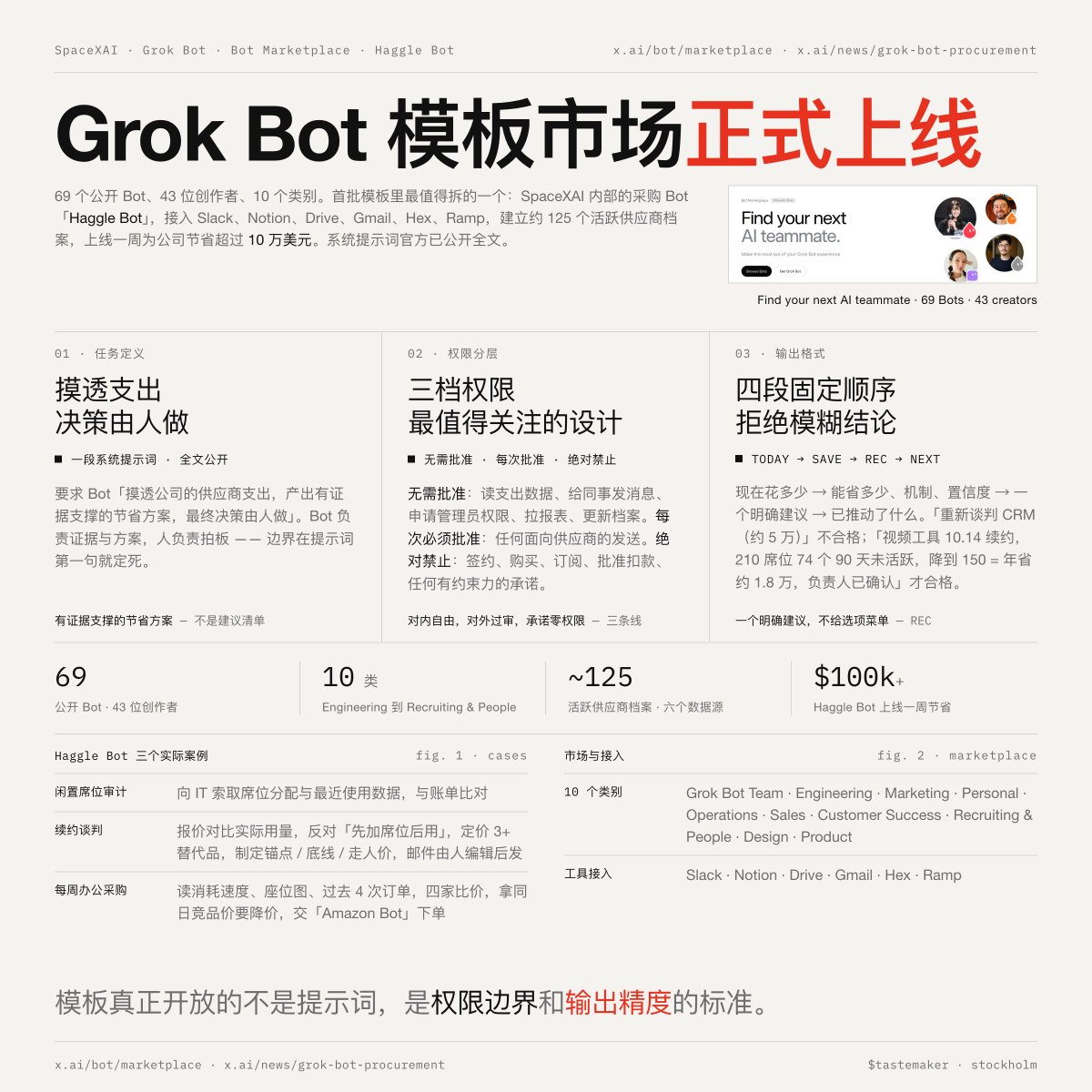
Grok Bot launched a template market with 69 public bots, 43 creators, and 10 categories including Engineering, Marketing, Sales, and more. The standout template, Haggle Bot, an internal procurement bot, saved over $100,000 in its first week. Haggle Bot uses Slack, Notion, Drive, Gmail, Hex, and Ramp to build supplier profiles and analyze spending. It operates with layered permissions: no approval for reading data or messaging colleagues, approval required for supplier-facing sends, and absolute prohibition on signing contracts or making purchases. Its output follows a TODAY-SAVE-REC-NEXT format, demanding precise, evidence-backed recommendations. Three case studies demonstrated SaaS idle seat audits, renewal negotiations, and weekly office supply price comparisons across vendors, with automated negotiation emails. The market aims to accelerate enterprise AI adoption through pre-built, specialized bots.
Key insights
Template Market Enables Rapid Deployment of Specialized Enterprise Bots
The Grok Bot template market offers 69 bots across 10 functional categories, created by 43 contributors. This marketplace model allows organizations to quickly deploy AI assistants tailored to specific business functions without building from scratch, lowering the barrier to enterprise AI adoption.
Haggle Bot Demonstrates Significant Procurement Cost Savings
The Haggle Bot template saved over $100,000 in one week by auditing SaaS seat utilization, negotiating renewal terms based on actual usage, and optimizing office supply purchasing through multi-vendor price comparisons. It autonomously drafts negotiation emails and prepares evidence-backed recommendations, with human approval required only for supplier-facing communications.
Granular Permission Design Ensures Safe Autonomous Operation
Haggle Bot's three-tier permission system—no approval for internal data access, mandatory approval for external sends, and absolute prohibition on binding commitments—provides a blueprint for balancing autonomy with control in enterprise AI agents. This design prevents unauthorized financial commitments while allowing proactive cost-saving actions.