
Hugging Face releases tokenizers v1 with major speedups
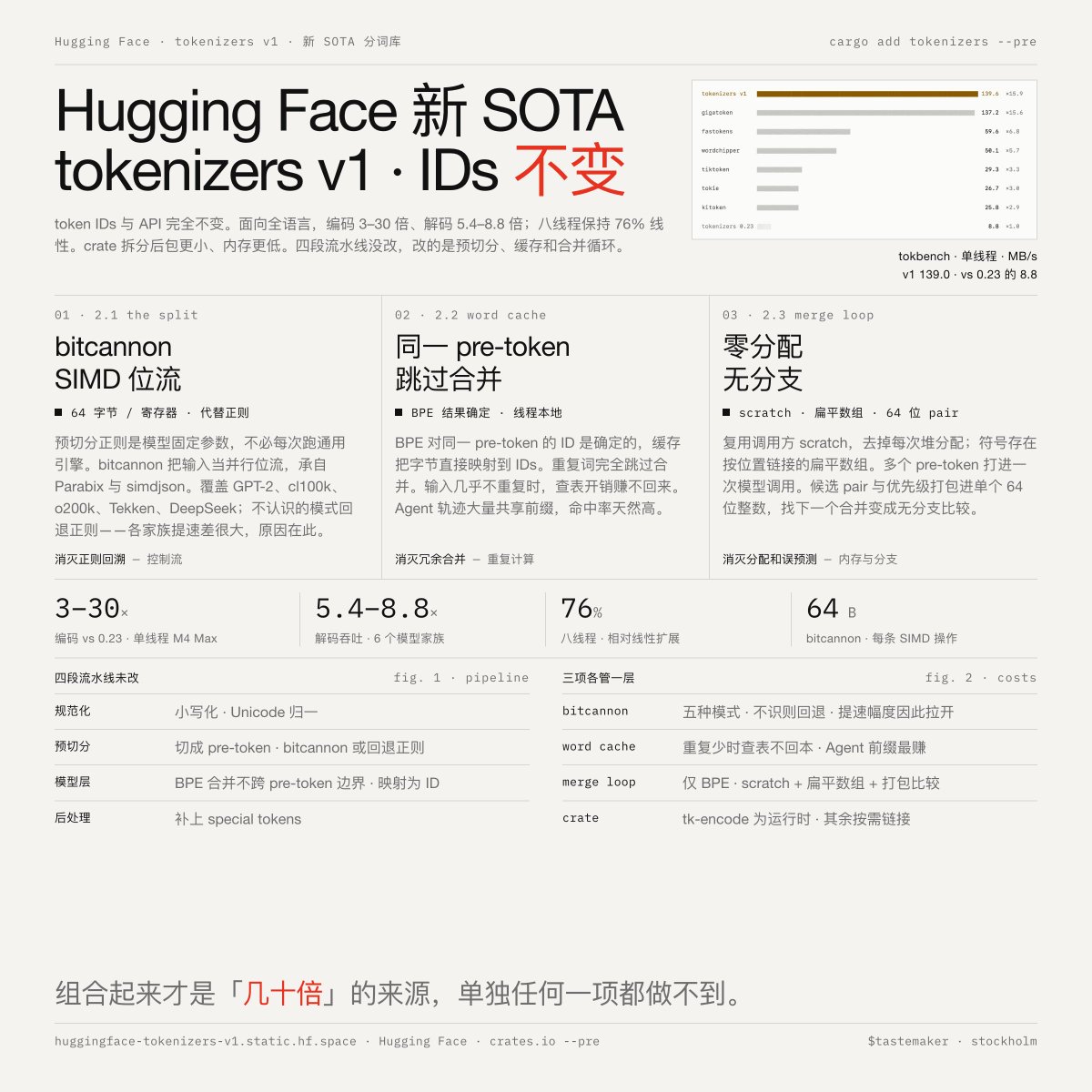
Hugging Face released tokenizers v1, a new tokenization library with unchanged token IDs and API. It delivers 3-30x encoding and 5.4-8.8x decoding speedups across languages via three core technologies: bitcannon SIMD-based pre-tokenization, word cache for repetitive inputs, and a zero-allocation merge loop.
Key insights
Bitcannon: SIMD replaces regex engine
The pre-tokenization regex is a fixed model parameter, so tokenizers v1 uses bitcannon, which treats input bytes as parallel bit streams and processes 64 bytes per SIMD register operation. This covers GPT-2, cl100k, o200k, Tekken, and DeepSeek splitting patterns, with automatic fallback to regex for unrecognized patterns, explaining varying speedups across model families.
Word cache leverages BPE determinism
BPE produces deterministic results for identical pre-tokens, so tokenizers v1 uses a thread-local cache mapping pre-token bytes to token IDs. Repeated words skip merge computation entirely. This is particularly effective for agent scenarios where many requests share common prefixes, yielding high cache hit rates.
Merge loop achieves zero allocation and branchless operation
The merge loop combines four techniques: reusing caller-provided scratch buffers to eliminate heap allocations, storing symbols in flat position-linked arrays instead of linked lists, batch processing multiple pre-tokens in one model call, and packing each candidate pair with merge priority into a single 64-bit integer for branchless comparisons.
Context: four-stage tokenization pipeline unchanged
tokenizers v1 does not alter the tokenization algorithm framework, maintaining the four-stage pipeline: normalization, pre-tokenization, model layer (BPE with highest-priority pair merging that never crosses pre-token boundaries), and post-processing with special tokens.