
Hugging Face Releases tokenizers v1 with Major Speedups
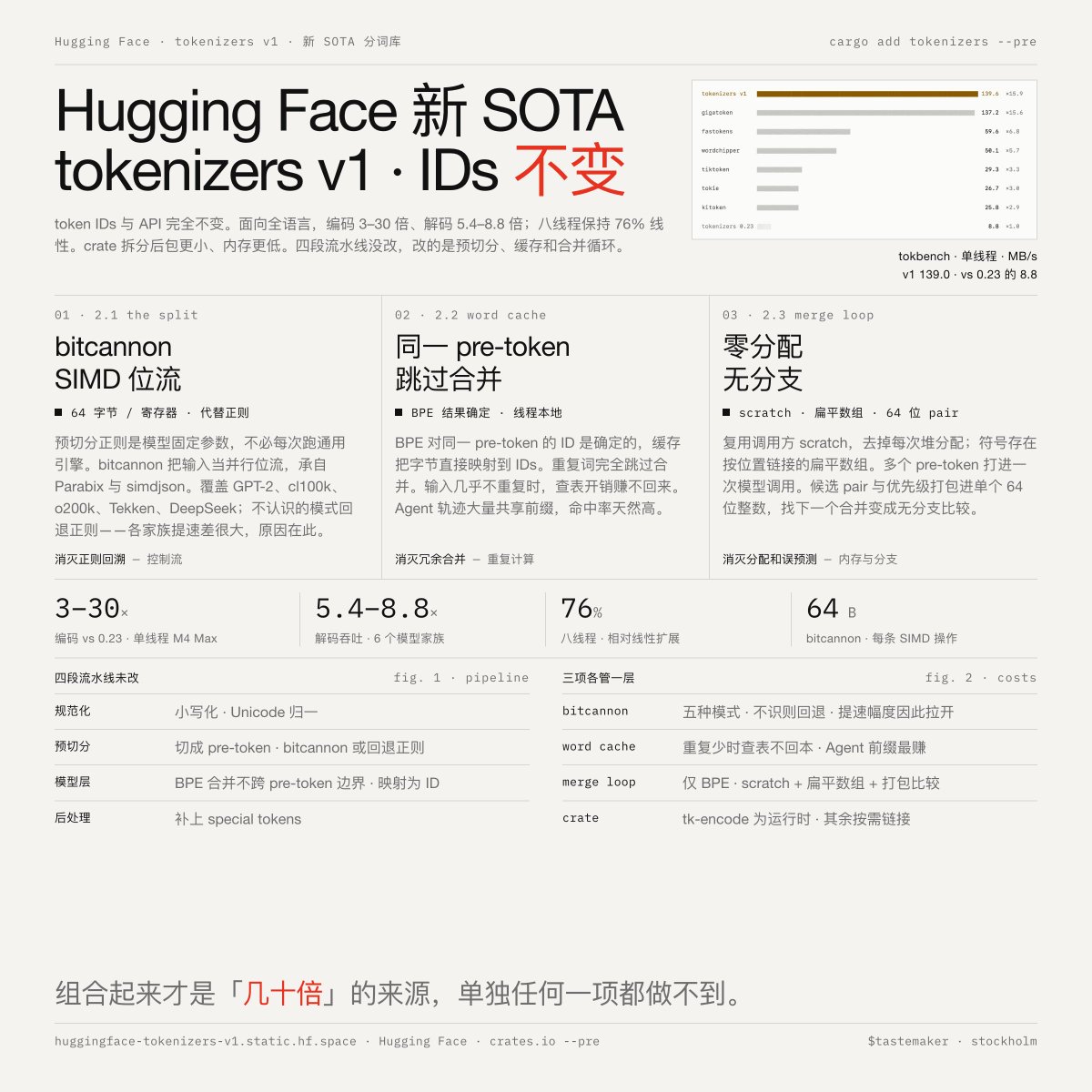
Hugging Face released tokenizers v1, a new tokenization library that speeds up encoding by 3-30x and decoding by 5.4-8.8x across all languages while keeping the API unchanged. The speed gains come from three core techniques: SIMD-based bitcannon, word cache for repeated tokens, and a zero-allocation merge loop.
Key insights
Bitcannon Replaces Regex with SIMD Bit Streams
The bitcannon technique treats input bytes as parallel bit streams processed via SIMD registers, eliminating the need for a general-purpose regex engine during pre-tokenization. It covers five tokenization modes (GPT-2, cl100k, o200k, Tekken, DeepSeek) and falls back to regex for unrecognized patterns, explaining the varying speedup across model families.
Word Cache Eliminates Redundant BPE Merges
A thread-local word cache maps pre-token bytes to token IDs, skipping merge computations for repeated words. This is especially effective in agent scenarios where many requests share common prefixes, leading to high cache hit rates. The overhead of cache lookup is only justified when repetition is frequent.
Merge Loop Achieves Zero Allocation and Branchless Execution
The merge loop optimization combines four techniques: reusing caller-provided scratch buffers, storing symbols in flat arrays linked by position, batching multiple pre-tokens into a single model call, and packing each candidate pair with its merge priority into a 64-bit integer. This eliminates heap allocations, linked list overhead, and branch mispredictions.
Three Techniques Target Different Bottlenecks
The three core techniques address distinct cost layers: bitcannon eliminates regex backtracking (control flow), word cache removes redundant merges (repeated computation), and the merge loop cuts allocation and branch prediction failures (memory and branching). The combined effect yields the reported 3-30x speedups; no single technique achieves that alone.