
Hugging Face tokenizers v1 release boosts encoding speed
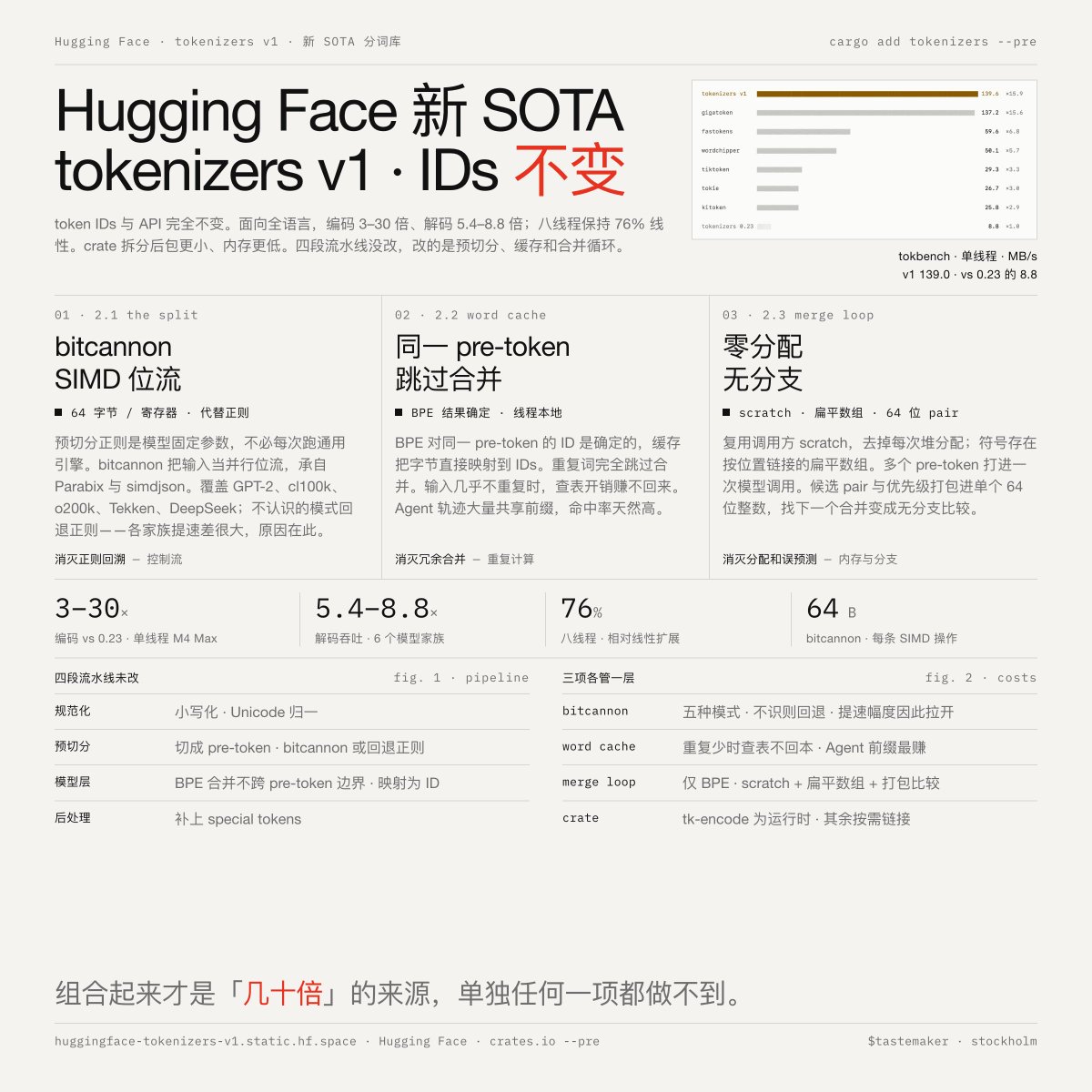
Hugging Face released tokenizers v1, an open-source library that speeds encoding by 3–30x and decoding by 5.4–8.8x across all languages with no API changes. It uses SIMD bitstream pre-tokenization, thread-local word cache, and zero-allocation merge loops.
Key insights
Performance gains across all languages without API changes
Tokenizers v1 accelerates encoding by 3–30x and decoding by 5.4–8.8x for all languages while maintaining full backward compatibility in token IDs and API. The improvements are achieved through hardware-aware optimizations rather than algorithmic changes to the four-stage pipeline.
bitcannon: SIMD bitstream replaces regex engine
The bitcannon technique treats input bytes as parallel bitstreams processed via SIMD registers, handling 64 bytes per operation. It covers five split modes (GPT-2, cl100k, o200k, Tekken, DeepSeek) and falls back to regex for unknown patterns, explaining speed variation across tokenizer families.
Word cache eliminates redundant BPE merging
A thread-local cache maps pre-token bytes to token IDs, leveraging the deterministic nature of BPE. Repeated words skip merge computations entirely. The cache is especially effective for agent scenarios where many requests share common prefixes, boosting hit rates.
Merge loop achieves zero allocation and branchless execution
The merge loop uses four techniques: caller-provided scratch buffers, linked flat arrays, batched model calls, and packing candidate pairs with priority into 64-bit integers for branchless comparison. This eliminates heap allocations, reduces memory overhead, and avoids branch mispredictions.
Combined optimizations target three cost layers
Each technique addresses a different cost layer: bitcannon eliminates control flow (regex backtracking), word cache removes redundant computation, and merge loop eliminates allocation and branch prediction failures. The combined effect yields the reported 3–30x speedup; no single technique achieves that alone.