
HuggingFace releases tokenizers v1 with significant speed improvements
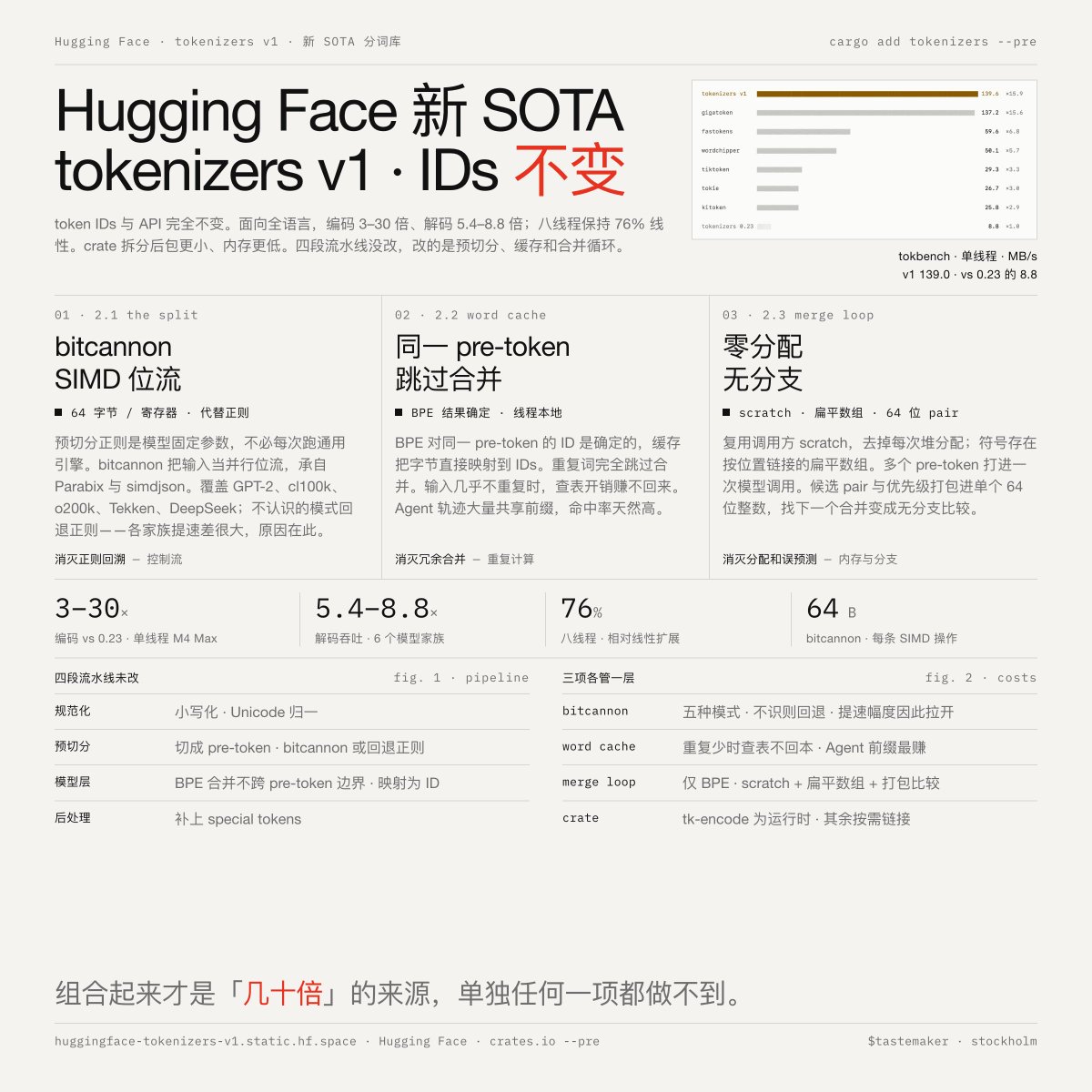
HuggingFace released tokenizers v1, a major update to its tokenization library. It achieves 3-30x encoding speedup and 5.4-8.8x decoding speedup using SIMD-based splitting, word caching, and zero-allocation merging. Memory usage drops 2.8x and the library is backward compatible with the same token IDs and API.
Key insights
Three core technologies drive performance gains
Tokenizers v1 uses three key optimizations. Bitcannon replaces regex with SIMD bitstream processing for pre-tokenization, handling five split modes (GPT-2, cl100k, o200k, Tekken, DeepSeek) and falling back to regex for unknown modes. Word cache caches BPE merge results per pre-token in thread-local storage, benefiting agent traces with high prefix reuse. Merge loop achieves zero allocation and branchless merging by packing priority into a single 64-bit integer and reusing scratch buffers.
Performance measurements across languages
In single-threaded tests, tokenizers v1 is 3-30x faster than the previous 0.23 version. For a 512-byte English document, latency dropped from 110 microseconds to 7 microseconds. Chinese throughput improved 6.8x, while Hindi and Amharic saw more than 10x improvement. Decoding speed improved 5.4-8.8x. Memory usage was reduced by 2.8x.
Backward compatibility and reduced package size
Tokenizers v1 maintains complete backward compatibility with the same token IDs and API as version 0.23. The library is written in Rust with Python and Node.js bindings. Inference and training modules are split into separate crates, reducing installation size when only inference is needed. It runs on x86 CPUs from 2008 onwards and includes specific optimizations for Apple ARM chips.
Word cache benefits agent and long-context scenarios
The word cache optimization is particularly effective for agent workloads where many requests share the same prefix. In these scenarios, cache hit rates are naturally high, reducing redundant merge computations. The cost is negligible when input repetition is low, as the lookup overhead is minimal compared to the BPE merge step.