
Image editing with multi-reference identity control
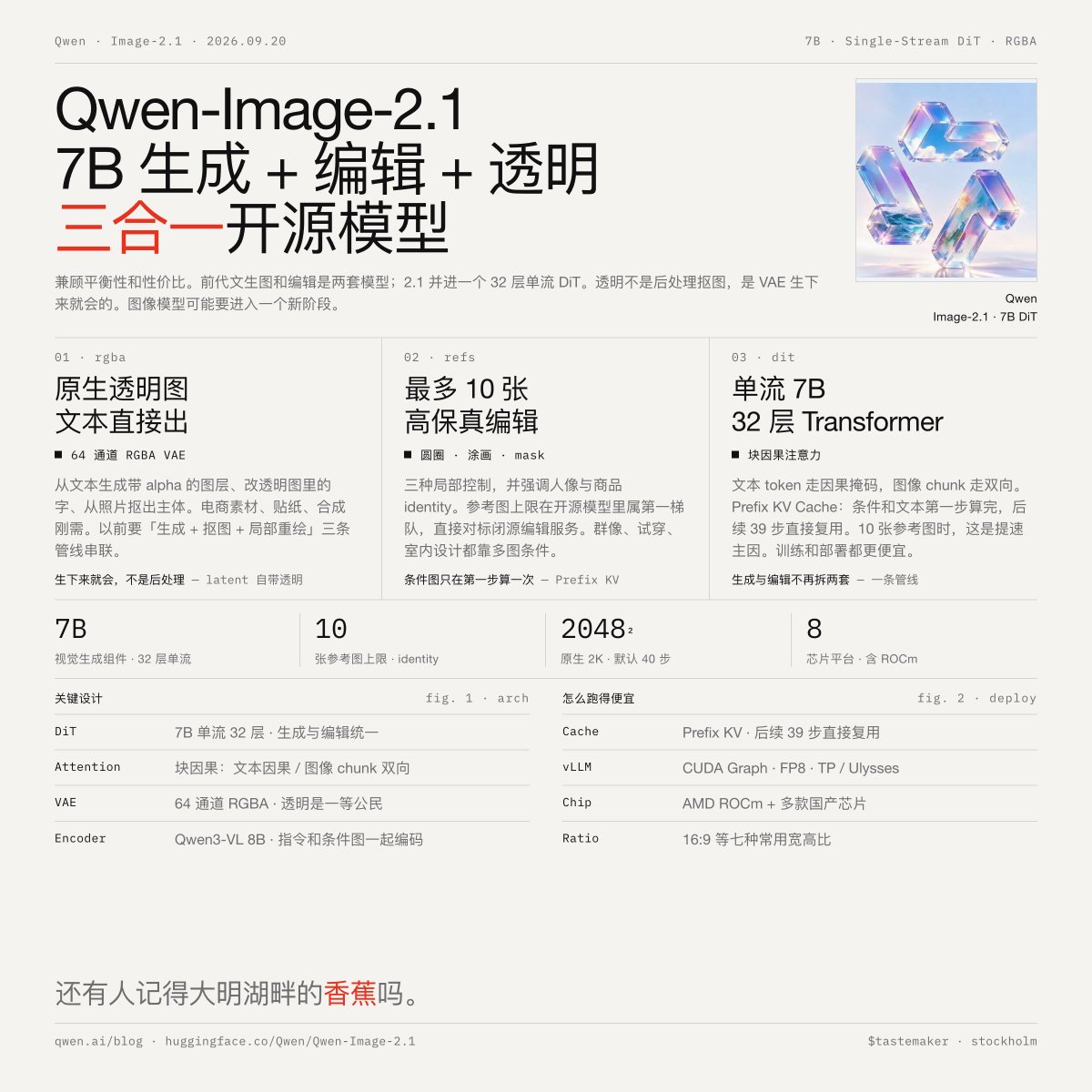
Qwen-Image-2.1 is a 7B parameter open-source model combining image generation, editing, and native transparent channel support. It handles up to 10 reference images for high-fidelity identity-preserving editing, uses a 64-channel RGBA autoencoder for native transparency, and offers vLLM deployment with CUDA Graph, FP8 quantization, and multi-chip support including AMD ROCm.
Key insights
Native RGBA transparency generation
Qwen-Image-2.1 generates RGBA layers directly from text with alpha channels, edits text within transparent images, and extracts subjects from photos. The 64-channel autoencoder carries transparency natively in latent space, not as post-processing, replacing multi-model pipelines previously needed for e-commerce materials, sticker design, and compositing workflows.
Up to 10 reference images with identity control
The model supports high-fidelity editing with up to 10 reference images - the highest tier among open-source models. Three local control methods include circle annotation, scribble marking, and independent masks. Identity preservation for portraits and products directly competes with closed-source editing services like GPT-Image series.
Single-stream DiT unifies generation and editing
Qwen-Image-2.1 consolidates previously separate text-to-image and editing models into a single 32-layer Transformer. Block-causal attention applies causal masking to text tokens and bidirectional masking to image chunks. This unified architecture lowers training and deployment costs compared to the previous dual-model approach.
Prefix KV cache accelerates multi-image editing
Conditional images and text compute only once during the first denoising step, with subsequent 39 steps reusing cached values. This is the primary inference speedup for multi-reference editing scenarios. Deployment options include CUDA Graph, FP8 quantization, TP/Ulysses parallelism, and support for 8 chip platforms including AMD ROCm.
2K resolution with multiple aspect ratios
The model runs 40 default inference steps at native 2K resolution (2048x2048), supporting seven common aspect ratios including 16:9. Text rendering and portrait lighting are qualitative strengths continued from the Qwen-Image series, especially Chinese text rendering.