
In-Depth Analysis of Google's TPUv7 Against NVIDIA Blackwell
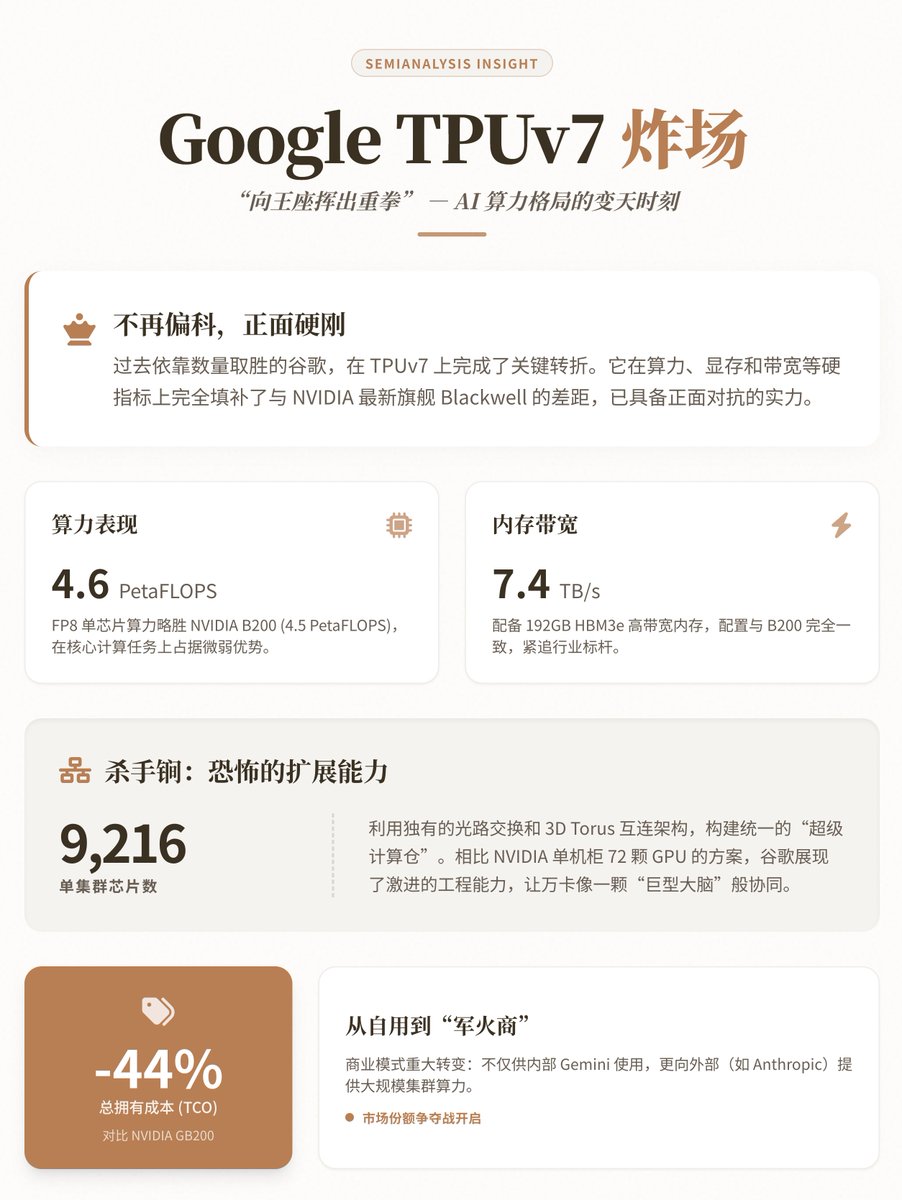
Google's TPUv7 (codename Ironwood) matches or surpasses NVIDIA Blackwell (B200) in performance, memory, and interconnect, while also offering significant advantages in scalability and cost.
Key insights
TPUv7 Single Chip Performance Matches or Slightly Exceeds Blackwell
The report lists TPUv7's single chip FP8 performance at approximately 4.6 PetaFLOPS, slightly higher than NVIDIA B200's 4.5 PetaFLOPS. TPUv7 is equipped with 192GB HBM3e, achieving a bandwidth of 7.4 TB/s, which is on par with B200. The article compares key hardware parameters and indicates that TPUv7 has reached the same level as Blackwell in terms of hard metrics for common training and inference computations.
TPUv7's Scalable Interconnect is Its Core Competitive Advantage
The article points out that TPUv7's greatest strength lies in its scalability: Google can connect up to 9,216 TPUv7 chips into a single supercluster using optical switching technology and a 3D Torus interconnect, significantly reducing communication bottlenecks when training trillion-parameter models. In comparison, NVIDIA's typical GB200 NVL72 system consists of 72 GPUs in a single machine, which, although capable of cross-rack expansion, differs from Google's approach to building a large-scale single cluster.
Google's Vertical Integration Provides Significant TCO Advantages
SemiAnalysis estimates that due to Google's control over chip design, data centers, cooling, and networking, the total cost of ownership for the TPUv7 system is approximately 44% lower than purchasing NVIDIA GB200 server solutions. This price attractiveness is significant for customers requiring large-scale computing power and may alter procurement choices.
Shift in Google's Business Model from Internal Use to External Sales
The article notes that TPUs were primarily used internally by Google in the past, with external customers renting through the cloud. Now, Google offers more flexible computing power services to external clients and has attracted customers like Anthropic, which has committed to purchasing and utilizing large-scale TPU clusters. This indicates that Google is beginning to compete with NVIDIA in the market as a 'computing power supplier.'
Challenges to NVIDIA's CUDA Moat from Engineering Capabilities and Open Source Ecosystem
Another user comment suggests that NVIDIA's CUDA moat is not as solid as it seems, as skilled engineers can surpass existing implementations through software (such as Triton) and system optimizations. Historically, many models have not been limited to training solely on GPUs, and Anthropic, along with other vendors, has long utilized TPUs, indicating that the differences in hardware efficiency are minimal, with the key factors being kernel and systems engineering talent.