
Intelligent Agents and Agents: Benchmarks, Practices, and Configuration Guide
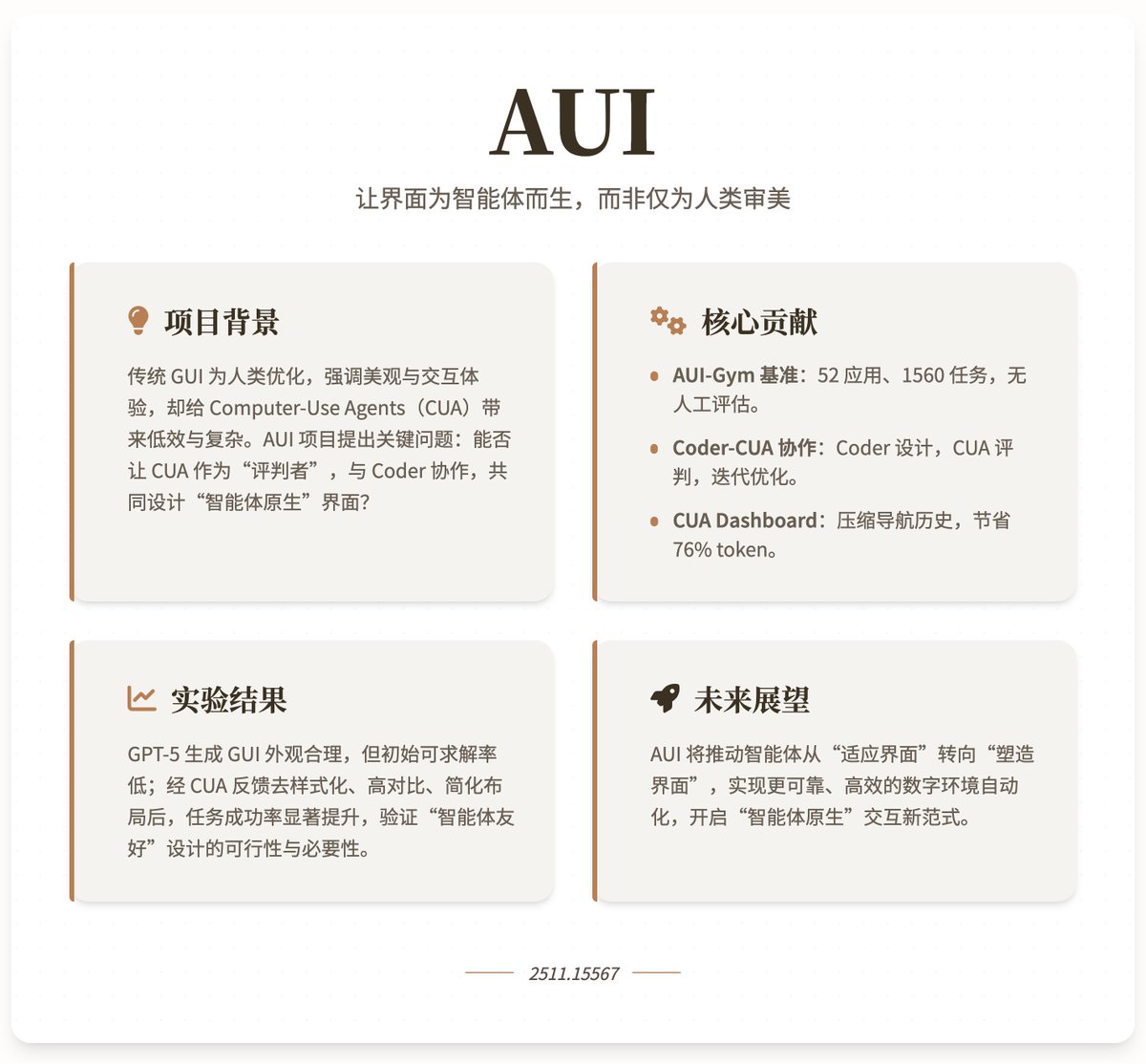
Multiple studies and tools focus on transitioning agents from prototypes to stable production. - The AUI project proposes the Coder-CUA collaboration framework and the AUI-Gym benchmark, aiming to optimize GUI design for agent-native interfaces, covering 52 applications and 1560 tasks, providing functionality integrity and CUA success rate metrics. - OpenAI releases a ChatGPT application development guide, proposing a framework of three core capabilities: 'Know/Do/Show' and application design principles, emphasizing capability enhancement rather than direct product transplantation. - agents.md summarizes over 2500 codebase experiences, presenting five key elements for successful agent configuration and six core domains. - System instruction templates for Gemini 3 Pro improve agent multi-step workflows by approximately 5%. - The open-source tutorial how-to-build-a-coding-agent and Acontext (an agent context data platform) provide practical building and long-term memory support, facilitating agents in extracting SOPs from interactions and reusing skills. - Related resources and book recommendations offer practical pathways for developers.
Key insights
AUI Shifts GUI Design from 'Human-First' to 'Agent-Native' Evaluation
The AUI project, proposed by Oxford, National University of Singapore, and Microsoft, aims to optimize GUI for agent (CUA) friendliness. The project includes the AUI-Gym benchmark library (52 applications, 1560 tasks, based on GPT-5 generated tasks and manually verified) and introduces the Coder-CUA collaboration framework: Coder as the designer generates interfaces, while CUA as the evaluator verifies task executability and provides navigational feedback. The project also offers a CUA Dashboard that compresses multi-step navigation history into a single image for debugging, with experiments showing that feedback from agents can significantly enhance the functionality integrity and task success rate of GUIs.
Building Excellent ChatGPT Applications Requires Focusing on the Three Core Capabilities: 'Know/Do/Show'
OpenAI's developer guide states that excellent ChatGPT applications must expand the model's 'Know' (access to real-time or proprietary data), 'Do' (empowering execution capabilities), and 'Show' (enhancing information presentation through GUI). The document provides specific design recommendations, including focusing on capabilities rather than transplanting entire products, dialogue-oriented design, privacy protection, and eco-friendly output structures, along with Apps SDK and operation name design to enhance the model's practical value and usability in dialogue scenarios.
agents.md Summarizes Practices: Defining Roles, Commands, and Boundaries is Key
Based on a summary of over 2500 codebases, successful agent configuration profiles (agents.md) should include six core domains: command preconditions, real code examples, clear boundaries, specific tech stacks, and coverage testing/project structures. Examples include usable commands, project knowledge, a three-tier boundary system, and several specialized agent types (docs-agent, test-agent, etc.), with a recommendation to iteratively improve from small tasks rather than building a generic assistant all at once.
System Instructions and Training Best Practices Can Significantly Improve Agent Multi-Step Workflow Reliability
A system instruction template for Gemini 3 Pro integrates post-training best practices, requiring the model to perform logical dependency analysis, risk assessment, causal reasoning, multi-source information integration, and persistence strategies before execution. Experiments show that this template brings about a 5% performance improvement across multiple agent benchmarks and has been collaborated on with the official post-training team and included in documentation.
Tools and Platform Implementation: Coding Agent Tutorial and Context Platform Acontext Support Long-Term Memory and SOP Extraction
The open-source project how-to-build-a-coding-agent provides six step-by-step examples from basic chatting to file reading, command execution, and code editing, suitable for understanding how coding agents work. Acontext (from memobase_io) is an agent context data platform that offers session persistence, task observation, self-learning mechanisms, and dashboards, capable of extracting SOPs from completed tasks and enhancing long-term performance, supporting multi-provider SDK integration to simplify context engineering.
Education and Reference Materials Facilitate Developers' Quick Familiarization with Agent Technology Stack
Community-recommended books (An Illustrated Guide to AI Agents), open-source tutorials, and tool collections provide diagrams, example code, and practical guides for developers looking to build agents, facilitating the integration of research findings with engineering implementations.