
Jev: Decision-Focused AI from ChatGPT Co-inventor
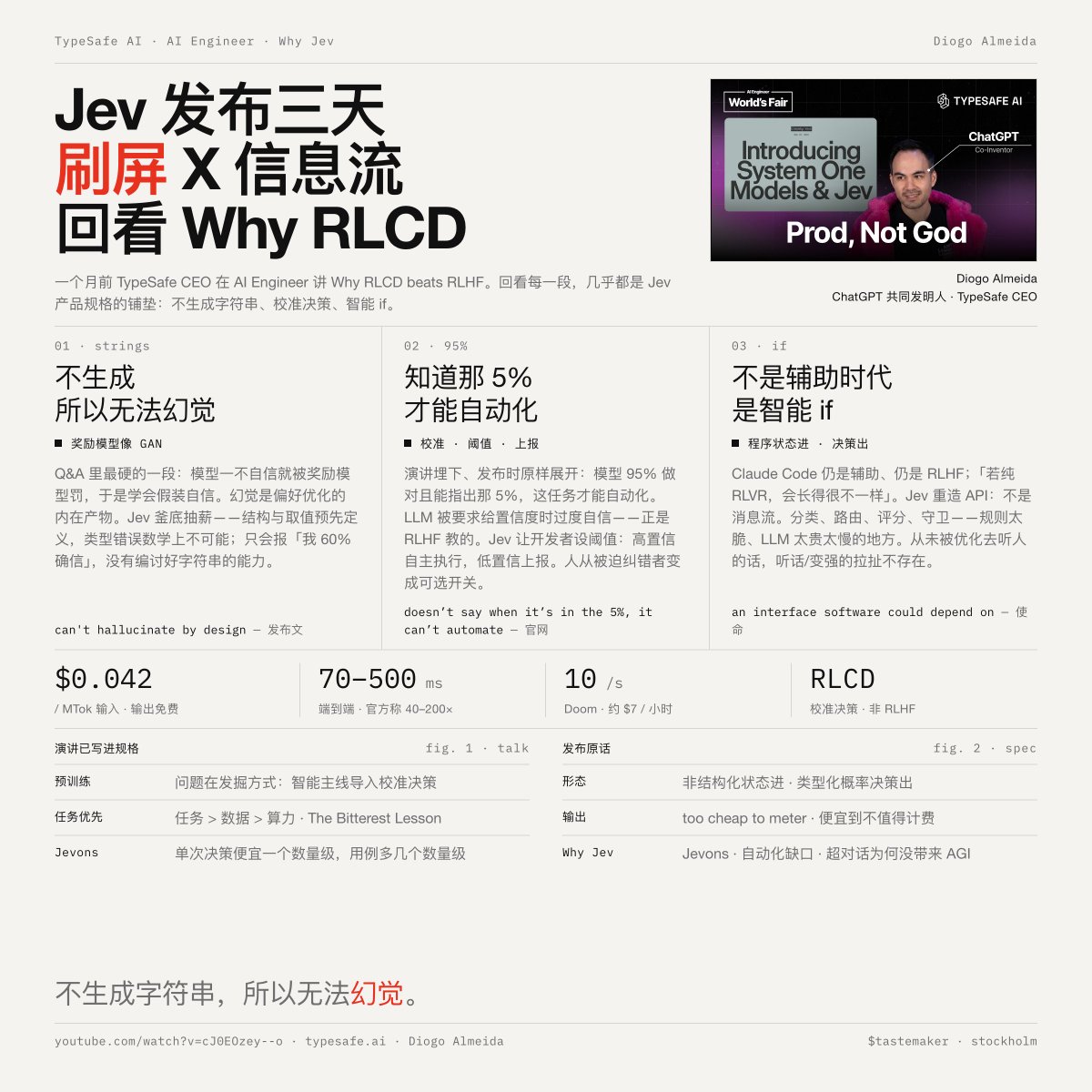
Jev, a new AI from a ChatGPT co-inventor, focuses on decision-making rather than conversation, offering 20-200x faster structured outputs. It is designed for classification, routing, and scoring tasks, with output token free pricing, and has been demonstrated in applications like Doom and browser agents.
Key insights
Core Difference: No Free-Text Generation, No Hallucination
Jev does not generate free text; it outputs structured decisions with predefined types and values, making type errors mathematically impossible. Each output includes an epistemically honest probability. This eliminates hallucination because the model cannot fabricate strings—it can only express confidence levels. The CEO argued that RLHF inherently produces hallucination by penalizing uncertainty, and Jev's design bypasses this.
Pricing: Output Tokens Free, Targeting Near-Zero Cost Decisions
Jev charges only for input tokens; output tokens are free. The company claims to be profitable and plans to further lower prices. This pricing reflects the Jevons paradox: as decision cost drops, usage increases dramatically. The model is designed for tasks where LLMs are too expensive or slow, such as real-time game AI (Doom at 10 queries/second, ~$7/hour) and browser agents.
Use Cases: Classification, Routing, Scoring, and More
Jev is positioned as an 'intelligent if-statement' for software. It excels at classification, routing, scoring, extraction, branching, and guard tasks. Demonstrations include playing Doom, Minecraft, browser automation, and LLM evaluation. It is 20-200x faster than frontier LLMs on System One tasks while matching their intelligence. The company targets areas where hand-written rules are too brittle and LLMs are too slow or unreliable.
Comparison to RLHF and RLVR
The CEO's earlier talk argued that RLHF creates a fundamental asymmetry: models learn to fake confidence to avoid reward model penalties, leading to hallucination. Jev uses RLCD (Reinforcement Learning from Calibrated Decisions) instead. The model is never optimized to please humans, only to make calibrated decisions. This avoids the trade-off between capability and obedience seen in LLMs.
Product Philosophy: Smarter Software, Not Just Faster Software
Jev's mission is to create an interface that software can depend on, enabling 'smarter software' rather than just-in-time AI assistance. The company criticizes that SaaS has not changed since 2019, and Jev aims to embed AI directly into software logic. The name references the Jevons paradox, where efficiency gains increase total consumption.
Confidence Calibration as Core Feature
Jev provides calibrated confidence scores for every decision. Developers can set thresholds: high-confidence actions execute autonomously, low-confidence ones escalate to humans. This enables a 'human-in-the-loop' model where humans become optional supervisors rather than mandatory reviewers. The CEO stated that if a model is 95% correct and can identify the 5% it is wrong, the task can be automated.