
Jev launch: decision-making AI from a ChatGPT co-inventor
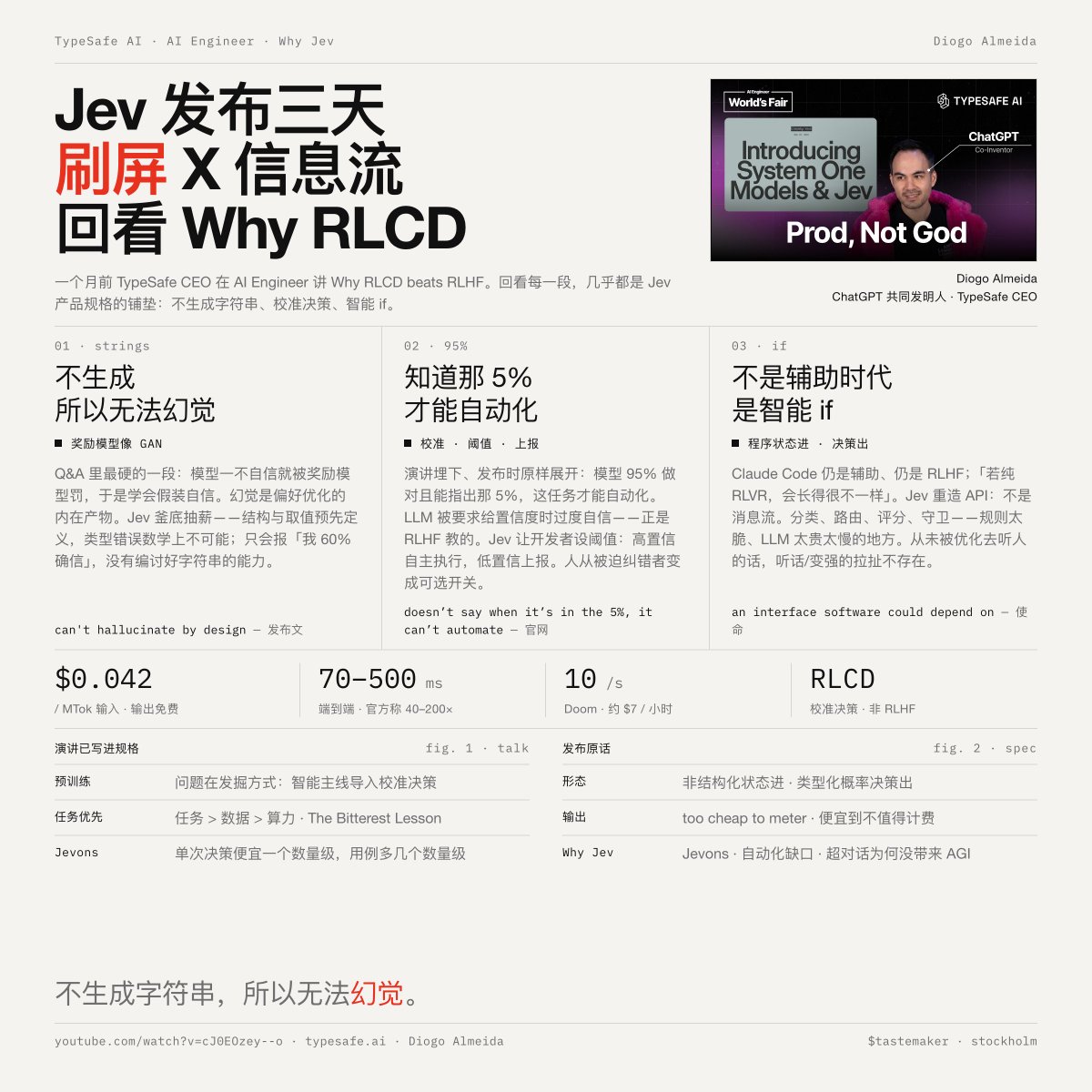
TypeSafe AI, founded by a ChatGPT co-inventor, launched Jev, an AI that outputs only structured decisions from predefined options, eliminating hallucinations. It is 20-200x faster than LLMs, with calibrated confidence. Applications include Doom agents, browser automation, and LLM evaluation. Output tokens are free; the company is profitable.
Key insights
No Hallucination by Design
Jev does not generate free text; it only outputs from predefined types and values. This makes type errors mathematically impossible. Each output includes an epistemically honest probability. In contrast, LLMs trained with RLHF learn to pretend confidence to avoid being penalized for uncertainty. Jev's output is always a calibration of what it knows.
Speed and Cost Advantage
Jev is 20-200 times faster than LLMs for System One tasks. In a Doom demo, it ran 10 queries per second at about $7/hour. Output tokens are free, so cheap that TypeSafe AI claims they are not worth billing. The company says it is already profitable and will continue lowering prices.
RLCD vs RLHF
Jev uses RLCD (Reinforcement Learning from Calibrated Decisions) rather than RLHF. Its CEO argued that reward models have GAN-like asymmetry: uncertainty is penalized, leading LLMs to abandon unsure patterns and hallucinate. Jev avoids this by never generating strings; it only offers choices with confidence.
Product Positioning: Smart If-Statements
Jev is positioned as 'smarter software, not just-in-time software.' It excels at classification, routing, scoring, extraction, branching, and guard rails—tasks where hardcoded rules are brittle and LLMs are too expensive and slow. Developers set a confidence threshold: high confidence auto-executes; low confidence escalates to humans.
Architecture: Import Pretrained Intelligence
Jev does not reinvent intelligence; it imports the intelligence of pretrained models into calibrated decisions. The CEO stated that compressing the internet into an intelligence kernel is great; the problem is the discovery method. Jev uses a different method to extract that intelligence into a structured decision space.
Economic Logic: Jevons Paradox
Jev's name references William Stanley Jevons, whose paradox states that efficiency gains increase total consumption. TypeSafe AI bets that as decision cost drops by orders of magnitude, usage will increase by even more. The task space is chosen for high reuse at near-zero incremental cost.
Applications and Ecosystem
Jev has been demonstrated in Doom (real-time gameplay), Minecraft, browser agents, and LLM evaluation. It is designed as an 'intelligent if statement,' usable where software needs reliable AI decisions. The company believes this is the interface for AI that software can depend on, not just a completion API.