
Kimi K3 Open Frontier Intelligence Launch
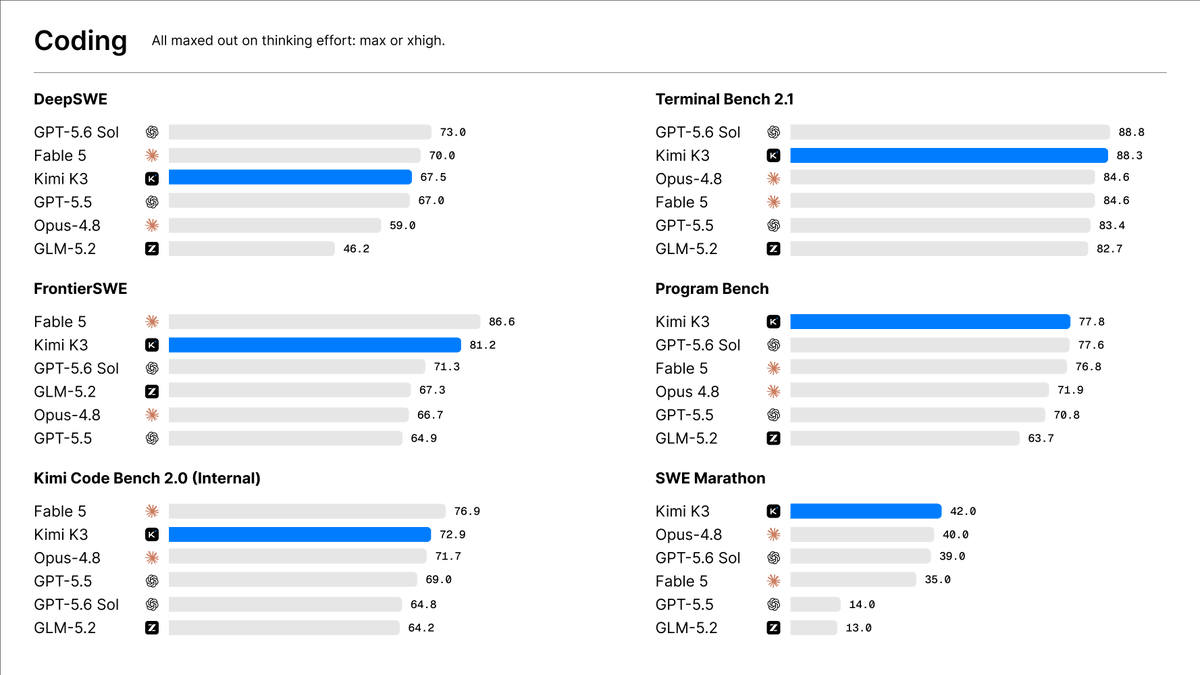
Moonshot AI introduced Kimi K3, an open frontier intelligence model with 2.8 trillion parameters, a Mixture-of-Experts architecture with 896 experts (16 activated), and 1 million token context length. It is natively multimodal. Two architectural innovations are highlighted: Kimi Delta Attention enables up to 6.3x faster decoding in long contexts, and Attention Residuals deliver approximately 25% higher training efficiency at less than 2% additional cost. The model is designed for long-horizon agentic coding and self-evolving workflows. It is available on the Kimi platform, Kimi Work, Kimi Code, and the Kimi API. Open weights are promised by July 27, 2026. A technical report reveals training used 51.22 million sandboxes and that the architecture changes boost overall compute efficiency by 2.5x.
Key insights
Kimi K3's Scale and Efficiency Innovations Position It as a Competitive Open-Weight Model
With 2.8 trillion parameters, 1M context, and novel attention mechanisms, Kimi K3 achieves significant speed and training efficiency gains. Delta Attention provides up to 6.3x faster decoding in million-token contexts, while Attention Residuals improve training efficiency by ~25% at minimal cost. These innovations make large-scale, long-context models more practical.
Open-Weight Release Could Impact the Open-Source AI Ecosystem
The commitment to release open weights by July 27, 2026, provides the community with a powerful, freely available model optimized for agentic coding. This could accelerate open-source development and challenge proprietary models in long-context, agent-based tasks.
Model Built for Agentic Coding and Self-Evolving Workflows
Kimi K3 is explicitly designed for long-horizon agentic coding and self-evolving workflows, suggesting a focus on autonomous software development and continuous improvement scenarios. Its 1M context window supports maintaining coherence over very long interactions.
Training Infrastructure and Compute Efficiency Detailed
The technical report notes the use of 51.22 million sandboxes during training and a 2.5x improvement in compute efficiency due to architectural changes. This provides transparency into the scale of resources required and the effectiveness of the efficiency optimizations.