
Kimi K3 Open Source Model Release and Performance
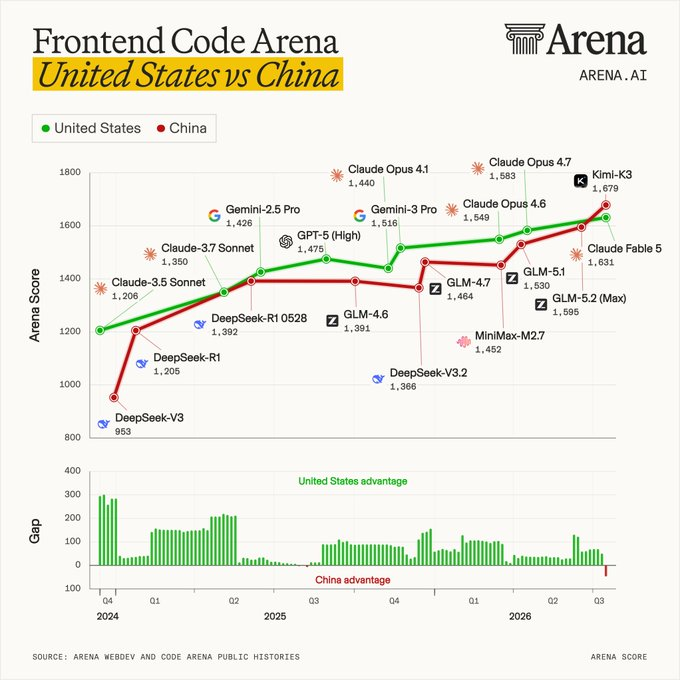
Moonshot AI released Kimi K3, a 2.8-trillion-parameter open-source model with 1M token context and native multimodality. It quickly topped the Frontend Code Arena with a score of 1679, surpassing Claude Fable 5 (1631) and GPT-5.6 Sol (1618). Performance and reception: • On Artificial Analysis and Arena benchmarks, K3 ranks behind Fable 5 and GPT-5.6 Sol but above Opus 4.8 and GPT-5.5, placing it as the strongest open-source model. • In real-world bug fix tests under identical harness, K3 solved a bug using 3.4× more time and 1.7× more tokens than Fable 5, but cost 2.3× less due to lower pricing ($0.92 vs $2.13). • User demos showed K3 building a full-stack World Cup tracking app with database and a one-sentence video editor, though edge issues remained. • Massive demand caused server overload: throughput dropped from 30 tokens/s to 13, latency rose to 72s, first-token wait exceeded 20s. OpenRouter daily volume hit 14B tokens. • Analysts note the model's size likely exceeds Opus and approaches Fable, marking a narrowing gap to ~6 months behind the frontier. • Open weights promised by July 27, 2026.
Key insights
K3's Frontend Code Leadership Signals Open-Source Parity in Specific Domains
Topping the Frontend Code Arena above both Fable 5 and GPT-5.6 Sol demonstrates that an open model can excel in practical, high-demand tasks. This challenges the assumption that closed-source models hold blanket superiority and could shift developer adoption for web development projects.
Cost-Performance Trade-Offs Favor K3 for Budget-Constrained Agentic Work
Although K3 consumed 1.7× more tokens and 3.4× more time in a bug-fix test, its total cost was 2.3× lower than Fable 5. This makes open models highly competitive for tasks where latency is not critical and token costs dominate. The server overload, however, undercuts this advantage in practice.
Infrastructure Bottlenecks Limit Real-World Usability Despite High Demand
Immediate server capacity issues—30→13 tokens/s throughput and 72s latency—highlight that hosting a 2.8T model at scale poses non-trivial engineering challenges. Even with strong model quality, service reliability and speed will determine enterprise adoption, not just benchmark scores.
K3 Demonstrates Full-Stack and Creative Capabilities Closer to Frontier Models
User tests showed K3 generating a feature-rich sports tracking app with backend and database, and a browser-based video editor from a single prompt. While the outputs were rough, they illustrate a leap in agentic coding that was previously the domain of Fable 5/GPT-5.6.