
Kimi K3 surge and compute economics
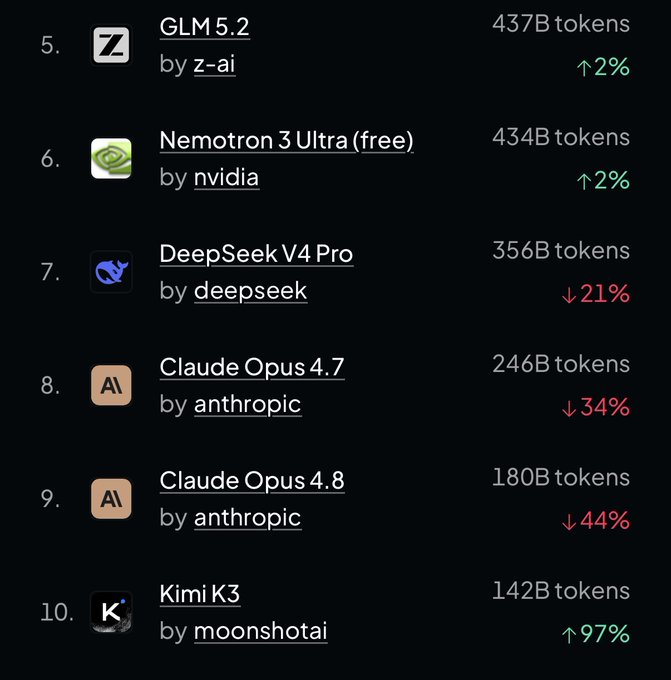
Kimi K3 surge caused compute strain. - Kimi K3 reached OpenRouter #10 in two days. - Daily traffic about 140 billion tokens. - Servers overloaded; throughput fell 30→13 t/s. - Latency rose to 72 seconds; TTFB >20s. - Deedy framed issue as compute economics. - Kimi founder gave GTC 2026 talk K2.5. - Kimi and Qwen run active YouTube channels. - Kimi K3 teaser amassed 16 million views. - GTC talk has about 300k views.
Key insights
Kimi K3 rapid adoption created extreme traffic
Kimi K3 reached OpenRouter’s top 10 within two days and registered about 140 billion tokens per day. The rapid traffic spike caused server degradation: throughput fell from 30 tokens/second to 13 tokens/second, latency rose to 72 seconds, and time-to-first-byte exceeded 20 seconds. These operational metrics were cited as immediate evidence of infrastructure strain following K3’s release.
Framing: AI core narrative as compute economics
Deedy framed Kimi K3’s performance and the resulting operational issues under a broader thesis that the core AI narrative is compute economics. The write-up used K3’s metrics—rank, token volumes, throughput drops, and latency spikes—as the opening data points to argue that compute capacity and economics are central to AI product behavior.
Kimi’s public outreach differs between technical talk and teaser
Kimi’s founder Yang Zhilin gave a GTC 2026 talk titled 'How We Scaled Kimi K2.5' with about 300,000 views, while Kimi’s K3 teaser video amassed roughly 16 million views. Observers noted that Kimi and Qwen are among the only Chinese AI firms actively maintaining proper YouTube accounts, and Kimi’s teaser attracted far larger public engagement than the longer technical presentation.