
Kun Chen Argues AI Expands Software Market in Four-Part Analysis
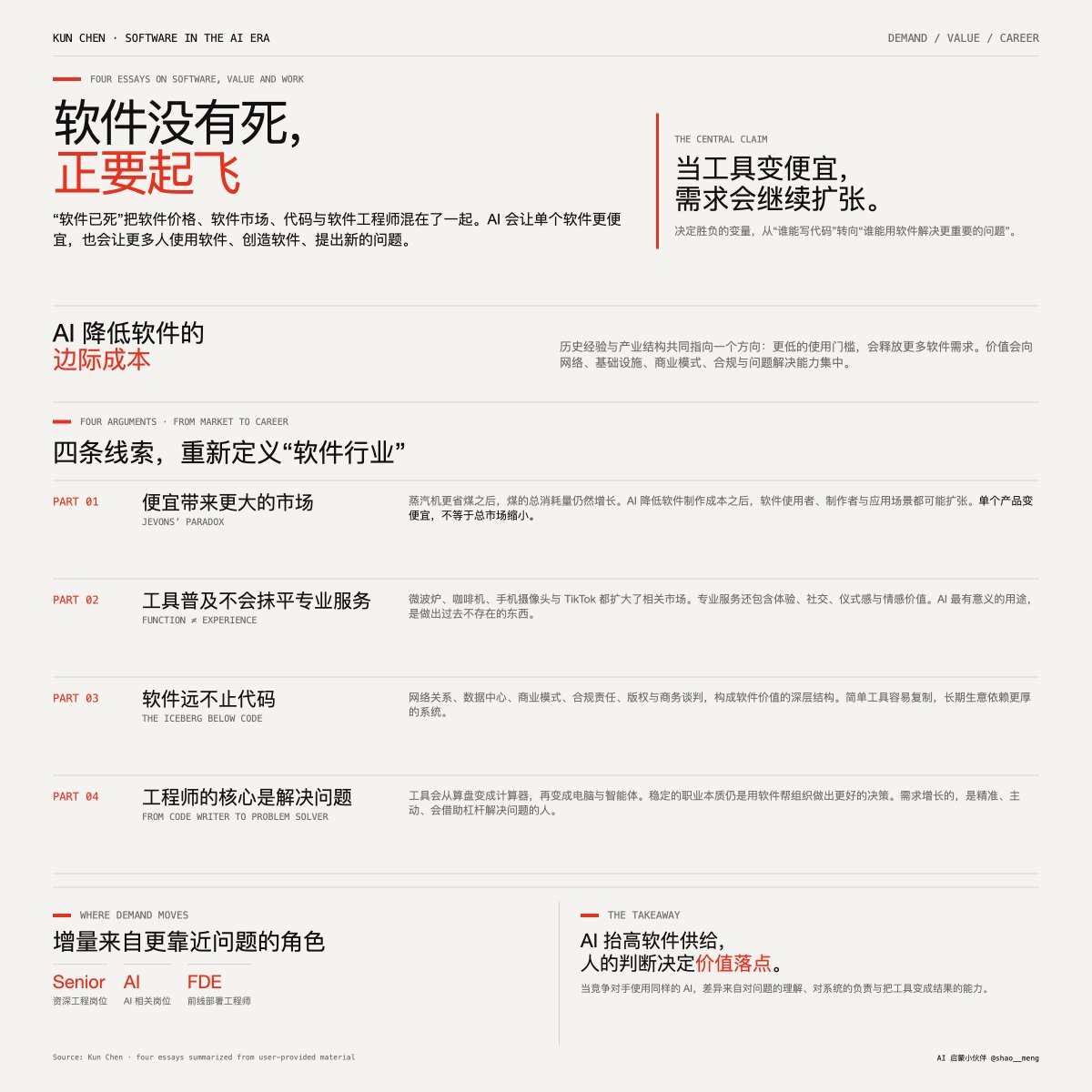
Kun Chen published a four-part analysis arguing that AI will lower individual software prices while expanding the overall software market, that valuable software extends far beyond code, and that demand for engineers who solve problems with software is growing. The analysis cites Jevons paradox, historical examples of technology adoption not replacing professional services, and US software engineering job posting data showing growth concentrated in senior, AI-related, and forward-deployed engineer roles.
Event version 1.
Key insights
Jevons paradox applies to software
AI lowers the barrier to building software, so individual software prices fall while the number of software users and builders rises, expanding the total software economy.
Technology adoption does not replace professional services
Microwaves, home coffee machines, smartphone cameras, and TikTok did not displace restaurants, coffee shops, professional photographers, or the film industry, because professional services sell experience, social value, ritual, and emotional value beyond raw functionality.
Valuable software is more than code
Durable software value comes from networks, infrastructure, business models, compliance risk transfer, and business negotiations, not from code alone; simple code-only tools are easy to copy but were never the core of the software industry.
Engineer demand is shifting, not disappearing
Roles limited to writing requested code are gone, and code-writing skill alone loses value within one to three years, while engineers who precisely and proactively solve problems with leverage are in growing demand.
US SWE job postings are growing
US software engineering job postings are increasing, with growth mainly from senior roles, AI-related roles, and forward-deployed engineer positions.