
Large-Scale Code Repository Documentation and Agent/Browser Development Tools
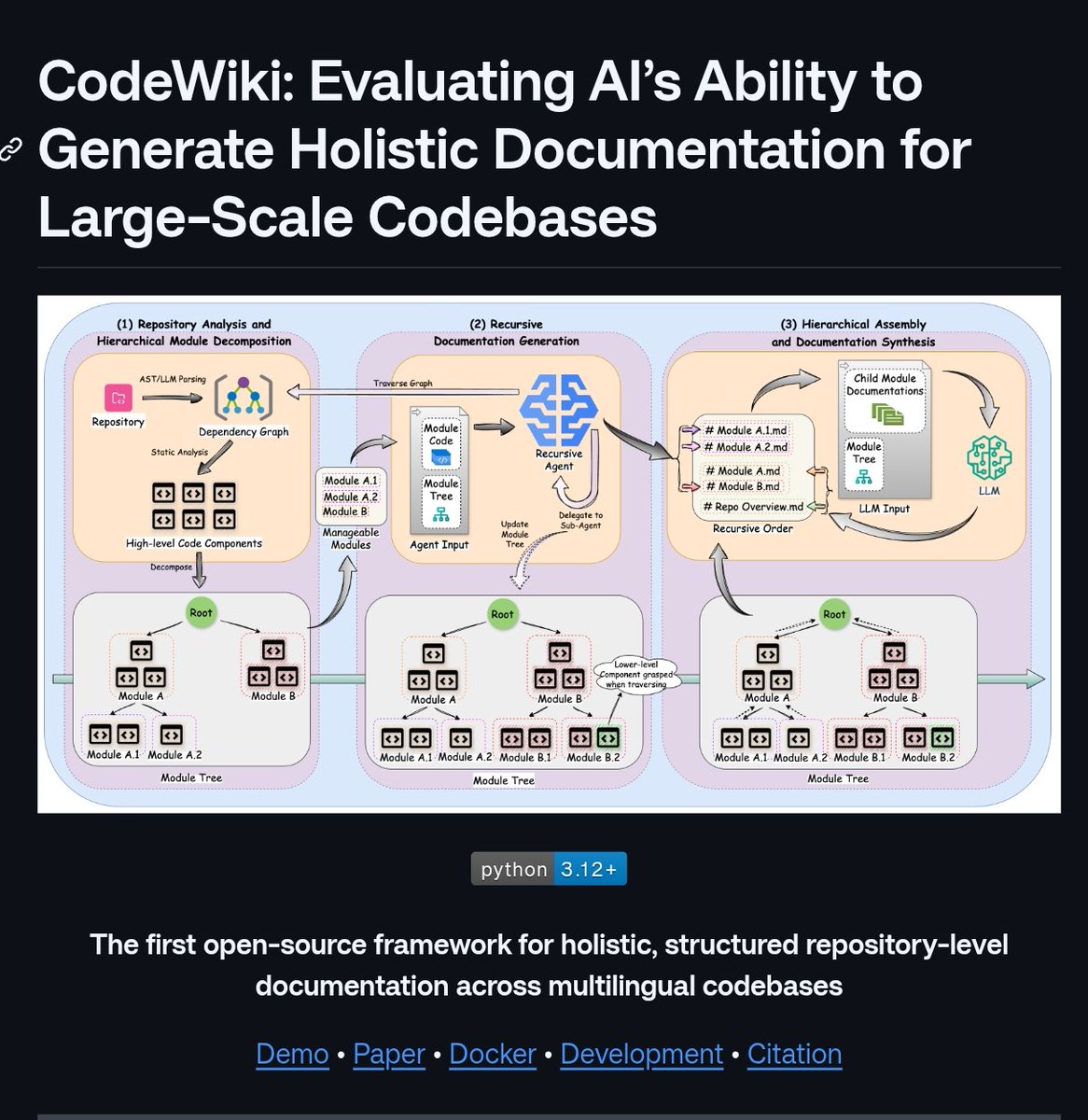
CodeWiki automatically generates complete structured documentation for large-scale, multilingual code repositories and supports multimodal output. It addresses the challenges of traditional documentation tools that struggle to capture interactions across files and modules. It generates comprehensive documentation similar to a 'project Wiki', including high-level architecture overviews and module dependencies. It supports multimodal outputs such as data flow diagrams, sequence diagrams, architecture diagrams, API references, and usage examples. The output can embed interactive Mermaid charts and Markdown text. The three core technologies are hierarchical decomposition, recursive multi-agent processing, and multimodal synthesis output. Hierarchical decomposition can split large repositories into module clusters, validated to support code sizes from 86,000 to 1.4 million lines. Recursive multi-agent processing allows complex modules to be dynamically decomposed and delegated to sub-agents, enhancing robustness. The CodeWikiBench benchmark shows an average score of 68.79% using closed-source models like Claude, surpassing DeepWiki by 4.73%. The improvement is particularly notable in languages like Python and JavaScript (approximately 10.47% increase). Open-source models perform around 64.8%, significantly better than traditional baselines. The open-source address has been published (link included in the original text). Additionally, there are related ecological tools and discussions: someone has implemented a UI for the Claude Agent SDK; discussions have proposed using a 'file system' as an external workspace for agents to improve context management; and there are projects that have forked Chromium to build browser infrastructure aimed at AI agents. Note: This CodeWiki is not Google's Codewiki.
Key insights
CodeWiki Generates Comprehensive Documentation for Large-Scale Repositories
CodeWiki is described as an open-source framework for large, multilingual code repositories that can generate complete documentation similar to a 'project Wiki', including high-level architecture overviews, inter-module dependencies, data flow diagrams, sequence diagrams, API references, and usage examples. The documentation output is multimodal, featuring both Markdown text descriptions and automatically embedded architecture diagrams and interactive Mermaid charts, aiming to address the shortcomings of traditional tools that focus solely on function/file-level details and miss the overall architectural perspective.
Core Technologies and Scalability of CodeWiki
The three core technologies of CodeWiki include: first, hierarchical decomposition, which intelligently splits large repositories into multiple 'module clusters', maintaining architectural context while making sub-tasks manageable, validated to support code sizes from 86,000 to 1.4 million lines; second, recursive multi-agent processing, which automatically decomposes complex modules and delegates to sub-agents to maintain quality and scalability; third, multimodal synthesis output, which integrates text, architecture diagrams, data flow diagrams, and sequence diagrams into the final documentation.
CodeWikiBench Benchmark and Model Performance
In the CodeWikiBench benchmark, the average quality score using closed-source models like Claude is 68.79%, which is 4.73% higher than the closed-source commercial tool DeepWiki. The improvement is particularly significant in high-level languages such as Python and JavaScript, with an increase of approximately 10.47%. The text notes that open-source models can also achieve around 64.8%, significantly surpassing traditional baselines.
Related Ecology: Agent UI, Context Management, and Browser Infrastructure
Community discussions and practices revolve around Agent and browser infrastructure: someone has implemented a UI for the Claude Agent SDK that mimics Claude Code Web (including code examples); discussions have proposed using a 'file system' as an external workspace for agents to improve context engineering (referencing LangChain blog perspectives); and there are projects that have forked Chromium, working on building browser infrastructure aimed at AI agents, pointing to the need for redesigning browsers as runtime environments for agents.
Clarification of Name: Not Google Codewiki
The text clearly states that this project is not Google's Codewiki, and it is important to note the distinction in names for open-source recommendations.