
Lauren Tan Details AI Coding Rules at AI Engineer Talk
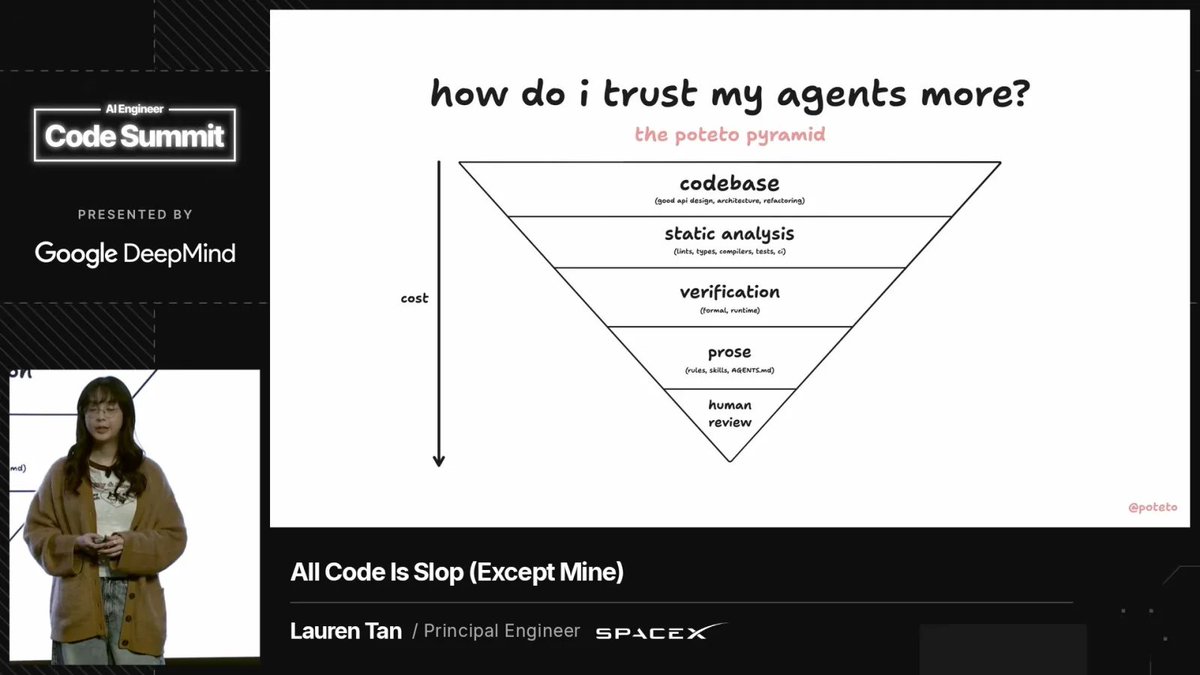
Lauren Tan, who leads Grok Bot desktop at SpaceXAI, presented "All Code Is Slop (Except Mine)" at the AI Engineer conference, outlining practices for keeping AI-generated code clean. She recommended converting each AI correction into automated lint rules, banning error-prone features and most code comments, and having AI verify its own work with recordings and screenshots. Her team merged 11,000 pull requests last month with about 0.5% reverted, and the app runs faster than at launch.
Event version 1.
Key insights
Corrections become lint rules
Each correction to AI should be written as an automated check such as a lint rule rather than added to instruction documents like agents.md. Code violating lint rules fails and cannot be committed, while documentation instructions are not always followed.
Codebase is AI's main learning material
Bad patterns and temporary patches in the codebase get copied by the next AI as convention and spread like weeds, so the codebase must stay clean.
Ban error-prone features and most comments
A commonly misused React feature was disabled in product code, eliminating that class of problem. About 99% of code comments were banned because AI uses comments to justify shortcuts that later AI copies; at Cursor such justified patches spread and slowed the app.
AI self-verification and formal methods
AI runs the program and clicks through it like a user, submitting recordings and screenshots that humans review instead of reading code, consuming most of her tokens. Strict verification such as mathematical proof of correctness is now affordable because AI lowered its cost.
Results and foundation first
The team merged 11,000 PRs last month with about 0.5% reverted, and the app is faster than at launch. A solid foundation must come before full automation, since automating bad AI code generation only produces more bad code at higher cost.