
LLM Research & Paradigm Shifts: RLVR, World Models and Engram
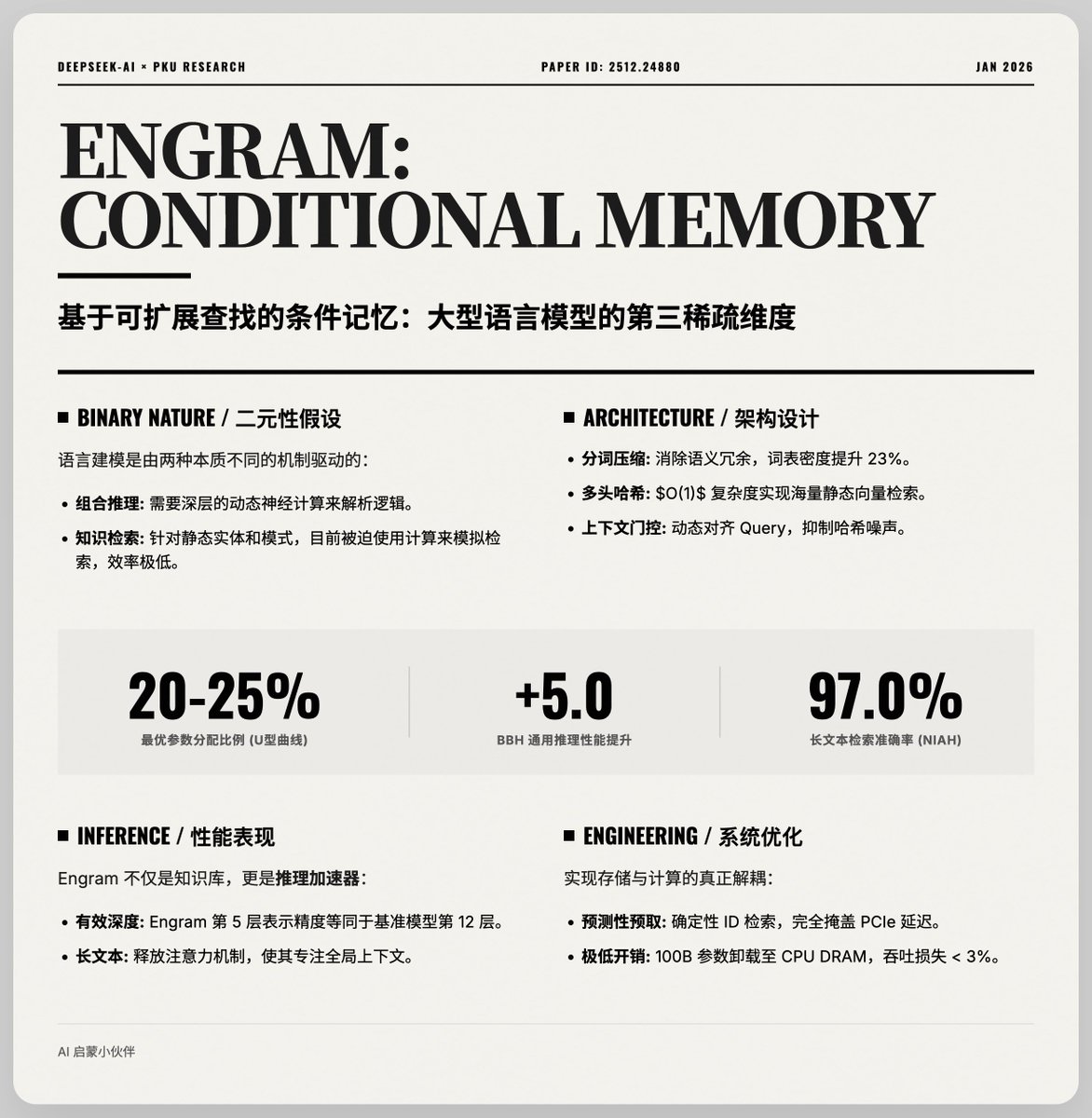
Recent LLM research covered Engram memory, RLVR, empirical reflections, and year-end reviews. - Engram (DeepSeek + Peking Univ) introduces conditional O(1) memory lookups using hashed n-gram keys, gated integration, and sparse allocation, improving knowledge retrieval and freeing attention for global context. - Engram experiments show optimal sparse parameter split (~20–25% to Engram) and log-linear gains with larger memory slots; 27B Engram showed gains on MMLU, BBH, HumanEval, and MATH. - Engram supports async prefetching from host memory; offloading large tables to host reduced throughput loss to <3%. - Andrej Karpathy and others summarized 2025 shifts: RLVR (Reinforcement Learning from Verifiable Rewards) became central; models developed chain-of-thought via RL in verifiable domains. - Karpathy highlighted 'vibe coding', local intelligent agents like Claude Code, 'jagged intelligence' concept, and LLM GUI evolution (Nano Banana). - Salvatore Sanfilippo noted that skepticism about 'random parrots' diminished; LLM internal representations and reasoning improved, while existential risk caution remains. - Overall trends: new training paradigms (RLVR), conditional memory modules (Engram), stronger reasoning and tool use, and the rise of local/agentic deployment models.
Key insights
Engram introduces conditional O(1) memory for scalable retrieval
The Engram paper proposes a conditional memory module that separates static knowledge lookup from dynamic computation via hashed n-gram keys and context-aware gating. Engram reduces token-level retrieval cost and frees attention to handle global context. Experiments indicate a U-shaped allocation law where dedicating ~20–25% of sparse parameter budget to Engram yields best performance; Engram-27B improved MMLU, BBH, HumanEval, and MATH metrics and enabled large host-memory offloads with <3% throughput loss via async prefetching.
RLVR emerged as a dominant training paradigm in 2025
Researchers summarized that Reinforcement Learning from Verifiable Rewards (RLVR) became a key addition to pretrain+SFT+RLHF pipelines. By placing models in environments with objective, verifiable rewards (e.g., code execution, math problems), models learned emergent multi-step strategies and chain-of-thought behaviors without human stepwise labels. The shift moved compute allocation toward RL phases and produced measurable gains in reasoning-capable benchmarks.
Community reassessed LLM capabilities: from 'random parrots' to structured internal representations
Practitioners like Salvatore Sanfilippo reported that the 'random parrot' critique waned as models demonstrated strong performance on exams, code, and structured benchmarks, and as interpretability work revealed internal concept-like representations. However, researchers emphasize LLMs exhibit 'jagged intelligence'—high capability in verifiable domains and brittle behavior elsewhere—requiring nuanced evaluation beyond standard benchmarks.
Local intelligent agents and 'vibe coding' changed developer workflows
Karpathy and others highlighted a shift to local agentic tools (e.g., Claude Code) that run on developer machines and integrate with private contexts. 'Vibe coding'—describing intent in natural language to generate code—became widespread, lowering barriers to program creation and altering how developers prototype and iterate, making one-off code cheap and disposable.
LLM GUI and multimodal outputs are becoming new interaction norms
Karpathy described early LLM GUI work (e.g., Gemini Nano Banana) that fuses text, images, and animations into richer responses. This trend aims to move beyond text-only interactions to visual, slide-like, and interactive outputs—adapting models to human-preferred presentation formats.