
LLM Understanding and Chain-of-Thought Monitoring
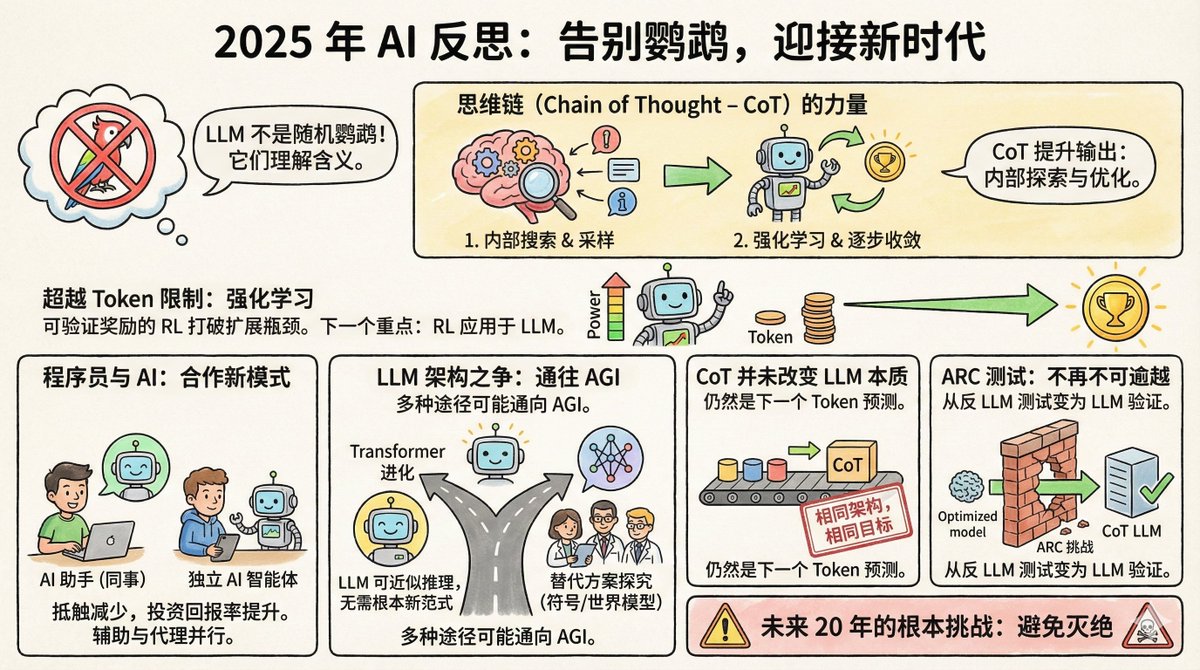
Two analyses argue LLMs now form internal concept representations and that chain-of-thought (CoT) monitoring is a measurable safety tool.
Key insights
LLMs are more than stochastic parrots
Salvatore Sanfilippo reports that by 2025 the 'stochastic parrot' critique has largely fallen away; empirical evidence includes LLM performance exceeding most humans on law/medicine/math exams and reverse-engineering showing internal concept representations. He cites Geoffrey Hinton’s argument that predicting next tokens requires sentence-level understanding. Sanfilippo frames this as a practical end to simplistic denial of model understanding while noting philosophical disputes remain.
Chain-of-thought is an underestimated breakthrough
Sanfilippo argues chain-of-thought (CoT) prompts shift model behavior by exposing internal representations prior to answers, and when combined with reinforcement learning they guide models toward reliable multi-step solutions. He explains CoT works by prompting the model to sample and foreground relevant concepts ('outline on scratch paper') and that token-by-token RL steers generation toward convergent reasoning paths.
OpenAI: CoT monitorability improves safety
OpenAI research presents a CoT monitorability framework and 13 evaluation methods showing that longer internal reasoning can increase external monitorability. Findings include a 'monitorability tax' tradeoff—smaller models with longer reasoning are easier to monitor than much larger shallow models—and that targeted follow-up questions can elicit clearer internal reasoning. The paper reports that, at current scales, RL has not measurably reduced CoT transparency.
Compute and self-supervised RL expand training signals
Sanfilippo notes that verifiable-reward tasks (e.g., program optimization, theorem proving) provide near-infinite training signal allowing continued capability growth beyond human text limits; he links this to RL-driven improvements in reasoning and suggests Transformers need not be abandoned for progress.