
Long-Running Intelligent Agent Architecture and Engineering Practices (Anthropic / Multi-Agent)
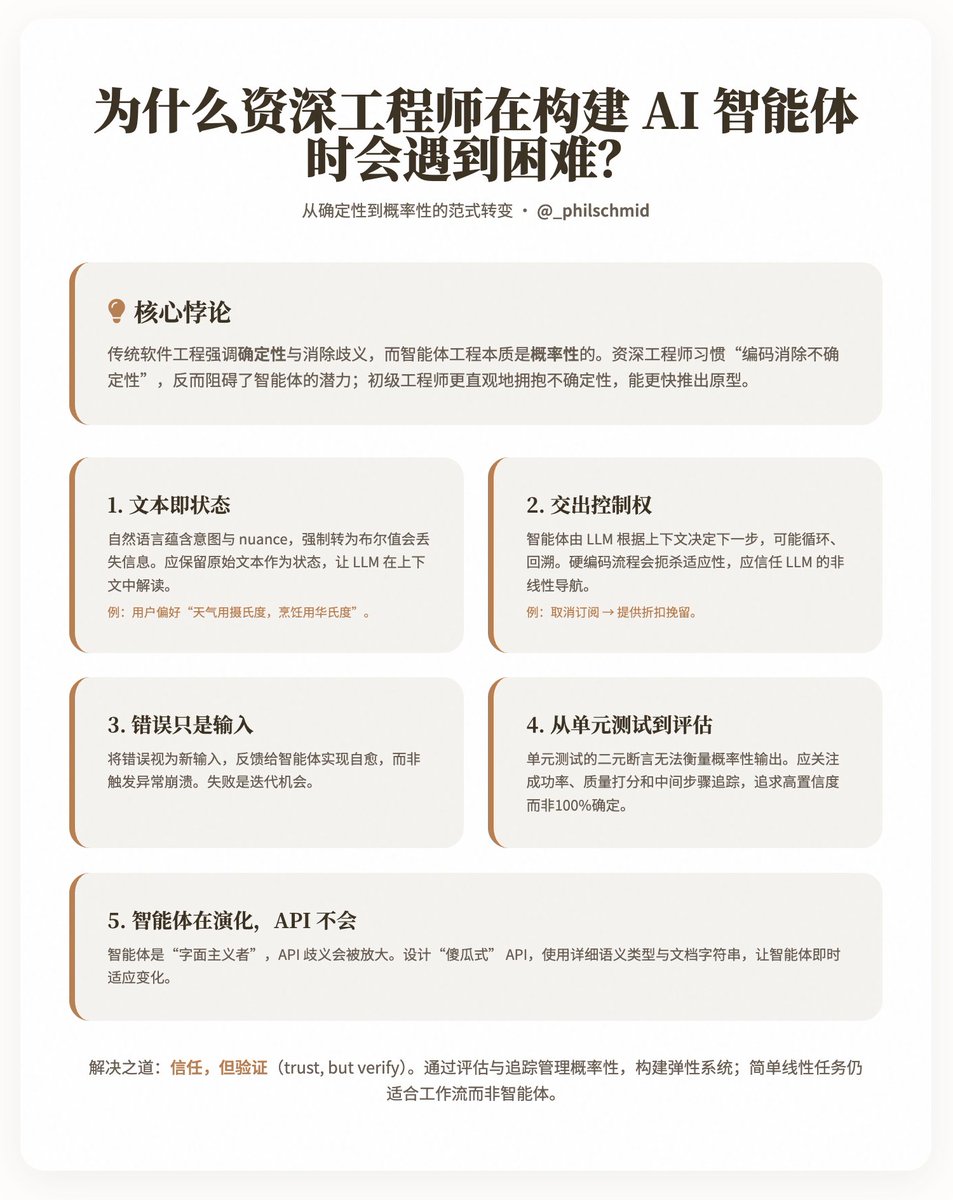
Anthropic has released engineering experiences for long-running intelligent agents, proposing a dual-agent architecture and engineering practices to ensure continuity and verifiability across session tasks. Senior engineers face a paradigm shift from deterministic software engineering to probabilistic intelligent agent development. They encounter five major challenges: text as state, relinquishing control, treating errors as input, transitioning from unit testing to evaluation, and agent evolution rather than static APIs. Anthropic proposes a dual-agent design: Initializer (the initializing agent) and Coding Agent (the coding agent), which maintain continuity through a JSON feature list and progress logs. The Initializer is responsible for setting up the environment, generating init.sh, feature_list.json, and the first Git commit; the Coding Agent implements one feature at a time and records clear commits. Experiments show that this framework allows agents to work continuously for hours, check and fix previous submissions, and reduce context breaks, though limitations remain. Spotify employs a similar approach, merging over 1500 AI-generated PRs in production with Claude Code, indicating that engineering and tool whitelisting strategies are key. The Sub Agent concept allows for collaborative division of labor among front-end, back-end, testing, and other roles. However, practices still need to address multi-sub-agent load, end-to-end verification, and certain browser native element capture issues.
Key insights
From Deterministic Engineering to Probabilistic Agents: A Shift in Mindset and Methodology for Senior Engineers
The experience article points out that traditional software engineering pursues determinism and ambiguity elimination, while agent engineering is inherently probabilistic, requiring engineers to accept text as state, trust the control flow of large language models (LLMs), and treat errors as new inputs for self-healing. Existing habits of senior engineers may hinder agent development, necessitating the replacement of certain roles of unit testing with evaluations.
The Dual-Agent Architecture Addresses Memory and Handover Issues in Long Tasks
The dual-agent architecture proposed by Anthropic consists of the Initializer and Coding Agent: the Initializer establishes structured working memory and a feature list (JSON), while the Coding Agent implements and verifies one feature at a time, submits clear Git records, and updates progress, thereby externalizing 'memory' into files and version control to achieve cross-session continuity.
Engineering Practices Include JSON Feature Lists, End-to-End Testing, and Browser Automation
The practices emphasize establishing baselines using feature_list.json, claude-progress.txt, and init.sh; integrating browser automation (such as Puppeteer MCP) for end-to-end validation to capture interaction-related bugs; and limiting agents to one task at a time to ensure a 'clean state' for the next handover.
Spotify and Other Companies Validate the Practical Value of Agent Workflows in Production
Spotify has used agents in the background to generate and merge over 1500 AI-generated PRs, employing conservative tool strategies, customized prompt engineering, and validation processes, saving 60–90% of time, indicating that under strict control, agents can significantly enhance engineering efficiency.
Sub-Agent Division of Labor and Multi-Agent Parallelism Are Feasible but Need Load and Verification Solutions
Anthropic and the community propose allowing the creation of Sub Agents (front-end, back-end, testing, etc.) for team-style collaboration, but also point out that high load from multiple sub-agents may lead to memory exhaustion and crashes, and that cross-session end-to-end verification and certain browser native elements remain unresolved issues.
Agent Engineering Should Learn from Human Software Engineering's Division of Labor and Handover Mechanisms
One of Anthropic's conclusions is that for agents to work long-term, they must simulate the division of labor seen in human engineering teams (clear handovers, version control, testing, and checklists), breaking complex tasks into verifiable small functions to avoid failure modes of 'one-time completion' or 'premature victory declaration.'