
Long-Running Intelligent Agents and Engineering Framework (Anthropic / Claude Code / Practical Application)
Anthropic proposes a dual-layer/framework solution to address the issues of cross-session memory and continuous execution for intelligent agents. • Anthropic introduces a dual-agent architecture: Initializer and Coding Agent. • The Initializer creates JSON feature_list, claude-progress.txt, and init.sh. • The Coding Agent performs one function at a time, runs init.sh, submits to Git, and updates progress. • Insufficient context compression requires external files and Git to maintain persistent state. • Experiments show that this method enables several hours of continuous development and automatic bug fixing. • The Claude Code framework supports sub-agent collaboration, background tasks, and browser control functionalities. • The Claude Code Marketplace includes 48 command plugins that support code analysis and automated testing. • Senior engineers need to shift from deterministic to probabilistic thinking, embracing LLM control flow and evaluation systems. • Spotify successfully merged over 1,500 AI-generated PRs using Claude Code, saving 60–90% of time while retaining existing review processes. • Senior engineers have advantages in prompt design, task decomposition, and result validation, enhancing the effectiveness of intelligent agents.
Key insights
Dual-Agent Architecture Solves Memory Breaks in Long-Running Tasks
Anthropic proposes a dual-agent (Initializer Agent + Coding Agent) design in its engineering blog: The Initializer sets up the development environment in the first round and generates feature_list.json, claude-progress.txt, and init.sh; subsequently, the Coding Agent reads progress each session, runs the initialization script, implements one function, writes clear Git submissions, and updates progress. This method externalizes 'memory' into files and Git history, enabling continuous development and verifiable handovers across sessions. Experiments demonstrate that it allows agents to maintain logical consistency across multiple sessions and fix legacy issues.
Claude Code Framework Becomes Core Tool for Engineering Intelligent Agents
Claude Code provides functionalities such as browser control, configuration file management, sub-agent collaboration, and automated execution, allowing the Opus model to function as a 'full-computer usage intelligent agent.' Developers can customize sub-agents and background tasks through the Agent SDK, supporting 'send and forget' tasks and parallel sub-agents, but memory and stability issues persist under high loads.
Community Ecosystem and Tool Marketplace Accelerate Third-Party Plugin and Command Circulation
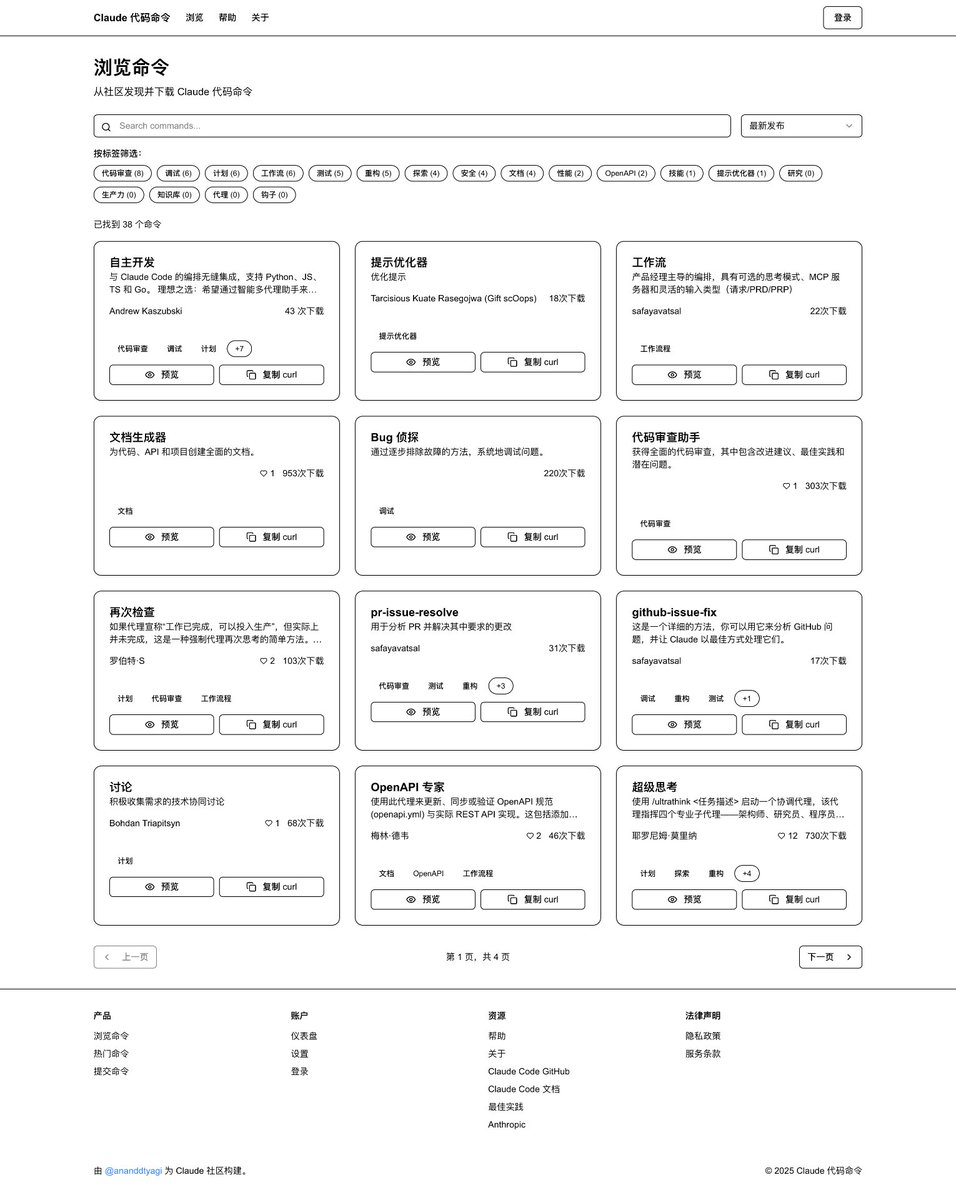
The Claude Code Marketplace has emerged on GitHub, driven by the open-source community, featuring 48 command plugins covering categories such as code analysis, refactoring, security auditing, performance optimization, and automated testing. Users can install and manage plugins in the terminal like apt/brew, and the project continuously collects new commands.
Engineering Mindset Needs to Shift from Deterministic to Probabilistic to Drive Agent Development
Experienced engineers often face obstacles in intelligent agent engineering due to traditional engineering's pursuit of determinism, making it difficult to let LLM handle nonlinear processes. It is recommended to retain text as state, view errors as feedback inputs, replace unit tests with evaluations (evals), and design 'foolproof' APIs to reduce ambiguity, thus achieving a balance of 'trust but verify.'
Enterprise Practice: Spotify Automates Large-Scale Production PRs with Claude Code
Spotify adopted Claude Code during migration and large-scale code changes, applying it in about 50 migrations and generating most production PRs, merging over 1,500 AI-generated PRs in total. In practice, existing repository selections, PR processes, and verification mechanisms are retained, allowing agents access only to restricted tools (formatting, static checks, restricted Git, whitelisted Bash), and emphasizing clear preconditions, specific examples, and verifiable goals to enhance predictability.
Engineering Plugins Enhance Code Quality and Review Capabilities of Intelligent Agents
There are open-source practices aimed at endowing intelligent agents with engineering workflows (such as Plan-Work-Review, Compounding Engineering Plugin). By generating detailed issues during the Plan phase, executing in an isolated Worktree, and having dedicated agents for security/performance review in parallel, Claude Code can behave more like a disciplined virtual colleague, reducing technical debt.