
Memory, context management and agent skills (Claude / ChatGPT)
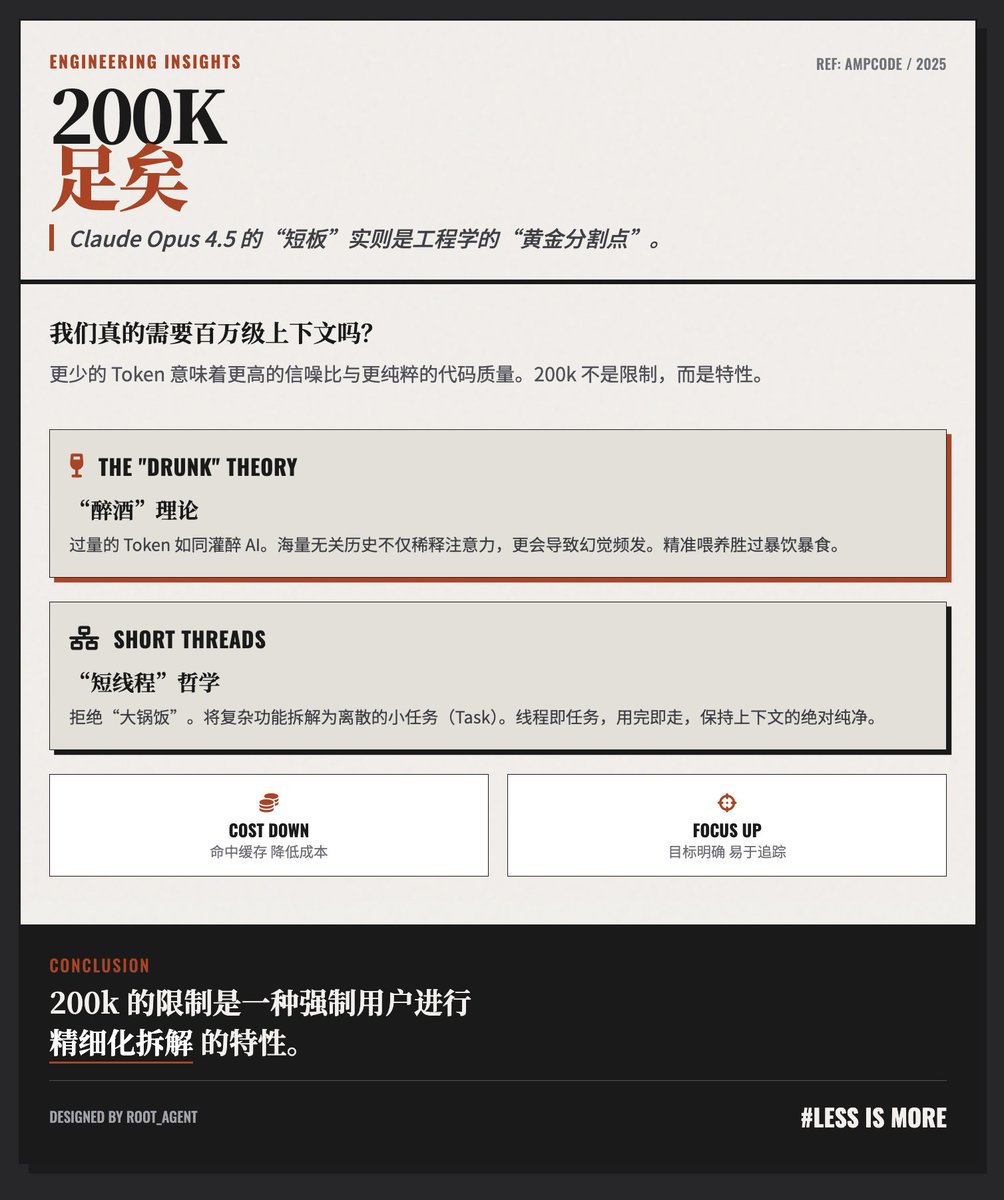
Multiple analyses compare memory architectures, agent skills, and context strategies for modern LLMs. - An essay argued 200k tokens is sufficient; recommends 'short-thread' task decomposition to avoid context noise (200k suffices for high-quality coding tasks). - ChatGPT memory design described as four-layer: session metadata, user memory (long-term facts), recent-dialogue summaries (~10–15 sessions), and current session window. - Claude's memory design uses on-demand retrieval tools (conversation_search, recent_chats) and avoids injecting full histories by default. - Claude-Mem open-source project provides local, compressed persistent memory for Claude Code using semantic compression and SQLite, saving token costs and enabling cross-session continuity. - ChatGPT introduced built-in agent skills in Thinking models with three initial skills (excel, word, pdf) and supports zip-ing local skill files for processing. - Practical trade-offs noted: ChatGPT favors seamless user experience via injection; Claude favors precision via retrieval tools.
Key insights
200k-token context argued as sufficient and preferable for coding workflows
A technical post argued that a 200k token context window is not a limitation for high-quality coding and task execution; the post recommends splitting complex projects into multiple concise 'threads' where each thread contains only necessary context. The argument cites signal-to-noise concerns with giant continuous histories, token cost, cache inefficiency, and operational manageability, and argues shorter threaded workflows improve reliability and cost efficiency.
ChatGPT uses a four-layer memory injection architecture
Reverse-engineering work describes ChatGPT memory as four layered: session metadata (temporary environment signals), user memory (long-term facts stored and injected), recent-dialogue summaries (lightweight summaries of ~10–15 prior sessions), and the current session window. This design emphasizes precomputed summaries plus explicit long-term facts to balance personalization, token cost, and responsiveness.
Claude relies on on-demand retrieval tools for precise past-context access
Claude's memory approach was described as a retrieval-first design: it does not inject past dialogues by default but provides tools (conversation_search, recent_chats) that the model calls when it decides historical context is required. This enables high-fidelity retrieval of past details but adds latency and requires the model to judge when to invoke tools.
Open-source and third-party projects add persistent compressed memory and skills
Projects such as Claude-Mem provide local, compressed persistent memory for Claude Code, using semantic compression and SQLite storage to restore cross-session context while reducing token usage. Separately, ChatGPT's Thinking models began shipping agent skills (excel, word, pdf) and support reading zipped local skill files; open-source tooling and agent-skill managers are emerging to offload skill logic outside model context windows.