
Memory & Context Strategies in ChatGPT vs Claude
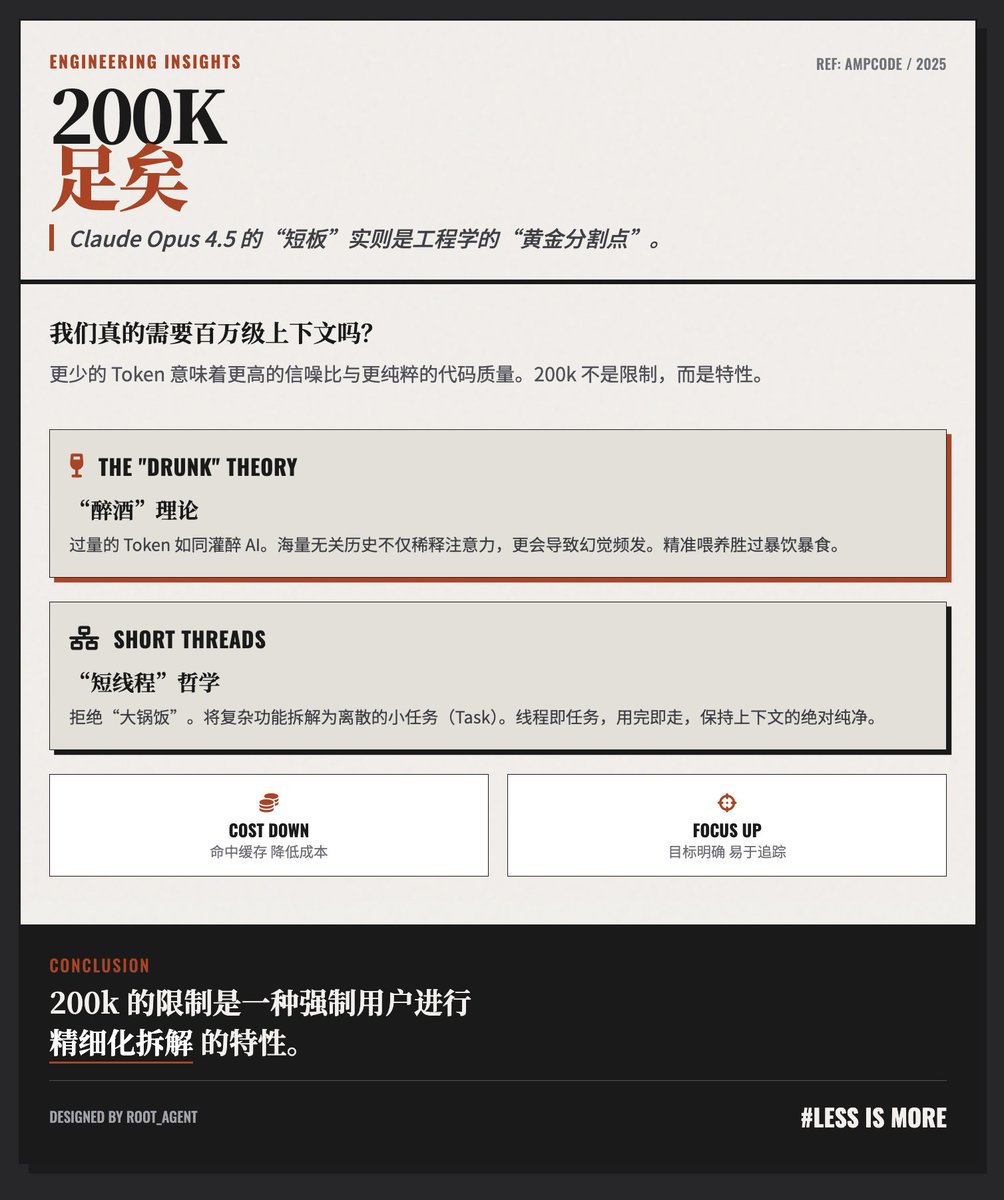
Memory strategies compared: ChatGPT vs Claude. • 200k-token windows deemed sufficient • Too-long context lowers signal-to-noise • 'Drunk' theory: excess tokens confuse agents • Recommend short-thread workflow and task split • Pass only necessary context between threads • Long contexts increase token cost and cache misses • ChatGPT injects full user memory each turn • ChatGPT precomputes recent 10–15 convo summaries • Injected summaries include user utterances only • Claude defaults to minimal context injection • Claude provides conversation_search and recent_chats tools • Claude stores long-term memory in XML-like format • Claude calls tools on-demand, adding latency • ChatGPT is faster and seamless for casual use • Claude offers higher fidelity recall for complex projects • Use web-search + summarization prompts for quick surveys
Key insights
200K-token window is sufficient and sometimes better
A technical blog argued that a 200k token context window (Claude Opus 4.5) is sufficient for high-quality coding and task execution, and that excessively long contexts lower signal-to-noise and can 'intoxicate' agents, causing attention drift and hallucinations. The author recommends dividing work into multiple short threads, each focused on a single subtask, and passing only necessary context between threads. The post framed the 200k limit as a feature that enforces disciplined task decomposition rather than a defect.
ChatGPT uses full injection plus lightweight summaries
ChatGPT’s memory system injects maintained user memory and precomputed lightweight summaries of the most recent 10–15 conversations into each prompt. Architecture layers identified: transient session metadata, long-term user memories (editable), recent conversation summaries (user-only snippets), and the current session window. The system prefers injection to proactive retrieval, trading some detail resolution for seamless, faster responses and improved conversational continuity.
Claude uses on-demand retrieval and tools for high-fidelity recall
Claude’s approach keeps the session context minimal and uses two retrieval tools—conversation_search and recent_chats—for on-demand lookup of past conversations. Long-term memories are stored and injected in XML-like format when needed. This yields high-fidelity retrieval of past AI outputs or specific data structures at the cost of extra latency and dependence on the model’s decision to call tools.
Trade-offs: ChatGPT excels at seamless flow, Claude at precision
Comparison of strengths: ChatGPT offers fluid experience and quick context switching because it injects summaries and memories each turn; downsides include potential detail loss and irrelevant summary interference. Claude avoids irrelevant history, saving tokens and improving precision for long projects, but can be slow or appear to 'forget' if it fails to call retrieval tools. Use cases differ: ChatGPT for companion-like interactions and shallow continuity; Claude for long-term projects requiring exact past artifacts.
Use web-enabled LLM search+survey pattern for fast deep overviews
A practical tip recommends an 8-word LLM prompt pattern: networked search plus summarization. The pattern uses the model’s web retrieval and synthesis capabilities to produce survey-level overviews in minutes—faster and often higher-quality than human solo research for initial exploration. The workflow suggestion: store LLM-generated overviews as v1 notes in a personal knowledge system (e.g., Logseq) to build incremental knowledge bricks.