
Memory system for long-context agents
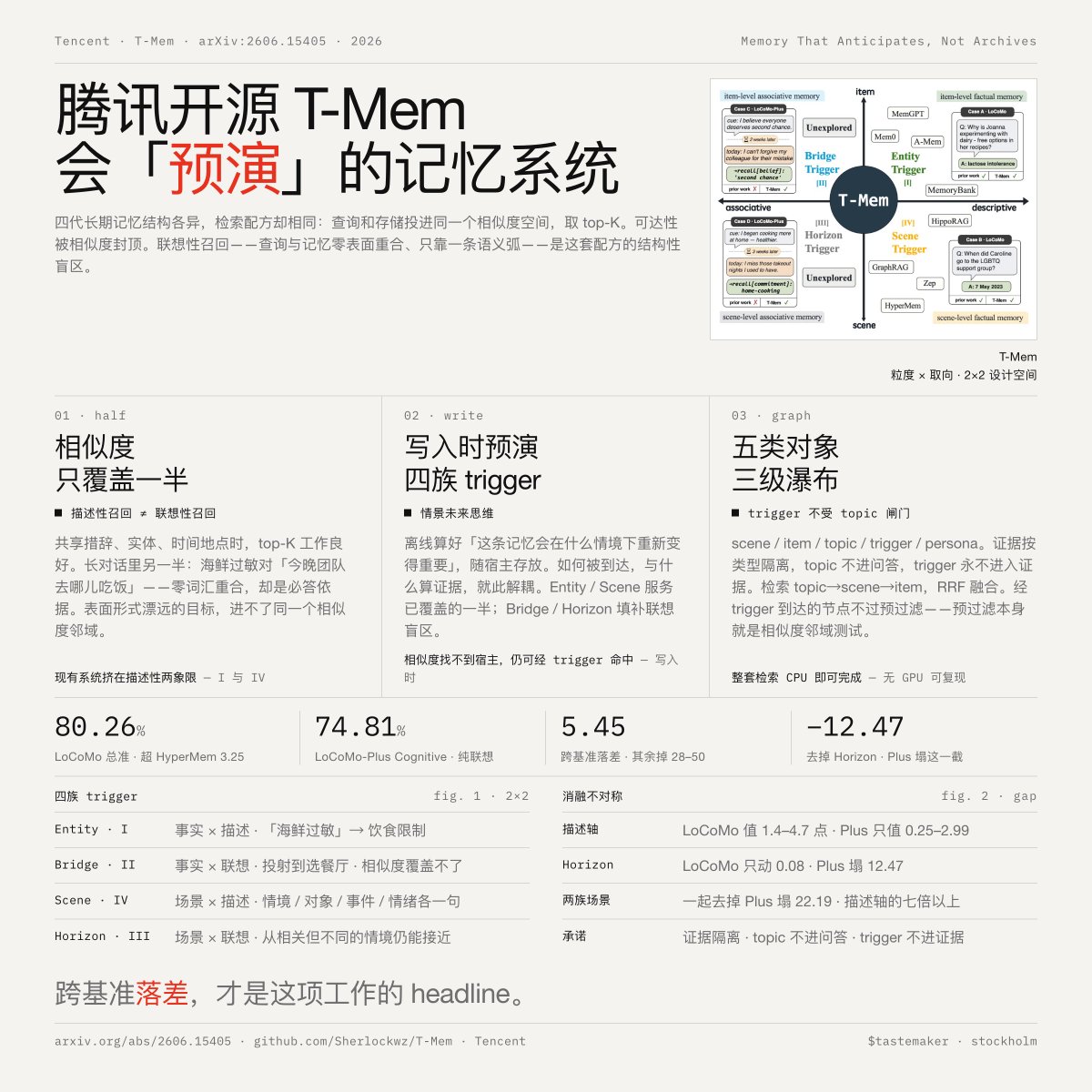
Tencent's T-Mem memory system for long-context agents solves the structural blind spot in existing memory architectures - associative recall when queries share no surface similarity with stored memories. It uses 'triggers' generated at write-time to create associative entry points, scoring 80.26% accuracy on LoCoMo and 74.81% on LoCoMo-Plus Cognitive subset, beating HyperMem and MemOS.
Key insights
Similarity search caps memory retrieval reachability
All four generations of memory architectures (Flat RAG, graph memory, agentic hierarchical, OS-style memory kernels) use identical retrieval recipes: projecting queries and stored content into the same similarity space and taking top-K. This caps reachability at similarity level, leaving the associative half of retrieval as a structural blind spot.
Triggers create associative entry points at write time
T-Mem borrows from cognitive science's episodic future thinking: when writing memories, a builder LLM generates 'triggers' - predictions of future contexts where the memory becomes important. Four trigger families cover the design space: Entity (factual-descriptive), Bridge (factual-associative), Scene (situational), and Horizon (situational-associative). Bridge and Horizon fill associative blind spots.
LoCoMo-Plus Cognitive subset shows decisive advantage
On cognitive reasoning questions designed to probe pure associative recall, T-Mem scores 74.81% versus HyperMem's 48.63%, MemOS's 32.67%, GPT-4o zero-shot at 21.05%, and Gemini-2.5-Pro at 26.06%. Cross-benchmark drop is only 5.45 points versus 28.38-50.07 for others, proving scaling backbone models cannot fix broken associative recall.
Ablation asymmetry validates associative axis importance
Removing descriptive-axis components costs 1.4-4.7 points on LoCoMo but only 0.25-2.99 on LoCoMo-Plus. Removing Horizon Trigger barely moves LoCoMo (0.08) but collapses LoCoMo-Plus by 12.47 points; removing both scene-level triggers drops 22.19 points - over seven times the impact of any descriptive-axis component. This directly demonstrates similarity-based benchmarks structurally cannot detect associative failures.
Efficiency: CPU-only retrieval with offline construction cost
Building is an offline one-time cost: 9,689 model calls and 15.60M tokens for 10 LoCoMo conversations, higher than Mem0's 12.20M due to Bridge and Horizon triggers. At answer time, token budget is lower than HyperMem with higher accuracy on both benchmarks. Full retrieval runs on CPU, reproducible on a single GPU-less workstation.