
Meta Releases SAM 3 and SAM 3D
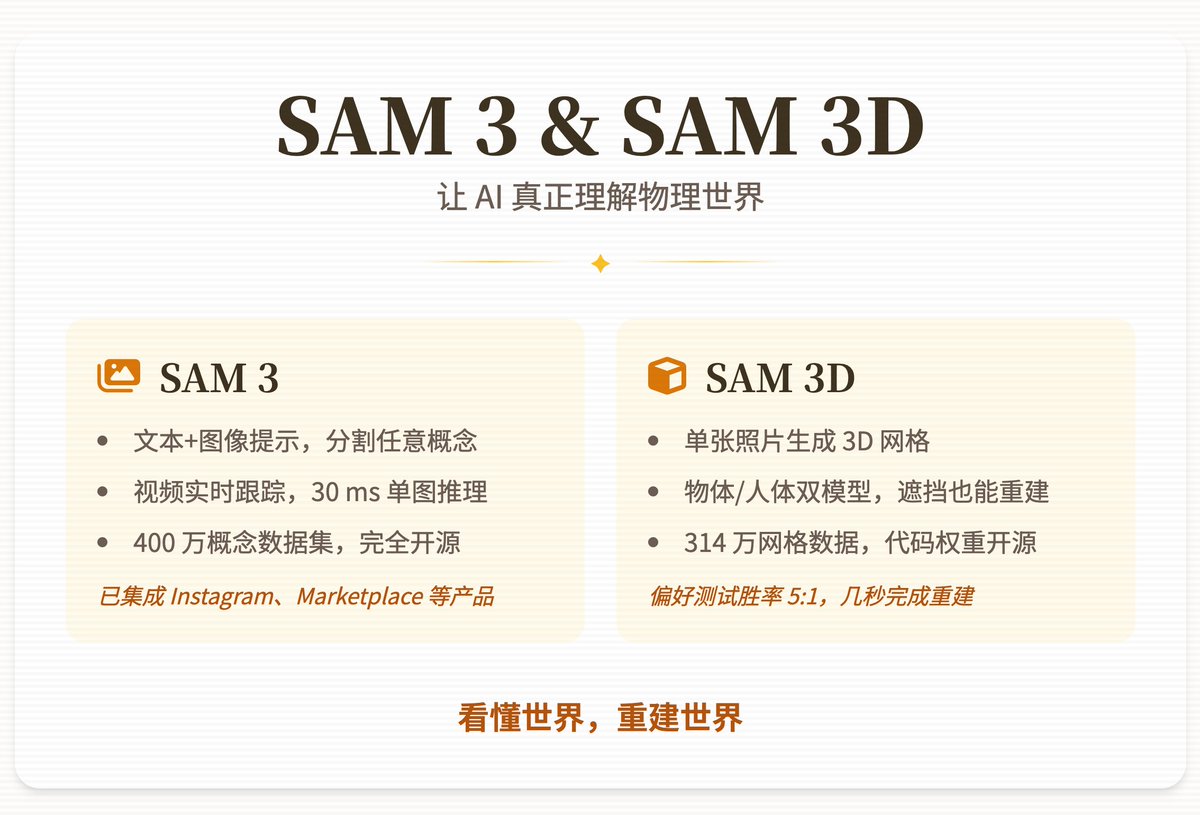
Meta has released two new models, SAM 3 and SAM 3D, on November 20, 2025. SAM 3 supports point, box, and mask prompts, along with new text and image example prompts. It implements open vocabulary concept-level segmentation and can handle composite concepts. SAM 3 achieves real-time object tracking in videos, supporting dynamic scenes such as first-person glasses videos. It serves as a visual tool for multimodal large language models, integrating with Llama and others. SAM 3 shows approximately 2x improvement over leading models like Gemini 2.5 Pro on the SA-Co benchmark. Inference for a single image (100+ objects) takes about 30ms (H200 GPU), with near real-time performance for videos. It is trained on over 4 million unique concept data using AI + human hybrid labeling (validated with Llama 3.2v). All model weights, evaluation datasets (including SA-FARI), and fine-tuning code are open-sourced. SAM 3D includes two sub-models, SAM 3D Objects and SAM 3D Body, aimed at object and human reconstruction. SAM 3D can generate textured, poseable 3D meshes from a single natural photo. It uses a 'model-in-the-loop' data engine: AI generates rough 3D, human scores/corrects, resulting in about 3.14 million mesh annotations. SAM 3D employs synthetic pre-training and real data multi-stage alignment, supporting interactive prompts like segmentation masks and 2D keypoints. In human preference tests, SAM 3D outperformed existing best models by at least 5:1, with generation speeds in seconds. Both sub-models, weights, and the new datasets SA-3DAO and the human parametric model MHR are open-sourced under a permissive license. Product integration examples include Instagram Edits, Meta AI Vibes, and Facebook Marketplace's 'View in Room'.
Key insights
SAM 3: A Unified Segmentation Engine with Open Vocabulary and Multimodal Prompts
SAM 3 is positioned as a unified image and video 'arbitrary segmentation' model, inheriting point, box, and mask prompts while introducing text and image example prompts. It achieves open vocabulary concept-level segmentation, capable of handling fine-grained and composite concepts, and enables real-time object tracking in videos along with first-person video support. Trained on over 4 million unique concepts through an AI + human hybrid labeling process, its performance on the SA-Co benchmark is approximately 2x better than competitors, with single image inference around 30ms (H200).
SAM 3D: Generating Interactive 3D Meshes from a Single Image
SAM 3D includes two sub-models, Objects and Body, capable of reconstructing 3D shapes, textures, and layouts of objects and humans from a single natural image. SAM 3D Body can recover complete human posture and shape without multi-view or depth sensors, supporting occlusions and unusual poses. The reconstruction results can be rotated, scaled, and posed, with generation speeds in seconds, moderate resolution, and robustness to occlusions and indirect views.
Model-in-the-loop Data Engine for Large-scale 3D Annotation
SAM 3D's training relies on a 'model-in-the-loop' data engine: AI first generates rough 3D, followed by human scoring and correcting difficult cases, resulting in nearly a million to millions of high-quality annotation sets (report mentions a total of 3.14 million meshes). Combining synthetic data pre-training with real data alignment in a multi-stage training process addresses the gap from simulation to reality, supporting single-image 3D reconstruction capabilities.
Open Source Strategy and Industry Integration
Meta has open-sourced the model weights, evaluation datasets (including SA-FARI, SA-3DAO), fine-tuning code, and the human parametric model MHR under a permissive license for SAM 3 and SAM 3D. On the product side, features of SAM 3 have been integrated into Instagram Edits, Meta AI Vibes, and Facebook Marketplace's 'View in Room', covering application scenarios such as video effects, 3D visualization of products, and wildlife monitoring.
Performance and Usability Metrics
Meta's report provides key metrics: SAM 3 outperforms Gemini 2.5 Pro, GLEE, OWLv2, and others by about 2x on standard benchmarks; single image (100+ objects) inference takes about 30ms (H200), with near real-time video performance; SAM 3D outperforms existing best models by at least 5:1 in human preference tests, with generation speeds in seconds, supporting interactive prompt-guided reconstruction.
Prompt Interaction and Value of Multimodal Toolchain
SAM 3 supports text and image example prompts, allowing users to segment 'similar things' based on natural language or example images, and can be integrated as a visual tool for multimodal large models (e.g., Llama), enhancing controllability for complex visual reasoning and downstream tasks. SAM 3D also supports interactive prompts like segmentation masks and 2D keypoints to guide the 3D reconstruction process.