
MIT MAS.S62 Lectures 4-5 Cover Harness and Multi-Agent Evolution
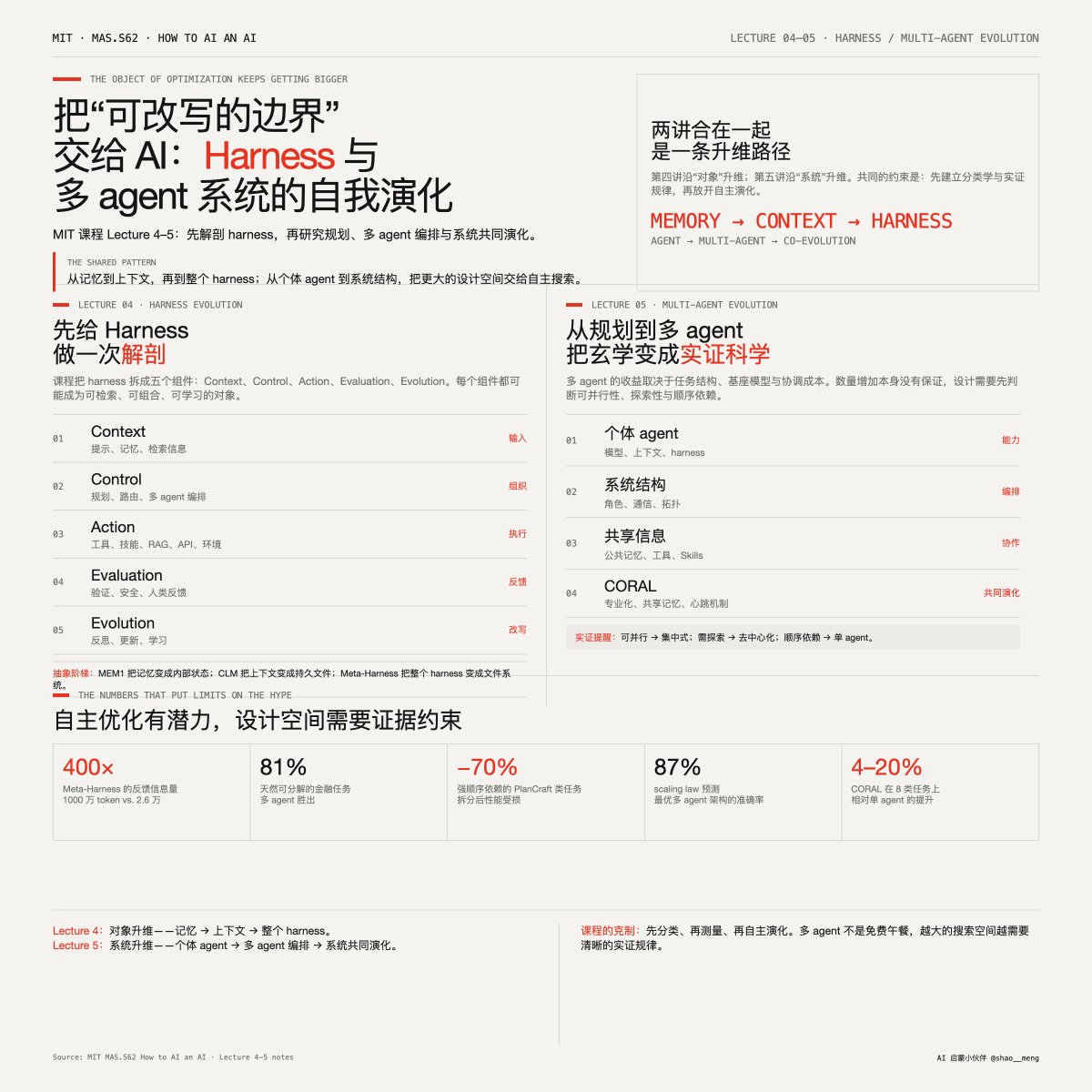
MIT course MAS.S62 "How to AI an AI" released Lectures 4 and 5 on harness evolution and multi-agent evolution, taught by Paul Liang. Lecture 4 decomposes the harness into context, control, action, evaluation and evolution components and traces memory, tool and skill research toward Meta-Harness, while Lecture 5 presents five empirical findings on multi-agent scaling and the CORAL system, which reports 4%–20% gains over single-agent evolution across eight tasks.
Event version 1.
Key insights
Harness decomposed into five components
The course frames the harness as context, control, action, evaluation and evolution components. This framework runs through both lectures.
Memory taxonomy and representative systems
Memory research is organized along three axes: what is stored, how it is represented, and where it resides, plus how it is reused. Four systems are arranged by storage location: MemGPT and mem0 for external memory, MEM1 for in-context memory, and Reflexion/ExpeL for experiential memory.
Meta-Harness treats the harness as a file system
Meta-Harness represents the entire harness as a file system containing full source code, scores and execution traces, letting a proposer trace failures to specific harness decisions. Its feedback volume is nearly 400 times that of prior methods, at 10 million tokens versus 26,000.
Five empirical findings on multi-agent systems
Multi-agent systems help only on specific task structures, with gains varying by base model; more agents are not always better; heterogeneous mixes can beat a stronger single base; and a scaling law predicts optimal architecture with 87% accuracy.
CORAL enables multi-agent co-evolution
CORAL achieves new state of the art on eight tasks including math, algorithms and system optimization. Multi-agent evolution yields 4%–20% improvement over single-agent evolution, with 36% of evolution attempts using another agent as parent and a 17% improvement rate for those attempts.