
MIT Media Lab Paper Proposes Pull-Based Inbox for LLM Agent Coordination
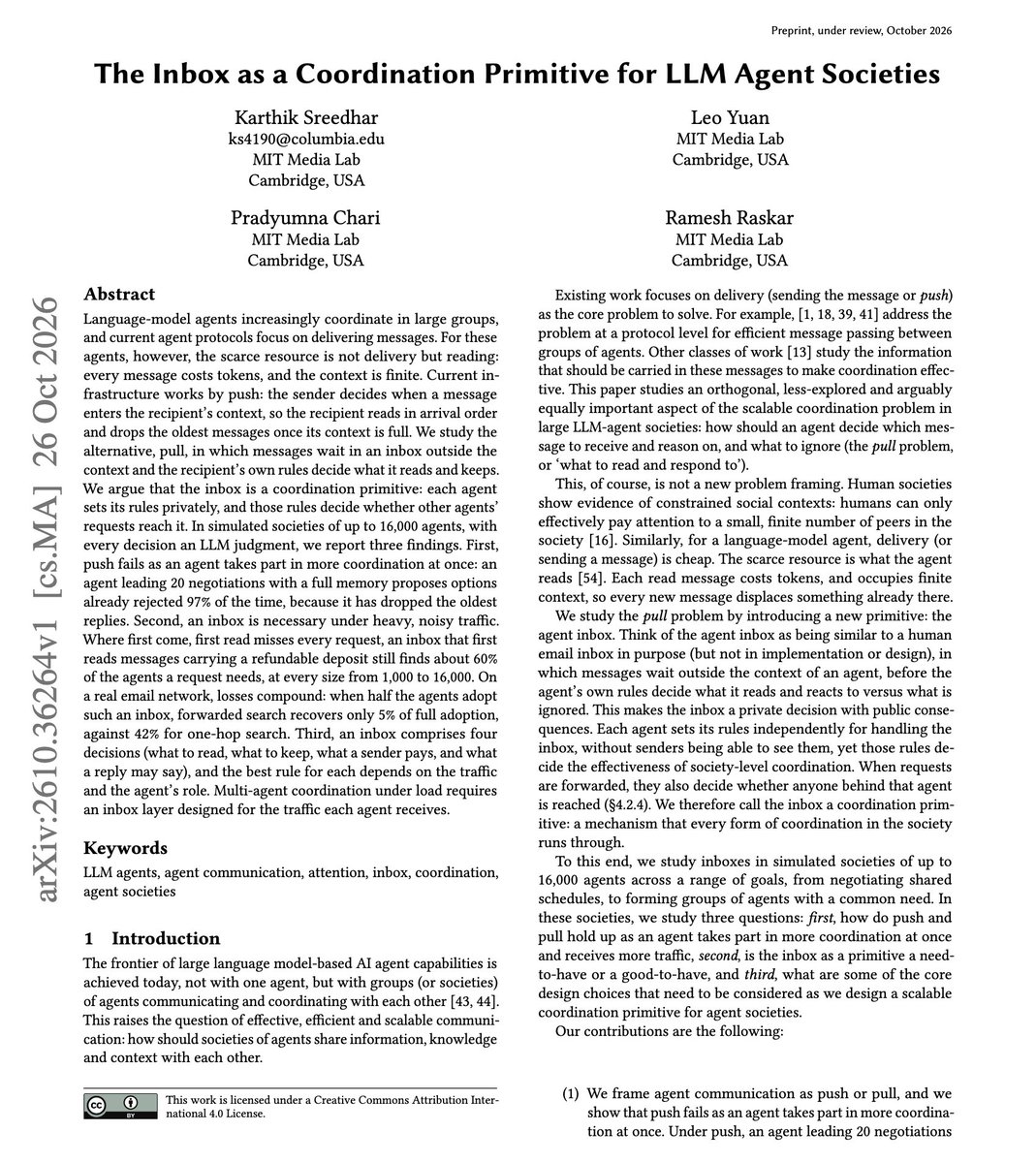
MIT Media Lab researchers Karthik Sreedhar, Leo Yuan, Pradyumna Chari and Ramesh Raskar published a paper arguing that reading, not delivery, is the scarce resource in large language-model agent societies. In simulations of up to 16,000 agents, push delivery caused an agent leading 20 negotiations to propose already-rejected options 97% of the time, while a pull-based inbox with a refundable deposit found about 60% of needed agents under noisy traffic. The authors define the inbox as four decisions: what to read, what to keep, what a sender pays, and what a reply may say.
Event version 1.
Key insights
Push delivery fails under coordination load
With push delivery, an agent leading 20 negotiations with a full memory proposes options already rejected 97% of the time because it drops the oldest replies. The sender decides when a message enters the recipient's context, and the recipient reads in arrival order.
Pull-based inbox recovers requests under noise
Where first-come-first-read misses every request, an inbox that first reads messages carrying a refundable deposit finds about 60% of the agents a request needs, at every size from 1,000 to 16,000 agents.
Losses compound on a real email network
When half the agents adopt such an inbox, forwarded search recovers only 5% of full-adoption performance, against 42% for one-hop search.
Inbox design comprises four decisions
An inbox comprises what to read, what to keep, what a sender pays, and what a reply may say. The best rule for each depends on the traffic and the agent's role.