
Model Selection & Deployment Practices (Phases from Experiment to Production)
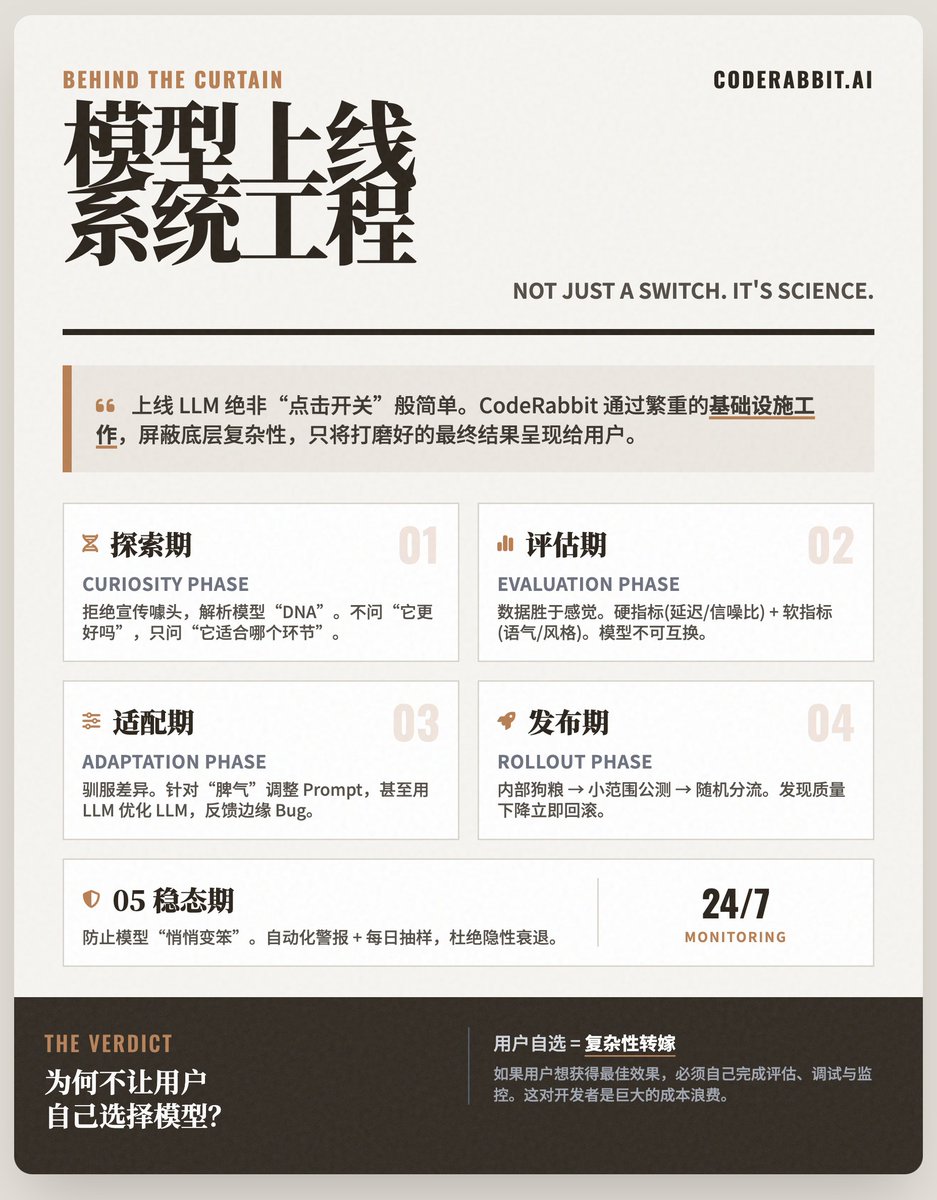
CodeRabbitai prescribes a five-stage model deployment lifecycle. - Phases: Exploration, Evaluation, Adaptation, Release, Steady-State (post 16975). - Exploration analyzes model strengths to place it in system roles. - Evaluation uses quantitative metrics and qualitative style checks. - Adaptation includes prompt tuning and vendor collaboration. - Release uses dogfooding, small public tests, randomized routing, and rollback. - Steady-state uses automated alerts and daily sampling to detect drift. - Related Cursor materials support codebase understanding and promotion (posts 16983, 16984).
Key insights
Five deployment phases govern production model rollouts
CodeRabbitai outlines five phases for bringing new LLMs into production: Exploration (analyze model 'DNA' and capability fit), Evaluation (quantitative benchmarks for coverage, precision, SNR, latency plus qualitative style checks), Adaptation (prompt tuning and model-specific adjustments, using the LLM to help refine prompts), Release (cautious gray releases with internal dogfooding, small public tests, randomized routing and immediate rollback on regressions), and Steady-State (continuous monitoring, automated alerts, and daily sampling to detect silent quality drift).
Model selection must be centralized, not left to users
CodeRabbitai argues that exposing raw model choice to end users transfers heavy evaluation and maintenance burdens to them. Proper selection requires infrastructure, testing, prompt adaptation, and ongoing monitoring; offering users configurable model picks would force each user to recreate that complex process. The team abstracts away these complexities so users get a consistent, vetted experience.
Practical guides and promotions support adoption and codebase understanding
Related posts highlight practical guidance: Cursor offered free one-week GPT-5.1 Codex Max access and published workflows for using Cursor to understand unfamiliar codebases via structured workflows, mode/model switching, and generated documentation. These resources align with the deployment lifecycle by aiding evaluation and internal dogfooding stages.