
Models, Hardware, and Benchmarks (Mathematical Models, Document Models, TPU/GPU Comparison)
Multiple advancements in models and hardware have been reported: DeepSeek releases a mathematical model and open sources it, discussions on hardware benchmarks and the TPU/GPU ecosystem heat up, and Landing AI launches a lightweight document model.
Key insights
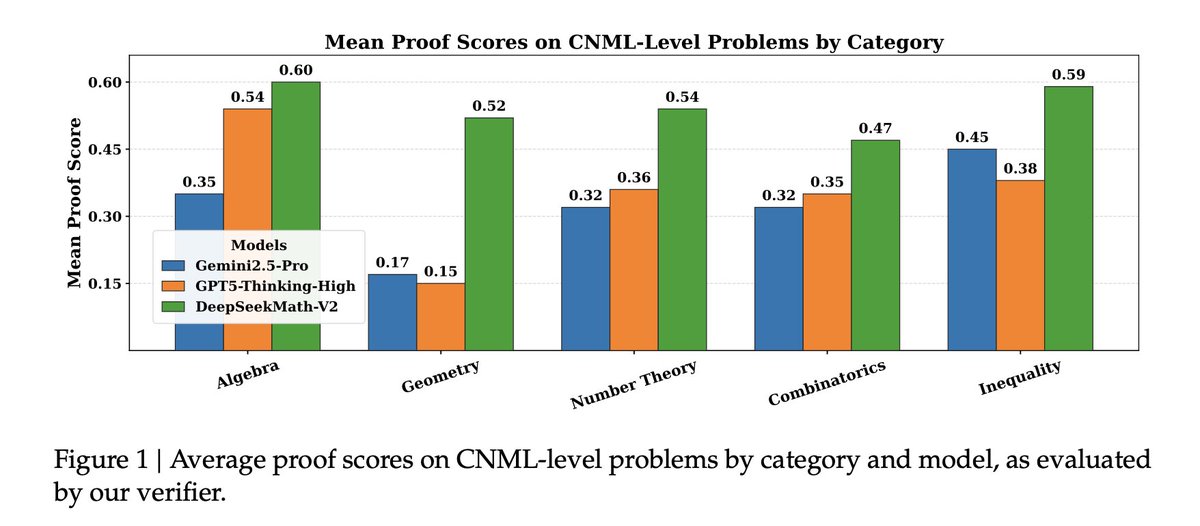
DeepSeekMath-V2 Announces Open Source and High Scores in Math Competitions
DeepSeek has launched DeepSeekMath-V2, claiming it performs near gold medal level in IMO-ProofBench and the 2025 IMO problems, achieving near-perfect scores in the Putnam 2024. The model is open-sourced under the Apache 2.0 license on Hugging Face, providing a path for community downloads and reproductions.
Hardware Comparison Shows Significant Differences in Inference Costs, NVIDIA Leads
Benchmark reports indicate that at a reference rate of 30 tokens per second, the inference cost for NVIDIA H100 is $1.06 per million tokens, AMD MI300X is $2.24, and TPU v6e is $5.13, highlighting H100's significant lead in inference costs, with TPU v7 set to release soon but pricing unknown.
Community Discussion on TPU and CUDA Moat
Some in the community argue that NVIDIA's CUDA moat is not unbreakable, as excellent engineers can achieve performance advantages on non-native platforms through software optimizations (e.g., Triton). Organizations like Anthropic have long used TPU, and hardware advantages are more influenced by system engineering and kernel optimizations.
Landing AI Launches Lightweight Document Parsing Model DPT-2 mini for High Throughput Scenarios
Landing AI has released DPT-2 mini, a small model optimized for parsing English digital native documents (such as invoices and contracts), emphasizing speed and consistency, suitable for batch structured extraction, but not for complex layouts or handwritten scanned documents, and providing quick-start examples through the ADE library.
Jeff Dean Reviews and Emphasizes Multiple Technologies Driving Rapid AI Development
In his talk, Jeff Dean reviewed key advancements in AI over the past fifteen years, including the discovery of concepts through unsupervised learning, the vector semantics of Word2Vec, the dedicated hardware advantages of TPU, the self-attention architecture of Transformer, sparse models, distillation, and reasoning chains, all contributing to recent leaps in model capabilities.
Chip Manufacturers and Cloud Services' Strategic Complementarity and Communication Stance
NVIDIA expressed admiration for Google's progress while reiterating the generality and superiority of its GPUs in performance and versatility, noting that ASICs (like TPUs) are efficient but limited in flexibility, indicating a coexistence of ecological cooperation and competition.