
Multiple Labs Report Progress in AI-Driven AI Research and Development
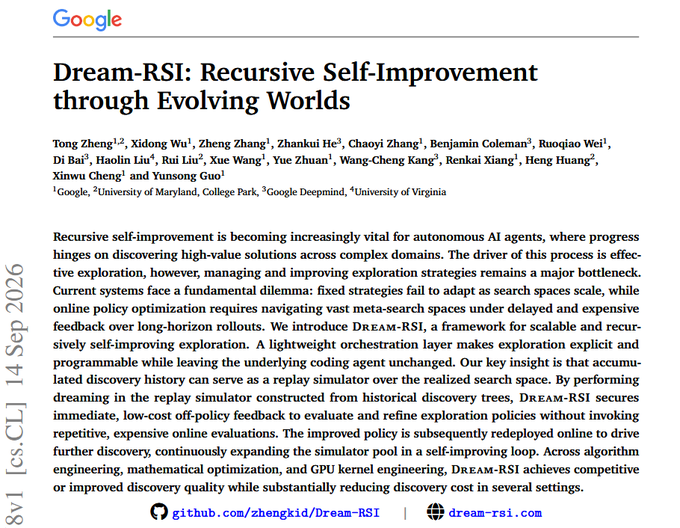
Multiple leading AI labs reported significant advances in using AI to automate AI research. Google's Dream-RSI, Z.AI's GLM-5.3 self-optimization, OpenAI's automated training, and Anthropic's internal dashboard showing 26% of R&D is AI-led all point to a rapidly closing loop of recursive self-improvement.
Key insights
Google Dream-RSI: Recursive Self-Improvement Loop
Google and DeepMind demonstrated Dream-RSI, a recursive self-improvement loop. The system replays past discovery processes to cheaply test thousands of exploration strategies, using the better strategies for the next round. In algorithm design, math optimization, and GPU kernel engineering, it maintained or improved result quality while reducing agent calls by up to 162x.
Z.AI GLM-5.3: Self-Optimizing Inference Infrastructure
Z.AI (Zhipu AI) disclosed that its GLM-5.3-Flash model, running on over 100,000 domestic AI accelerators, was optimized by an AI agent driven by GLM-5.3 itself. The agent achieved a 3.2x end-to-end throughput improvement in under two weeks. The key innovation was building a layered verification interface to provide dense feedback signals (correctness, system behavior, performance) to the agent.
OpenAI Internal Automation of Training
According to The Information, OpenAI's internal AI models can now largely automate the training pipeline for new experimental models, including writing GPU kernels and optimizing training code. Researchers provide an optimization example, and the AI spends weeks implementing and testing similar improvements. Multiple AI agents are now collaborating to solve problems without human involvement.
Anthropic Internal Dashboard: 26% of R&D is AI-Led
Anthropic publicly shared an internal dashboard measuring AI's role in its own R&D. As of July 2026, 26% of R&D work is at AL4 (AI-led, human supervision), and over 90% has deep AI involvement. At any given time, 30,000 agents are working on R&D. About 6% of compute for AI R&D is dedicated to safety work. No work subset has reached AL5 (fully autonomous).
NVIDIA Agora: Collaborative Multi-Agent Research
NVIDIA researchers introduced Agora, a system where 13 coding agents collaborated for 12 days without a central planner to solve a weight-transfer problem. The system uses a Git-based DAG to store all research artifacts, enabling shared state and preventing duplicated work. The agents successfully improved the target metric by 62% towards a trained baseline, discovering a novel method in the process.
A 5-Level Framework for AI Self-Improvement
A paper co-authored by over 30 researchers proposed a 5-level framework for AI self-improvement, from Level 1 (humans decide what to improve) to Level 5 (AI rewrites the process of creating the next AI). Reviewing 491 papers, they found 75% are still at Level 1-2, and less than 6% have reached Level 5.