
Multiple Reports Analyze AI Recursive Self-Improvement Progress
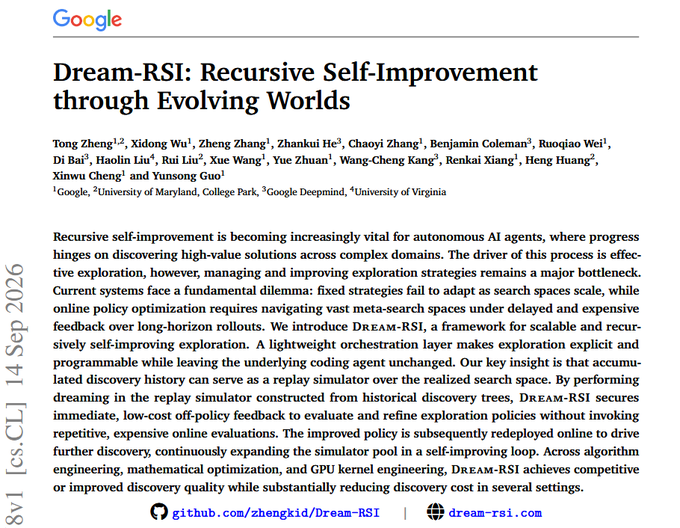
Recent reports from Google DeepMind, Databricks, Anthropic, and NVIDIA examine the state of AI recursive self-improvement. Google's Dream-RSI reduced agent calls by up to 162x. Databricks CEO argues RSI criteria are unmet and real risk is AI-driven cyberattacks. Anthropic's internal dashboard shows 26% of R&D tasks are AI-led. NVIDIA's Agora system enabled 13 agents to collaboratively improve a model over 12 days.
Key insights
Google DeepMind's Dream-RSI: Replaying Past Discoveries
Dream-RSI replays past discovery processes to test thousands of exploration strategies at low cost, then feeds better strategies into the next round. In algorithm design, math optimization, and GPU kernel engineering, it maintained or improved result quality while reducing agent calls by up to 162x. This demonstrates a closed-loop self-improvement mechanism.
Databricks CEO: RSI Criteria Unmet, Real Risk is Cyberattacks
Ali Ghodsi proposed four conditions for RSI: reduced compute, reduced time, increased intelligence, and repeatability. He argued all four are currently false: training costs have risen from ~$100M to $5-10B, time is longer, and failures occur. He dismissed existential risk as 'near zero' and highlighted that AI-driven cyberattacks are the real threat, with CVE-to-weaponization time shrinking to hours.
Anthropic's Internal Dashboard: 26% of R&D Tasks AI-Led
Anthropic published three metrics: (1) R&D automation index: 26% of R&D tasks are AI-led (AL4), 90%+ have AI deep involvement, none at AL5. (2) Agent oversight: 30,000 agents run simultaneously, 100% of actions monitored online with 0.002% interception rate, ~50 conversations/week escalated to human review. (3) Compute allocation: 6% of AI R&D compute goes to safety work. These provide a baseline for tracking acceleration.
NVIDIA's Agora: Multi-Agent Collaborative Research with Git-Based Shared State
Agora treats research as a Git-based DAG where each claim is a commit. 13 coding agents (Claude Code + Codex) ran for 12 days without central planning, producing 1,703 contributions. They improved a model's bpb from 3.392 to 1.899, closing 62% of the gap to trained GPT-2 124M. The winning method transferred behavioral knowledge (bigram distributions) rather than parameters, a scientifically novel finding.
5-Level Taxonomy of AI Self-Improvement
A 75-page paper from 30+ researchers classified AI self-improvement into 5 levels, from Level 1 (human decides what to improve) to Level 5 (AI rewrites the process to create next-gen AI). Reviewing 491 papers, 75% remain at Level 1-2, and less than 6% reach Level 5. This provides a structured framework to assess progress.